

A few weeks ago, I ranked my top-10 pure-play memory stocks. Micron took the #1 spot.
Yesterday, Micron MU 4.88%↑ reported another record quarter.
Revenue and earnings came in ahead of expectations. Demand remains exceptionally strong. At the same time, supply is still tight. In other words, the memory boom still has plenty of room to run. And Micron sits in one of the best positions to profit from it.
Today, I want to show you why Micron is still the #1 memory stock to buy, even after surging 549% in the last year.
If you’re new to Micron, the first thing you need to understand is…
Micron sits at the heart of AI’s memory bottleneck.
A useful way to think about this is a kitchen. The GPU is the chef. Memory is the pantry. If the pantry is across the building, the chef wastes time fetching ingredients. Put it beside the stove, and everything speeds up.
That’s the problem AI faces today.
Compute power has exploded. Memory access hasn’t kept pace. More than 90% of the time an AI model takes to respond can be spent moving data between memory and compute rather than doing the actual calculation. That’s the “memory wall.”
HBM, or High-Bandwidth Memory, helps solve it by stacking memory chips and placing them right next to the GPU. Data travels a much shorter distance through a much wider pipe.
And as AI models grow larger and handle more context, demand for this kind of memory is expected to nearly quadruple by 2030. The problem is supply isn’t keeping up. AI capabilities are advancing faster than HBM production, turning memory into one of AI’s biggest bottlenecks. And HBM makers into one of the hottest stocks on the market.
Only three companies can make HBM at scale: SK Hynix, Samsung, and Micron. (SK Hynix was #2 in my Rankings.)
Micron is the only one based in the US. Samsung and SK Hynix are from Korea.
It’s also the only memory company investing in front-end fab manufacturing in the US. Samsung’s US investments are in logic foundries, not memory. SK Hynix’s US investments are in back-end assembly and packaging.
Micron’s US investment also means it’s able to charge a premium for its US supply. And the company has even baked that into its long-term Strategic Customer Agreements (SCAs).
SCAs are another reason why I like Micron.
They’re structurally different from anything the memory industry has done before.
In the past, “long-term agreements” (LTAs) weren’t really long-term. They were just 12-month agreements. And they had no binding terms.
That’s what “long-term agreement” meant in memory. A one-year handshake.
Then, Micron invented SCAs. These include:
- Five-year terms covering the overwhelming majority of contracted revenue.
- Binding volume commitments, by year, that are take-or-pay.
- No contractual outs for customers.
- An evergreen structure, meaning years can be added at the back end to keep extending them. Customers actually asked for this, because, as management put it, “they don’t expect that this is just a 5-year kind of thing.”
- Deep engagement on R&D and product roadmaps, not just volumes and prices.
Micron says the visibility provided by SCAs now extends through the end of the decade and beyond. That visibility is strong enough that management is using it to justify billions of dollars of additional capacity investment.
Now, the pricing, which a lot of folks get wrong.
Some SCAs float at market. Most sit inside a price band with a floor and a ceiling. The ceiling on the 16 SCAs announced so far was set at Q2 2026 pricing; agreements signed later carry ceilings at whatever the market price is when they’re signed.
The bears focus on that ceiling. What they miss is that the floor is set at a level that provides a gross margin well above the level achieved at the peak of any previous cycle. So Micron’s worst outcome produces a better gross margin than its best outcome in any previous cycle.
What’s more, the ceiling has a hole in it by design. It doesn’t apply to next-generation products. DDR6, LPDDR6, and future generations of HBM get negotiated separately at higher levels.
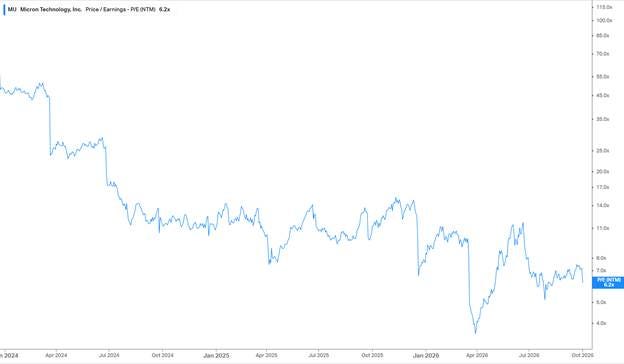
Finally, it’s important to note that Micron is trading at one of the cheaper valuations in the last three years.
Related: The Biggest Growth Stocks Keep Expanding Their TAM. Apple Could Be Next.
