


Penning obituaries for private credit, even amid calamity in the software space earlier this year, is proving premature. Of course, there are differences between private equity and private credit, but the two asset classes share something in common: Both remain prodigious raisers of capital.
Give private credit, well, some credit, because it’s on a torrid pace of capital-raising, particularly when considering the aforementioned headwind. Helped in large part by direct lending, private credit fundraising reached $190 billion in the first half of 2026, putting it on pace to easily top last year’s tally of $240 billion.
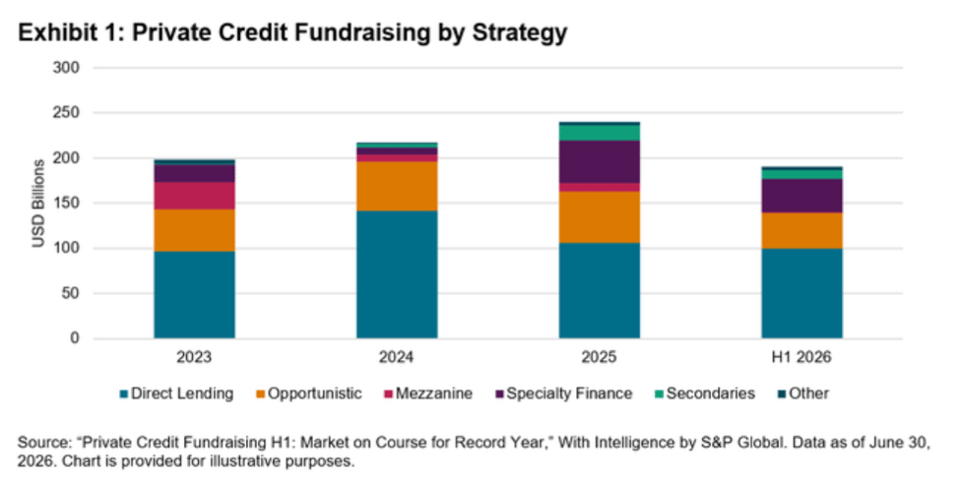
(Image Courtesy: S&P Dow Jones Indices)
That impressive run of capital raising confirms the “smart money” remains enthusiastic about private markets and for advisors, it’s another sign that exploring the differences between private equity and private credit is as relevant as ever and that’s likely to remain the case for the foreseeable future.
Private Credit Facing Scrutiny
Though impressive, private credit’s fundraising proficiency doesn’t free it from closer examination, some of which is potentially negative. Arguably, one of the significant differences between private equity and private credit is that the former draws more scrutiny than the latter and that’s saying something.
“The rapid growth of private credit has prompted increased scrutiny, reflecting concerns about the asset class’s inherent opacity, volatility and valuation uncertainty,” observes S&P Dow Jones Indices. “These concerns have been reinforced by recent headlines focusing on valuation practices, liquidity risk, redemption pressures and credit quality.” Thanks in large part to ETFs, private credit is more accessible than it’s ever been to investors of all stripes. But with that accessibility comes responsibility – responsibility that many market participants are overlook. It arrives in the form of private credit index construction.
“Credible loan-level data, however, is only one part of the solution. The next generation of private credit benchmarks should combine asset-level information with consistent methodologies, trusted calculations and robust index governance,” adds S&P. “That combination creates a common reference point for evaluating performance and risk across managers, constituents and markets over time.”
Yes, Indexes Can Be Advantageous with Private Credit
Indeed, there are an array of differences between private equity and private credit, but at the fund level, the asset classes share a commonality in that active management is often the preferred methodology, even with ETFs.
There’s nothing wrong with that, but even active managers need reliable benchmarks and credible data – needs that are heightened in private markets. On that front, the S&P Lincoln Senior Debt Index Series, constructed by the index provider and Lincoln International, is worth examining. It’s not a 100% failsafe, but it can help pros and advisors get firm grips on illiquid debt securities.
“It measures illiquid senior debt facilities issued primarily to private-equity-sponsored companies in the U.S. and Europe, using granular loan-level insights to provide a systematic view of direct lending,” concludes S&P. “This index series offers subscribers a rich set of credit metrics—including returns, fair value movements, yields, coupon spreads, leverage and borrower characteristics by firm size, sector and time period—that enable users to analyze how yields and spreads change over time, how risk differs between borrowers and how credit conditions vary across sectors.”
