


The pace of mutual fund-to-ETF conversions isn’t yet “breakneck” per se, but it is gaining steam. While that’s noteworthy in its own right, each individual “new” ETF that was born as an open-end mutual fund isn’t noteworthy. Some are. Some aren’t. That’s just the way the ETF cookie crumbles.
In the worth acknowledging camp of ETFs that used to be mutual fund is the group’s newest addition – the Calamos Timpani Active SMID Growth ETF (CTAG). Previously the Calamos Timpani SMID Growth Fund, CTAG debuted in ETF form last week.
The first mutual fund-to-ETF conversion to list on the Texas Stock Exchange (TXSE), CTAG could prove to be a well-time addition to the active ETF fray because, broadly speaking, both mid- and small-cap stocks are performing admirably this year. As of Friday, Sept. 18, the S&P MidCap 400 and Russell 2000 indexes were up 11.3% and 16.2%, respectively, since the start of the year.
CTAG Has Impressive DNA
In many cases, part of the allure with mutual fund-to-ETF converts is DNA, heritage, tradition, etc. Said another way, some of these newly transitioned funds gain audiences with advisors and investors due to prior achievements in the mutual fund form. As the mutual fund’s performance data indicate, CTAG the ETF could quickly gain a following.
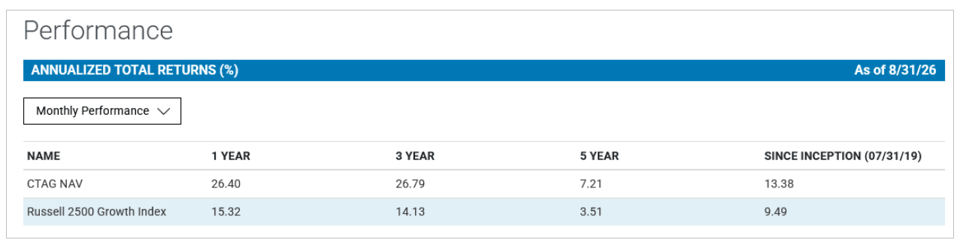
(Image: Calamos Investments)
Importantly, CTAG, which earned a Morningstar Silver rating as a mutual fund, will be managed by Brandon Nelson. He ran the mutual fund and that continuity could be appealing to advisors and investors. Data indicate it ought to be.
“Nelson was recognized as the only small cap manager in the Wall Street Journal's 2024 Winners Circle, which annually identifies the Top 10 performers among active US stock managers,” according to a statement issued by Calamos. “Since launching in 2019, the Calamos Timpani SMID Growth Mutual Fund has been a top-performer among peers in the Morningstar Small Growth category, healthily outperforming the Russell 2500 Growth Index over the last 1-, 3- and 5-year periods.”
The point is CTAG is tapping into continuity and lineage – two factors that are meaningful to advisors when it comes to ETFs that previously existed as mutual funds.
CTAG Flexibility and Focus Matter, Too
CTAG’s status as a focused actively managed fund could serve end users well on the basis that this new ETF tilts heavily toward mid-cap stocks. Nearly 53% of the fund’s holdings have market values of $2 billion to $16 billion so on the basis that the strict definition of mid-cap is $2 billion to $10 billion, CTAG holds a lot of mid-caps and smaller large-caps across its 88 holdings.
That’s worth bringing up because mid-cap growth is fertile territory for astute active managers. Over the past three years, the Russell Midcap Index beat its growth counterpart by 1,050 basis points, indicating that some index-based mid-cap growth strategies leave something to be desired.
As an actively managed ETF, CTAG can lean into more growth and isn’t obligated to include all of the sectors, including the defensive groups, dotting the Russell 2500 Growth Index. In fact, ETF has no exposure to real estate or utilities stocks, but it is overweight tech by 1,100 basis points, confirming it takes its growth mission seriously.
Related: Gen Z and Millennials Aren’t Abandoning Financial Goals. They’re Doing Them Differently
