


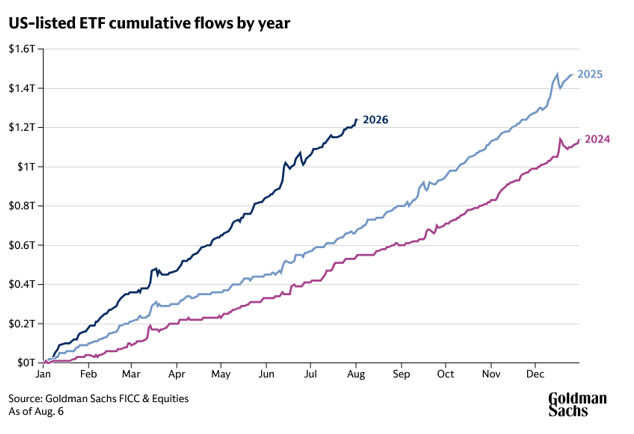
Exchange-traded funds (ETFs) are coming off a breakneck pace of asset accumulation in the first half of 2026. Through those six months, US-listed ETFs, in aggregate, added north of $1 trillion in new assets, so it stands to reason that the asset class here in the U.S. will add $2 trillion (or more) in fresh assets this year.
That’s the call from Goldman Sachs Global Banking & Markets, which notes that if the $2 trillion projection is accurate, it will exceed the 2025 asset-gathering tally by a staggering 40%.
Putting $2 trillion into context, that’s slightly larger than the current market capitalization of SpaceX (NASDAQ: SPCX).
Fun facts aside, it’s worth noting that ETFs’ undaunted pace of asset accumulation comes amid myriad issues that are, arguably, headwinds, including a record amount of cash in money market funds, the war in Iran and stress in the Treasury market. Still, catalysts abound when it comes to ETF inflows.
Active Alive and Well
There’s no denying that ETFs breathed fresh life into active management. Once viewed as a significant competitive threat, if not a death knell, ETFs provided salvation to active management by being, well ETFs. Today, many market participants, including advisors, are widely embracing active ETFs, making those funds important contributors to this year’s tidal wave of inflows.
“Institutional investors are increasingly using actively managed ETFs to outperform their underlying benchmark indexes and rebalance portfolios,” notes Goldman Sachs. “More than 35% of the flow this year is going into active funds, which comprise roughly 13% of the $16.1 trillion in assets under management in US-listed ETFs.”
Interestingly, enthusiasm for actively managed ETFs isn’t confined to old guard staples such as equity and fixed income funds. Undoubtedly, active bond ETFs are among the industry’s fastest-growing segments, but issuers and end users are embracing more sophisticated active strategies as well.
“We’re now seeing some of the most advanced active management strategies in the markets expressed within the ETF wrapper,” says Tom Campbell, head of Americas ETF distribution in Goldman Sachs Global Banking & Markets. “These range from levered funds to innovative fixed income offerings to structured derivatives.”
Thematic ETFs Doing Their Part
Forgive the personal insertion, but I’ve been covering ETFs for nearly two decades and I can assure that there was certainly a time when thematic ETFs were frequently maligned. I was around when cloud computing and social media ETFs and the like came to market and there were some talking heads that had verbal fun at those funds’ expense.
These days, thematic ETFs (some, not all) are more credible – credible enough to be mentioned in the Goldman report and credible enough to be valid contributors to this year’s inflow “mania.”
“Market access and affordability have long been a major attraction of ETFs. So, too, is the ability to trade themes such as South Korean stocks or memory chips,” notes Jackson Isaacs, head of Americas equity ETF trading in Global Banking & Markets. “Thematic ETFs have been available for some time. But again, what we’re seeing is increased adoption in the last couple of years as investors are attracted by the product’s listed equity format and its ease of use.”
