

Written by: Christopher Gannatti, CFA, Global Head of Research
Key Takeaways
- As Starship moves from engineering breakthrough to operational deployment, SpaceX is becoming the platform underpinning the space economy, with launch costs expected to fall dramatically and unlock new commercial markets.
- Rather than simply a launch provider, SpaceX could become the "App Store for space," enabling future businesses in satellite communications, orbital manufacturing and AI computing.
- The WisdomTree Space Economy Fund (WSPC) gives investors exposure to companies building the infrastructure of the next space economy, including a 12.6% allocation to SpaceX as of July 24, 2026.
There is a particular kind of investor credibility that comes not from tracking a stock price but from reading a filing, stress-testing a technical claim, and then arriving at a conclusion you didn't set out to find.
Christopher Begg, CEO and Chief Investment Officer of East Coast Asset Management and a professor at Columbia Business School, where he teaches the Security Analysis course originally developed by Benjamin Graham, is that kind of investor. When Begg began spending serious time on SpaceX, he did not start with a bull thesis and work backward. He started with an engineering problem.1
The heat shield and the Raptor engines.
Starship's reusability ambitions run directly through two engineering bottlenecks.
- The thermal protection system on the vehicle's belly must survive the violent aerodynamic heating of atmospheric reentry, not once but hundreds of times.
- The V3 Raptor engines must achieve the reliability and performance necessary to make full two-stage reusability economical.
Begg's team evaluated both challenges and concluded that SpaceX has essentially solved them and that the technical hurdles which once made Starship's cost targets look aspirational are now, in his assessment, behind the program rather than ahead of it. That engineering conviction formed the foundation of an investment thesis. The analytical direction here is worth noting. Science and engineering come first, then financial consequences. We believe it is exactly how the best asymmetric investment ideas tend to develop.
What Begg found, once he had satisfied himself on the engineering, was not simply a better rocket company. He saw something more fundamental.
The App Store Analogy
The most useful frame Begg has offered for thinking about SpaceX is this:
Starship is not a launch vehicle; rather, it is a platform. The best historical analog for what a platform does to an adjacent ecosystem is the App Store.
When Apple opened the App Store in 2008, the iPhone was already a remarkable device, but the App Store transformed it from a product into an operating system for an entirely new economy. Developers who had nothing to do with Apple, meaning people who didn't work for Apple, didn't sell hardware, and didn't manufacture anything, built businesses worth hundreds of millions of dollars on top of a platform they didn't own. The App Store didn't just create value for Apple; it catalyzed an application economy that now generates revenues far exceeding the device business that made it possible.2
Starship could be the App Store for space.
To understand why, Begg starts with cost curves. Legacy launch platforms charged more than $50,000 per kilogram to reach low Earth orbit. Falcon 9's reusability dropped that figure to roughly $2,400 per kilogram, a reduction that was itself transformative, enabling SpaceX to build and deploy the Starlink constellation at a scale that would have been economically impossible under prior pricing. Starship, with full reusability of both stages and the V3 Raptor engine configuration, is designed to compress costs further still, to $100 per kilogram in the near term, and eventually toward $10 per kilogram. Begg describes this progression not as incremental improvement but as a phase transition, meaning a multi-order-of-magnitude shift that changes what is economically possible in space in the same way that a phase transition in physics changes the fundamental properties of a material.
The argument is not that SpaceX will be the largest beneficiary of the off-Earth economy it is creating, though it may well be. The argument is that at $10 per kilogram, the economics of everything that happens in space change categorically.
- It transforms satellite constellation density.
- It makes orbital manufacturing viable.
- It creates the infrastructure layer on top of which an entirely new category of businesses can be built by companies that don't exist yet, pursuing applications we haven't imagined.
Just as no one in 2008 predicted that a company offering rides in strangers' cars would be one of the App Store's defining business models, the most valuable applications of affordable orbital access may not yet have names.
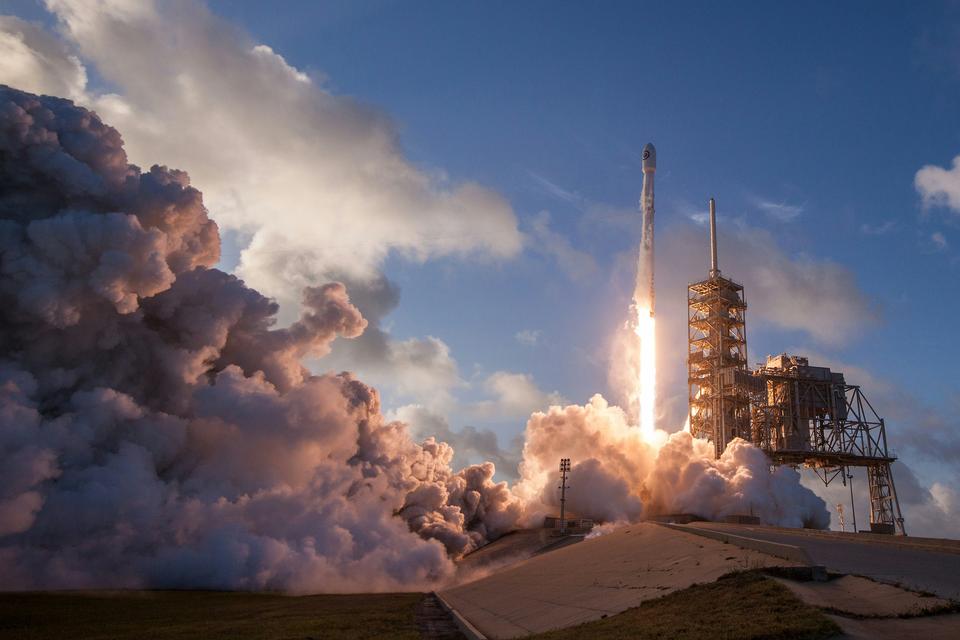
SpaceX has spent more than $15 billion developing Starship, including $3 billion in 2025 alone. That investment crossed a tangible threshold on July 24, 2026, when Starship Flight 13 became the first flight to deploy operational payloads, 20 next-generation V3 Starlink satellites that made contact with
ground receivers in what SpaceX described as its first operational satellite deployment. Full orbital payload delivery, expected in the second half of 2026, remains ahead. When it arrives at scale, a single Starship launch will carry up to 60 V3 Starlink satellites, each capable of delivering one terabit per second of throughput, a payload capacity that makes the economics of global broadband coverage qualitatively different from anything that came before.3
The New World Analogy
Begg offers a second frame that operates at a longer time horizon and carries perhaps even more weight. Think about the discovery of the Americas. The opening of the New World created extraordinary wealth, not just for the explorers and sovereigns who sponsored them, but for the merchants, shipbuilders, port cities, and trade network operators who enabled the flow of goods and people across the Atlantic. There was, for a period, effectively one set of vessels capable of making the crossing reliably. The entities that controlled and operated those vessels occupied a structural position of extraordinary leverage.
Starship, Begg argues, is the transfer vehicle for the new world that happens to be off-Earth. For the foreseeable future, it is the ship. Everything that needs to get to orbit, meaning satellites, components for space stations, materials for lunar missions, and the infrastructure for space-based computation, passes through this one chokepoint. The parallel is not merely rhetorical. It captures something precise about network economics, which is that when you control the only reliable means of reaching a new frontier during the period when that frontier's economic potential is first being unlocked, the value of that position compounds in ways that are structurally difficult for competitors to replicate.
This is not a speculative framing, and the structural barriers are real. Orbital launch is a domain where manufacturing scale, reusability economics, and cumulative flight experience interact to create compound-ing advantages. SpaceX's Falcon 9 has now completed over 650 flights. Starship is targeting thousands of flights per year as launch site capacity scales globally.4 Every successful flight builds the reliability record and operational knowledge base that institutional customers, including government agencies, defense contractors, and hyperscalers, require before committing the payloads that matter most to them.
Begg extends this logic to one of the most underappreciated dimensions of the SpaceX thesis, orbital compute. SpaceX has already signed terrestrial data center agreements with companies including An-thropic and Google. But Begg argues the more consequential move is placing orbital data center satellites directly into low Earth orbit, bypassing terrestrial power constraints, real estate costs, and conventional cooling infrastructure. His estimate is that orbital data centers could operate at roughly 75% lower cost than their ground-based equivalents, positioning SpaceX to become the lowest-cost producer of AI compute on the planet. Meanwhile, Starlink itself is evolving from a broadband constellation into what Begg describes as an emergent mesh graph, composed of 10,000-plus satellites with inter-satellite laser links, expanding to integrate direct-to-cell communications, autonomous vehicle fleets, and Internet-of-Things (IoT) devices. The network becomes more valuable as it densifies, compounding in a way that resembles less a utility and more an operating system.
What This Means for Investors
This framing matters for how we think about the WisdomTree Space Economy Fund (WSPC). The conventional mental model of the space economy tends to focus on satellite manufacturers, launch providers, and government contractors, and it’s true that this is the obvious layer. Begg's platform logic suggests a different analytical lens, asking instead what is the infrastructure enabling layer, and who benefits from volume on that infrastructure regardless of which applications ultimately win?
For reference, as of July 24, 2026, SpaceX represented a 12.6% weight in WSPC.5
That is a picks-and-shovels question, and it has historically been a productive one. The California Gold Rush did not reliably make individual miners wealthy, but it created sustainable fortunes for the merchants who supplied them, the banks that financed them, and the railroads that connected the territory to broader markets. The space economy version of that question is now becoming answerable in ways it simply was not five years ago, because Starship's economics are now real enough to model rather than theoretical.
The value investor's instinct, to go to the primary source, to check the engineering claim before accepting the narrative, to think about structural position rather than near-term earnings, applies here with unusual force. Space has historically attracted speculative capital and disappointed it, largely because the cost
of accessing orbit remained too high to support most of the business models that were proposed. That constraint is now being removed. And when a structural constraint that has limited an entire sector for decades is removed, the investment implications do not arrive slowly or politely.
Begg's intellectual pathway, through the heat shield and Raptor engines, through the analogy to the App Store, and finally to the New World framing, is a template that could be worth borrowing. The question for investors is not whether SpaceX is a great company. It is whether you have done the work to understand why access to affordable orbital transport changes the economics of everything adjacent to it.
The App Store created an economy larger than most countries. The new world opened by European exploration reshaped global trade and political power for centuries. If Begg's analogy holds at even a fraction of its historical precedent, the appropriate investment question is not whether to pay attention to the space economy. It is whether you understand it well enough to recognize which version of the shipbuilder, the port city, and the merchant you are looking at when you evaluate a space-economy holding.
1. The insights in this piece were inspired by two podcast conversations with Christopher Begg: 1) Green, W. (Host). (2026, July 26). Hunting for hidden treasures w/ Christopher Begg [Audio/video podcast episode]. In Richer Wiser Happier. The Investor's Podcast Network; 2) DeLaney, S. (Host). (2026, March 25). Chris Begg — An investor's search for what's timeless, beautiful, and true [Audio podcast episode]. In What Got You There with Sean DeLaney.
2. Source: Apple. (2026, June 4). App Store ecosystem reaches $1.4 trillion as developers thrive globally. Apple Newsroom.
3. Source: Dinner, J. (2026, July 24). SpaceX Starship Flight 13 launch updates: SpaceX 'over the moon' after Starship launch. Space.com.
4. Sources: Wikipedia contributors. (2026, May 30). List of Falcon 9 and Falcon Heavy launches. Wikipedia; SpaceX. (2026, May 12). SpaceX seeks additional Starship launch sites. Space.com.
5. Source: WSPC fund page, as of July 24, 2026. Holdings subject to change.
See the WisdomTree Glossary for definitions of terms and indexes.
Important Risks Related to this Article
There are risks associated with investing, including possible loss of principal. The Fund invests primarily in equity securities that provide exposure to global companies involved in activities that form the space economy (“Space Economy Companies”), which are subject to significant technological complexity, high capital requirements, extended development cycles, and uncertainty regarding the commercial adoption of space-based products and services. These companies face intense competition, rapid technological change, and evolving domestic and international regulatory requirements, which may adversely affect their operations and financial performance. The Fund’s exposure to certain sectors may increase its vulnerability to any single economic or regulatory development related to such sector. As this Fund can have a high concentration in some issuers, the Fund can be adversely impacted by changes affecting those issuers.
The Fund concentrates its investments in the Capital Goods and Technology Hardware & Equipment groups of industries and expects to have significant exposure to the Industrials, Information Technology, and Communication Services sectors, making it more susceptible to developments affecting those indus-tries and sectors.
Investments in non-U.S. securities involve political, regulatory, and economic risks that may not be present in U.S. securities. For example, foreign securities may be subject to risk of loss due to foreign currency fluctuations, political or economic instability, or geographic events that adversely impact issuers of foreign securities. Investments in securities and instruments traded in developing or emerging markets, or that provide exposure to such securities or markets, can involve additional risks relating to political, economic, or regulatory conditions not associated with investments in U.S. securities and instruments or investments in more developed international markets.
While the Fund is actively managed, the Fund's investment process is heavily dependent on quantitative models, including artificial intelligence-based models, and the models may not perform as intended.
Please read the Fund's prospectus for specific details regarding the Fund's risk profile.
Past performance is not indicative of future results.
U.S. investors only: Click here to obtain a WisdomTree ETF prospectus which contains investment objectives, risks, charges, expenses, and other information; read and consider carefully before investing.
WisdomTree Funds are distributed by Foreside Fund Services, LLC, in the U.S.
This WisdomTree article is provided as part of a paid sponsorship.
Related: Still Built for Any Market: How Blending Growth and Value Creates a Stronger Core
