


Yes, the silver lining associated with low dividend yields extends beyond the obvious that low yields mean share prices are rising.
But even that forest can be difficult to see through the trees because plenty of clients and investors rightfully want income. In yield terms, it’s not easy to come by these days. Take the case of the State Street® SPDR® S&P 500® ETF Trust (NYSE: SPY), the original ETF to trade in the U.S. It has a 30-day SEC yield of 0.96% and issuer data indicates the index – the S&P 500 – dividend yield is just 1.11%.
That’s practically nothing compared to the average dividend yield of 4.21% on that index seen from 1970 to 1990. Today’s S&P 500 dividend yield is so anemic that many equity income investors are missing the average yield of almost 2% seen for much of the decade spanning the aftermath of the global financial crisis.
Believe it or not, there is some positivity in today’s low dividend yields.
Buybacks to Blame? Sort of.
Put simply, companies are spending more on retiring their shares than on dividends – a phenomenon that’s been in place for quite some time.
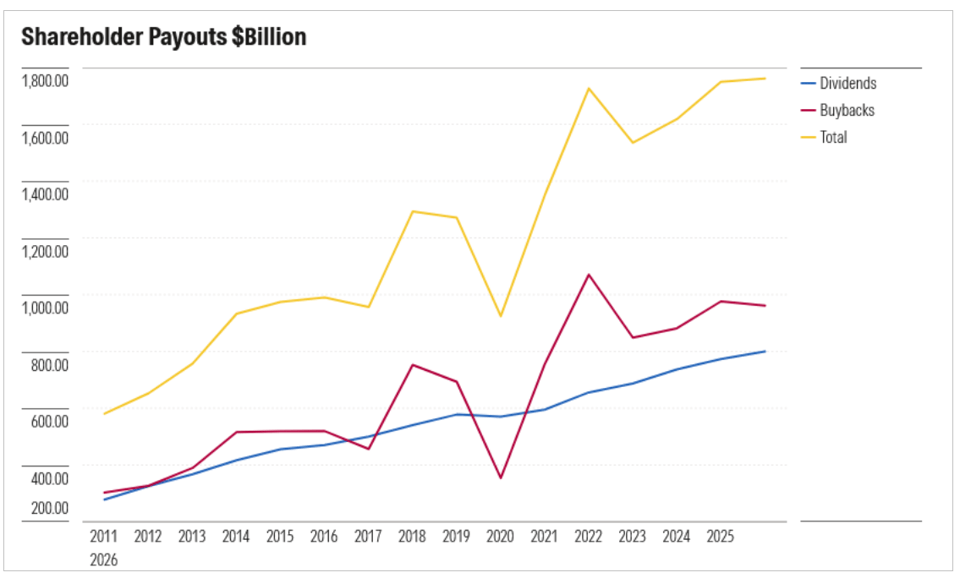
(Image Courtesy: Morningstar)
“In the past 15 years or so, it became widely understood that buybacks were better for shareholders because they were more tax-efficient than dividends,” notes Morningstar’s Allan Roth. “Suddenly, more cash was being returned from buybacks than dividends. Share dilution disappeared as stock buybacks were slightly greater than new shares issued.”
As the chart above confirms, dividends aren’t dead. Not by a long shot. They’re rising, but not as rapidly as share repurchases. Broadly speaking – and this is part of the silver lining of low dividend yields – buybacks have been contributors to increased share prices.
“While the payouts from both dividends and buybacks have increased, the market value of underlying stocks surged at a faster rate, so yields have declined,” adds Roth. “Nonetheless, total yields were roughly 2.5% in 2025 with more coming from buybacks than dividends. Stock buybacks are increasing despite a 1% excise tax that was enacted in 2022.”
So yes, buybacks maybe “culprits” in depressing dividend yields, but that’s not necessarily a bad thing.
Survive with Shareholder Yield
As advisors know, there are scores of ETFs and mutual funds focusing on dividend-paying equities and a smaller number of options dedicated to shares of companies that are prolific reducers of their shares outstanding counts by way of repurchases.
Advisors and investors seeking more encompassing approaches may want to examine ETFs emphasizing shareholder yield – a concept rooted in buybacks, dividends AND reduction of debt.
A prime example is the WisdomTree U.S. Value Fund (WTV), which obviously implies that it’s a value fund, but this $3.3 billion ETF focuses on companies meeting the shareholder yield mark. As of Sept. 15, WTV carried a dividend yield of 2.15%, which is stellar these days, and a net buyback yield of 4.50%. Financial services, technology and industrial stocks combine for nearly half of the WTV portfolio.
Related: Here’s Why Advisors Need Direct Indexing in Their Toolboxes
