


Growth stocks are rarely cheap. You’re paying for future earnings, and the good ones are worth it.”— Peter Lynch
Peter Lynch, one of our idols at Grow or Die, is arguably the second greatest investor of all time.
His performance as head of the Magellan Fund was legendary. His track record rivals even Warren Buffett. Buffett beats Lynch on longevity, having posted compound returns of 20% over about 50 years. But Lynch achieved much higher returns overall, having generated 29.2% during his 13 years tenure.
But unfortunately for investors in Lynch’s mutual fund—and for the investing world as a whole—he then exited the game. Lynch retired at age 46. He had made plenty of money and wanted to spend more time with his three daughters.
Lynch coined the term 10-bagger… stocks that gain 1,000%.
His approach was to find fast-growing companies that can sustain their growth, turn it into profits, and aren’t overvalued.
Our friends at disruption research firm RiskHedge studied every US stock in existence over the last 20 years.
They used various data sources, including Polygon.io, Financial Modeling Prep, and Yahoo Finance. They used premium AI systems to gather, parse, and cross-check the data. All in all, they had to sort through several million data points. Prior to the debut of ChatGPT and generative AI in November 2022, this would have been impossible without a team of data scientists and coders. AI is a gamechanger for sophisticated financial research.
We seem to be in a special window right now where a small team that leverages AI can get results that used to require the resources of a hedge fund. Beyond that, they used a combination of AI and human analysis to classify the 10-baggers and ultimately zero in on the core traits that tend to be shared by true 10-baggers.
Here’s the #1 trait they found…
First, let’s go back to Lynch’s quote… “Growth stocks are rarely cheap. You’re paying for future earnings, and the good ones are worth it.”
Lynch greatly preferred profitable stocks. He rarely touched unprofitable ones. His original criteria required a company to have minimum earnings growth of 20% per year. Earnings is another word for profits. Of all the ways the market has changed since Lynch’s time, this is probably the biggest.
These days, many companies—especially technology companies, where 10-baggers are most heavily concentrated—pursue a “grow now, profit later” approach. They do this because it works!
Tesla (TSLA), for example, didn’t turn profitable until 2020. Yet its stock had already become a 41-bagger by then, soaring 4,100%+. There are many such examples among the greatest stocks of the last 20 years.
Amazon (AMZN) wasn’t consistently profitable until 2015. Its stock was already up 36,567% by then (a 365-bagger!)
Shopify (SHOP) didn’t turn a profit until 2020. Its stock had already appreciated by 6,200%. See the pattern? Today’s fastest-growing companies that produce the biggest stock price gains are often unprofitable or barely profitable.
What these companies did have was rapid and consistent revenue growth. Look at how fast, and how consistently, these companies grew revenue before they reached consistent profitability:
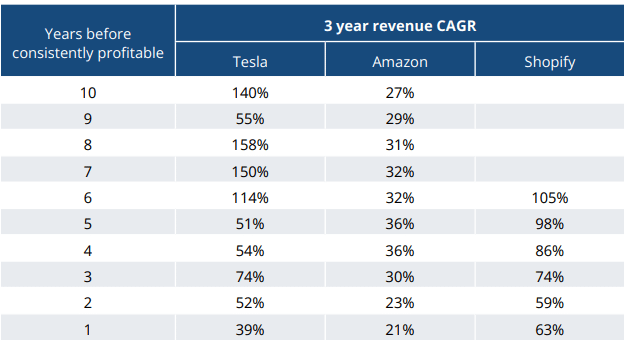
RiskHedge’s analysis indicates that rapid, consistent revenue growth is the #1 predictor of 10-bagger returns.
They measured the revenue growth of 347 true 10-baggers using a three-year compound revenue growth rate (CAGR). [The 347 number excludes all the risky lottery-ticket type stocks like biotechs and gold miners. It excludes all the stocks that only went up 1,000% if you managed to buy them around the depths of 2008/09. And it excluded all memestocks, like GameStop (GME).]
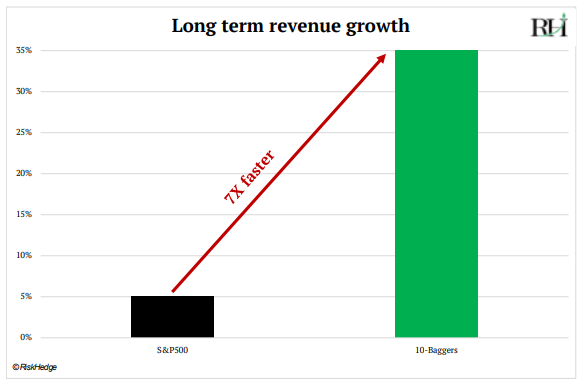
The results are telling. The average growth was 22% in the year their run began and 38% within a four-year window of when their run began. The S&P 500 as a whole has a long-term revenue growth rate of about 5%. So, depending on how you count, these 10-baggers grow around 5X–9X faster than a typical company.
Tesla hit the highest revenue growth of all, exceeding 1,000% at the start of its run in 2010. It maintained blistering growth all the way through 2018, never dropping below 50%. It was never profitable in all this time… yet its stock is now up roughly 38,000%.
That’s why…
We made growth stocks our focus at Grow or Die.
History shows that some of the greatest fortunes in the stock market have been made by owning fast-growing businesses and holding on as they become much bigger. These are the stocks with the potential to deliver 10X, 20X, or more over time.
And you only need to get a handful of them right to make an extraordinary difference to your portfolio and long-term wealth.
Related: AI Stocks Just Crashed. Here’s the One Stat To Know Before You Sell