


One of the most obvious differences between private credit and private equity is that, like any other corner of the fixed income universe, private debt features credit ratings, meaning that landscape includes investment-grade and junk-rated bonds.
Another significant difference between private credit and private equity is the risk behind private credit’s lack of liquidity and stagnant price.
“When public markets decline, private market portfolios often appear stable -- not because their underlying assets have somehow been immunized from economic forces, but because their prices simply have not been marked down yet,” notes Julian Koski, Chief Investment Officer of New Age Alpha, a Rye, New York-based investment management firm. “This creates a dangerous illusion. Investors see low reported volatility and conclude they have reduced risk. In reality, they have substituted transparent, real-time risk signals for opaque, delayed ones. The uncertainty has not been eliminated. It has been obscured.”
Combine those factors with junk-rated issues being the authors of much of private credit’s pain and it’s not surprising that clients and income investors are unnerved by the private credit market.
Things Don’t Have to Be This Way
Thanks to some unique ETFs, clients and private credit-enthused investors can have their cake and eat it, too, because funds such as the State Street® IG Public & Private Credit ETF (PRIV) provide investment-grade private credit exposure.
PRIV’s stablemates, the State Street Short Duration IG Public & Private Credit ETF (PRSD) and State Street IG Public & Private ABS ETF (PRAB), have different objectives, but also accomplish the goal of investment-grade private credit access.
“Rather than seeking exposure to sub-investment-grade middle-market lending, the suite focuses its private credit exposure on investment-grade (IG) private credit investments —including corporate finance and asset-backed finance private credit — both of which differ from middle-market direct lending,” according to State Street.
In plain English, middle-market direct lending is the “boogey man” in private credit today. Some investors have already learned the hard way that this isn’t the corner of the private credit world to be involved with in this environment. Consider the aforementioned ETFs “avoidance protocols.”
PRIV Delivering the Goods
Private credit clearly isn’t perfect, but it’s an asset class clients want access to and some of the risks can be mitigated with ETFs such as PRIV.
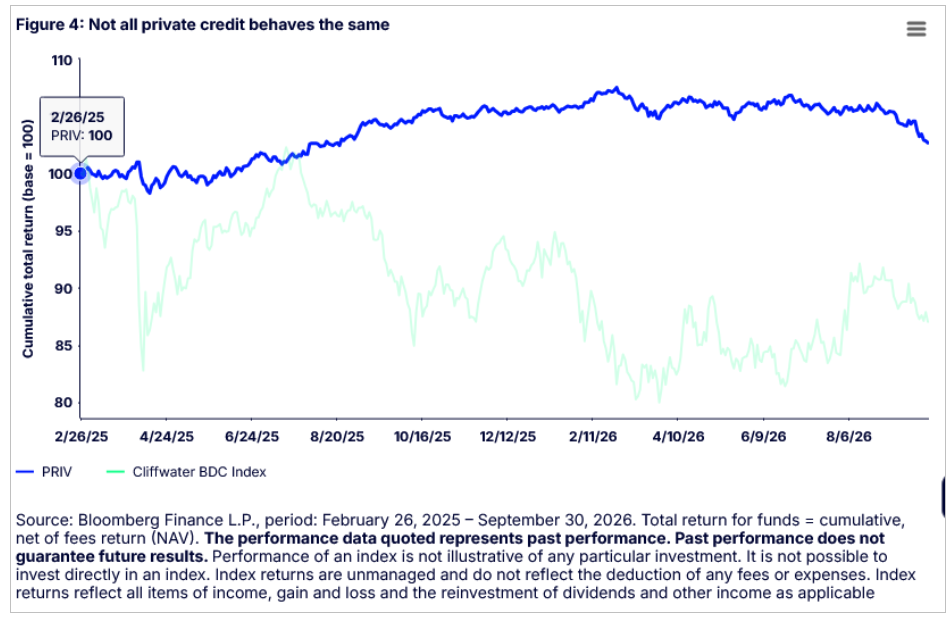
Underscoring another difference between private credit and private equity, some income-hungry investors believe they’re accessing one or both of those asset classes by embracing high-yielding business development companies (BDCs) when in reality they’re taking on more risk than they’re bargaining for.
(Image Courtesy: State Street)
“This contrast between PRIV's investment approach and private credit strategies focused primarily on middle-market lending becomes more apparent when comparing performance outcomes across the two segments,” concludes State Street. “Since PRIV's inception, exchange-traded BDCs focused on private middle-market lending have underperformed PRIV by nearly 16% while exhibiting meaningfully higher volatility. These contrasting outcomes highlight that "private credit" is not a single asset class and that results can vary significantly depending on the underlying exposures, credit quality, and underwriting framework.”
Related: How To Invest in AI Debt: Meet AIBN, the First AI Infrastructure Bond ETF