


Ample consternation remains in the private credit market, a situation exacerbated by soaring bond yields, but that doesn’t mean advisors and investors should abandon the asset class in wholesale fashion.
If anything, the current state of affairs in the bond market may be creating opportunity with private debt, underscoring the point that now is an appropriate time to explore the differences between private credit and private equity.
Arguably, the seemingly undaunted proliferation of private debt on its own is good reason to investigate the differences between private credit and private equity. The reason being is that each segment is nuanced and has “quirks” that advisors need to be mindful of prior to getting involved.
For starters, private credit aren’t typical loans. Various loans that are arranged by banks are packaged into a bond that can (or not) be sold on public markets. The loans themselves are usually held by a single creditor or a small group. That’s the tip of the iceberg when it comes to differences between private credit and private equity.
Why Borrowers Pursue Private Credit
Another difference between private credit and private equity is that the latter often involves a single entity or a duo (private equity firms) taking equity stakes in or acquiring companies in myriad industries, privatizing them, shaping them and eventually rolling them out to public markets again (the exit).
Private credit is a different animal. Borrowers pursue that option for various reasons, often boiling down to flexibility, the size of the loan needed and speed. Said another way, private creditors can more rapidly extend big loans to borrowers than can some traditional banks.
“These benefits – combined with the vacuum left by the banks when new regulations tightened lending conditions after the Global Financial Crisis – have helped foster explosive growth in private credit over the past decade and a half,” notes Goldman Sachs Asset Management (GSAM). “In 2011, private credit assets under management (AUM) was at $357 billion. By the end of 2025, it hit $1.8 trillion.”
So yes, there are potential perks with private credit but another difference between private credit and private equity to be mindful is that the former features both credit and market risk while private equity is typically subject to only of those two – market risk.
“Any credit investment, public or private, could experience default and sustain losses due to market or macro factors,” adds GSAM. “The borrower-lender relationship may help offset credit risk, as the private credit manager and the company can work together to support the latter’s recovery. And because private credit is non-traded, it’s less impacted by swings in market sentiment.”
Private Credit Is Useful for Income
One of the other perks of private credit is that investors are usually treated to higher yields – compensation for the risks associated with lock-up periods.
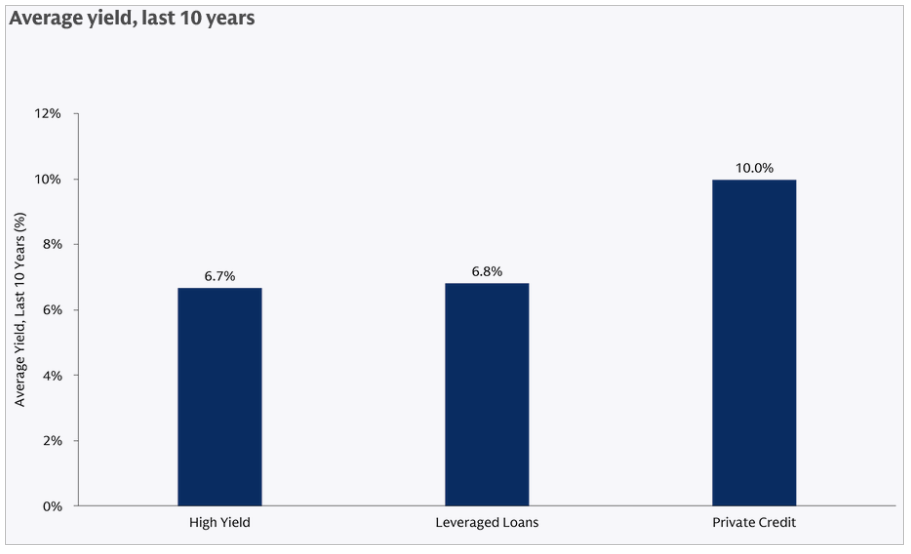
(Image Courtesy: GSAM)
That’s a clear benefit, but advisors need to assess another difference between private credit and private equity. That being that it’s usually fund manager who determines the value of private debt instruments.
“Because private credit funds don’t trade in the public market, there is no consensus market price for the loans that they hold,” concludes GSAM. “Instead, fund managers run their own process to determine the value of these investments. It may be worth considering how the manager of a fund approaches valuation.”
Related: Trump Accounts Are Going Automatic. Here’s What Parents Need to Know