


Assymetric Information
A month back, I argued that Treasury Secretary Bessent wouldn’t be able to keep long-term Treasury bond rates from rising. When I wrote, the 30-year nominal bond rate was 5.34%. It just reached 5.64%. Back then, Bessent claimed, straight faced and full of arrogance, that his “asymmetric information” gave him superpowers to control long-term rates. Unfortunately, Bessent wore a suit and tie, not his cape. Serious superheroes wear their capes. Even Superdog. Had Scott dressed the part, his stash of $6 billion to buy long-term Treasuries would have overwhelmed the global market’s $6 trillion trove of long Treasuries to sell.
Why Interest Rates Are Rising Like Crazy
Nominal bond rates are high for a reason. No one, with the exception of Scott, wants to hold them at their previous lower yield. Investors are, it seems, rather sick of nominal bonds, including Uncle Sam’s. Since 2020, nominal bonds have been killed by unexpectedly high inflation. On average, everything today costs 30 percent more than it did back then. But nominal loans, including those to the feds, pay back in dollars, not cans of Campbell Soup. Hence 30 percent higher prices means getting paid back in watered-down dollars — figuratively, 30 percent less beef and barley.
The Stock Market’s Incredible Ride
Had you invested $100K on January 1, 2020 in a diversified bond index, you’d have $78K today, adjusted for inflation. Had you invested the same $100K in stocks, you’d have $200K in real terms. Moreover, per unit of return above 1-year Treasuries, stocks have been far less volatile than bonds.
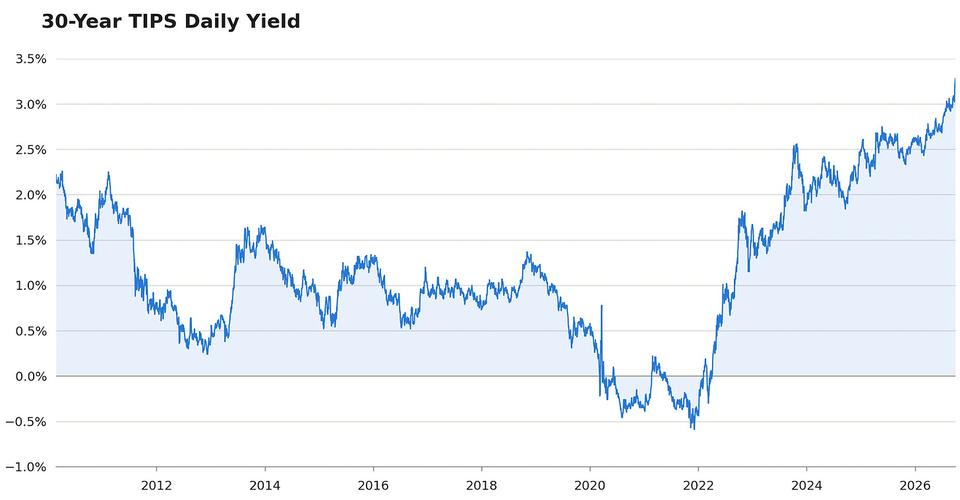
Bonds used to be considered the safe asset leading investors to forego a much higher average return to hold them. This return differential, called the equity premium, has averaged over 6 percent since 1928. In 2020, the demand for safety was particularly strong. In that year, the real return on 1-year TIPS was negative 1 percent, meaning savers were willing to accept a negative real return to keep their money safe! Today, the 1-year TIPS is yielding positive 2 percent. As for the 30-year TIPS, it averaged 0.4 percent in 2020, far below last week’s 3.4 percent peak.
Interest Rates and Federal Debt
Many people think Treasury and all other interest rates have risen over time due to concern that Uncle Sam could default on his now $40 trillion in federal debt. (It’s $32 trillion after subtracting debt the Federal Reserve monetized — purchased by electronically printing greenbacks.) The answer is yes, but not much more. The annual cost, set in the credit default swap (CDS) market, of insuring against federal debt over the next ten years was roughly 15 basis points back in 2020. It’s roughly 45 basis points today.
In 2020, the 10-year Treasury bond’s yield averaged 0.89 percent. Last week’s peak rate was, as indicated, 5.34 percent. Hence, only 10 percent of the post-2020 rise in 10-year Treasury rates is, arguably, due to fear of default. This means the perceived probability of default, let alone sustained default going beyond a temporary federal-government shutdown (the main driver of high CDS rates), is low.
This is remarkable given the extent of our nation’s extraordinary fiscal insolvency. Apparently, the market believes that whatever fiscal adjustments we make, they won’t occur via formal debt default. I think the market has this right.
Interest Rates and Inflation
What about fear of future inflation watering down repayment on nominal bonds? As just indicated, the last half dozen years have witnessed a 30 percent inflation-generated effective default on nominal federal debt. Yet purchasers of nominal long-term Treasuries aren’t, it seems, worried about inflation long-term.
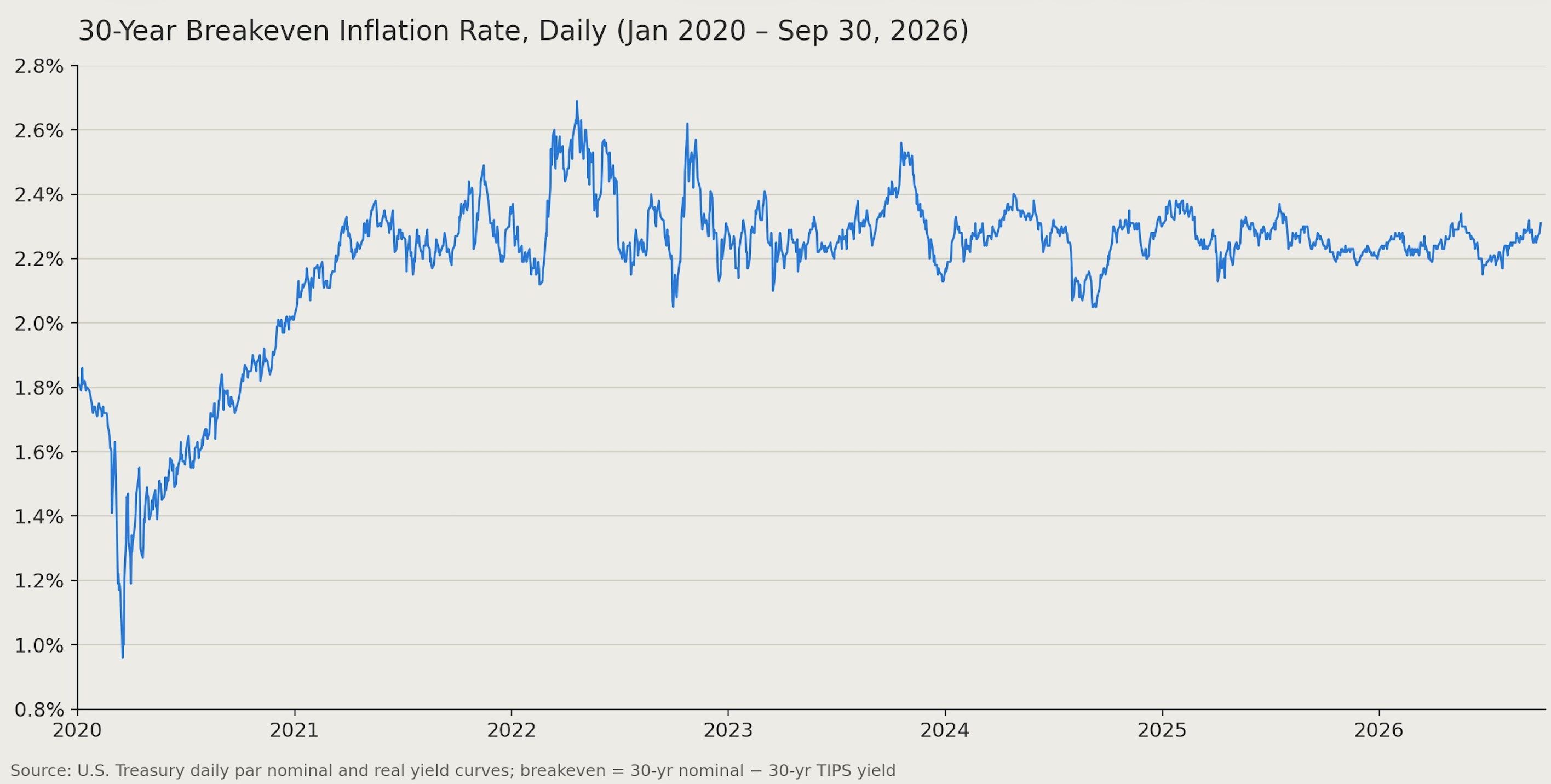
The following chart shows the 30-year annual inflation rate implied by the difference in yields on nominal 30-year Treasuries and that on 30-year TIPS (Treasury Inflation Protected Securities). Over the past year, the daily breakeven inflation rate has hardly budged, averaging 2.25 percent. As I write, the 30-year TIP is yielding 3.34 percent. Hence, the breakeven 30-year inflation rate is 5.64 percent less 3.34 percent or 2.30 percent. Thus, there is no indication that the recent rise in rates is due to fear of higher inflation. Indeed, according to the Philadelphia Federal Reserve Bank, professional forecasters project, on average, long-term inflation of 2.29 percent.
Should Anyone Hold Nominal Treasuries?
To me, TIPS dominate nominal Treasuries. They have the same default risk, roughly the same tax treatment, and, given survey data, the same expected real return. But TIPS come with seemingly free insurance against a massive risk — another major bout of inflation.
The Vanishing Equity Premium
If bonds, whether correctly or not, are no longer considered safe assets, we’d expect what we’re seeing — lenders demanding a higher real return on their loans. Alternatively, high stock returns may be viewed, these days, as a sure thing. In this case, bond yields would have to rise to induce their purchase. Either way, the bottom line is higher real rates that Scott can’t lower, cape or no cape.
The terrific news for savers is that they can now safely earn a far higher real return on their wealth — by investing in TIPS.
Risky Investing Is an Option, Not a Starting Point
As this recent column stresses, conventional financial planning assumes, from the get-go, that every household should hold risky assets. But economics says nothing of the kind. Instead, it says that each of us, not our Wall Street advisors, must decide whether we prefer a safety-first approach to investing or want to keep waking up at 3 AM worried about both the stock market and our sustainable living standard collapsing. Or, if we expect to leave money to our kids, trace our 3 AM cold sweat to putting their inheritances at risk.
A strategy of buying and holding, through maturity, a portfolio of TIPS — building a TIPS ladder — appears the safest way to secure one’s retirement. Yes, TIPS, like other Treasury bonds, face the just-mentioned small risk of federal default. But a default on federal debt would produce global financial armageddon, making its possibility beyond remote. Yes, Uncle Sam is in terrible fiscal shape. But there’s good news in the bad news. Our tax, welfare, Social Security, and healthcare systems are so poorly designed and so incredibly wasteful that fixing them can bail us out. For example, our adoption of the Swedish healthcare system could, by itself, lower our nation’s yearly healthcare bill by 7 percent of annual GDP. That’s the same as Sweden’s whose healthcare outcomes are ranked 4th best among developed nations. Ours are ranked 21st.
Stocks Aren’t Safe in the Short Run, Let Alone the Long Run
Wall Street says that holding securities, like money market funds, for the short run and stocks for the long run will get you through retirement. Its presumption is that stocks are safer the longer you hold them. Basic finance and the cost of buying longer-dated portfolio insurance says the opposite. Indeed, stocks evolve as a random walk with a drift. The drift references the roughly 7 percent average annual real yield on stocks. The term random walk references the fact that the market can drop at any moment with no financial force of nature standing by to restore its value.
Thus, if the market drops in half, as it did in the Dot Com crash and the Great Recession, there is no reason to expect that drop to be systematically reversed in the short, medium, or long term. Yes, you can expect your half-sized portfolio to grow at 7 percent real starting from its new reduced level. But you can’t expect today’s unexpected loss to be recouped by tomorrow’s unexpected gain.
Indeed, having dropped in half, your stock portfolio is, apart from the 7 percent positive drift, as likely to fall further as it is to rise. The reason is simple. Financial markets incorporate available information. Hence, any market movement, up or down, apart from its trend, must reflect new information — news. But news, by definition, is unpredictable, i.e., random. If we knew what was coming, it wouldn’t be news. That’s why the term “random walk” is used to describe deviations of the stock market from its trend.
Gee, you’re probably saying, “The market recovered after both the Dot Com crash and the Great Recession. It even recovered after Black Tuesday on October 29, 1929. I can count on stocks being safe in the long run.”
Not quite.
In the case of Black Tuesday, it took 25 years for the stock market to regain its nominal value and 16 years for it to regain its real value. Between 1929 and 1933, the market fell, in nominal terms, by 89 percent. Another example of “recovery” is the Japanese market, which peaked in 1989, fell by 82 percent, and took 34 years to reach its 1989 value (whether measured in real or nominal terms).
TIPS Laddering — How to Secure Your Retirement and Sleep at Night
My company’s top-ranked personal financial planning software — MaxiFi Planner — helps users understand the pluses and minuses from risky investing. But it starts by presenting a safety-first plan — a plan under which households invest in either a TIPS ladder or assets that are equally safe. Your safety-first plan calculates something no other financial tool can get right — what to spend each year to maintain your living standard (discretionary spending per household member) at its highest sustainable level.
Once you have established your safety-first plan, MaxiFi helps you raise the plan’s sustainable living standard by determining which Social Security benefits to take, and when, to maximize your lifetime benefits. It also lets you optimize your retirement account decisions — contribution levels, timing, and type (Roth versus non-Roth), Roth conversions, non-Roth withdrawal dates, use of QCDs and QLACs, allocation of Roth and non-Roth accounts for bequests, and more. Finally, it lets you see the impacts of different retirement dates as well as different post-retirement downsizing and/or relocation decisions.
Each of these moves affects your sustainable living standard and, if you’re planning on making bequests, your terminal estate. But each move changes your path of spending, which means changes in your path of assets and taxable asset income, which means changes in your path of taxes, which means changes in your sustainable living standard and estate, which means … .
MaxiFi is the only financial planning tool that produces internally consistent results. Whether you are paying a financial planner tens of thousands or hundreds of thousands of dollars, if they aren’t using MaxiFi, they are surely giving you inconsistent, if not terrible advice — mistakes that carry over to their investment “guidance.” AI is no better. It can’t guess what it doesn’t know and it doesn’t know the multiple intricate steps involved in forming internally consistent economics-based financial plans.
As for helping you build a TIPS ladder, MaxiFi shows you the annual withdrawals from your regular assets, from your own retirement account, and from your spouse/partner’s retirement account that can be secured by using the assets in those accounts to buy an appropriate set of TIPS of different maturities. As described in this video, with Kevin Esler, the developer of tipsladder.com, you can just plug in the withdrawals produced for each account in running MaxiFi and, presto, see how many TIPS of different maturities, with their associated CUSIPs, to buy.
Thus, MaxiFi helps you, in conjunction with Kevin’s tool, to ladder up. But whether you do so or not is entirely your decision. Neither MaxiFi nor I provide investment advice. We’re both simply providing education about options.
Risky Investing Is Far Less Attractive Now Compared to a TIPS Ladder
How much better is investing in TIPS these days than it was back in 2020? Unfortunately, the precise answer to anything in personal finance depends on everything. Small differences in circumstances can make major differences in what economics suggests you do.
Let’s consider hypothetical Jim from this article entitled Conventional Financial Planning Doesn’t Get the First Thing Right About Investing — Assessing Risk. Jim is a 62-year-old, single, retired, childless Alaskan. He has a $3 million IRA and a $3 million brokerage account — 3x more assets than in the prior post. Jim has no expenses apart from renting an apartment in Juneau for $1000 a month and paying federal income and IRMAA taxes.
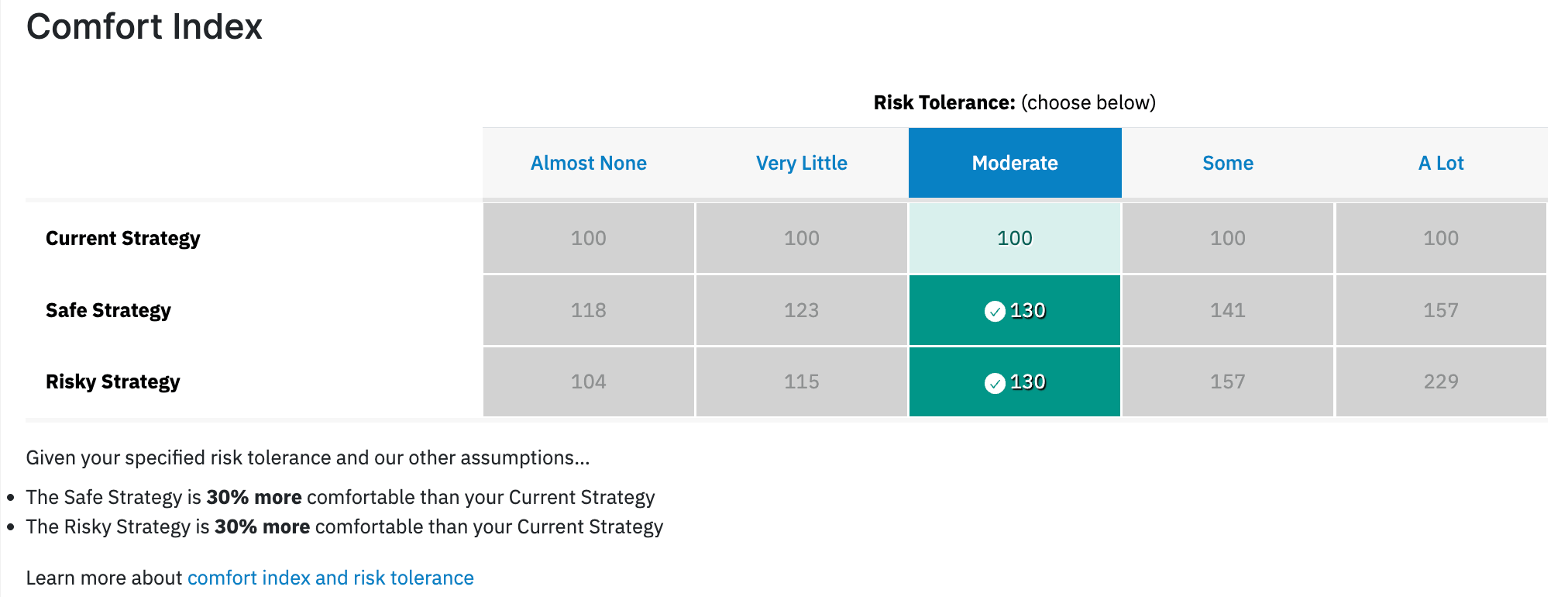
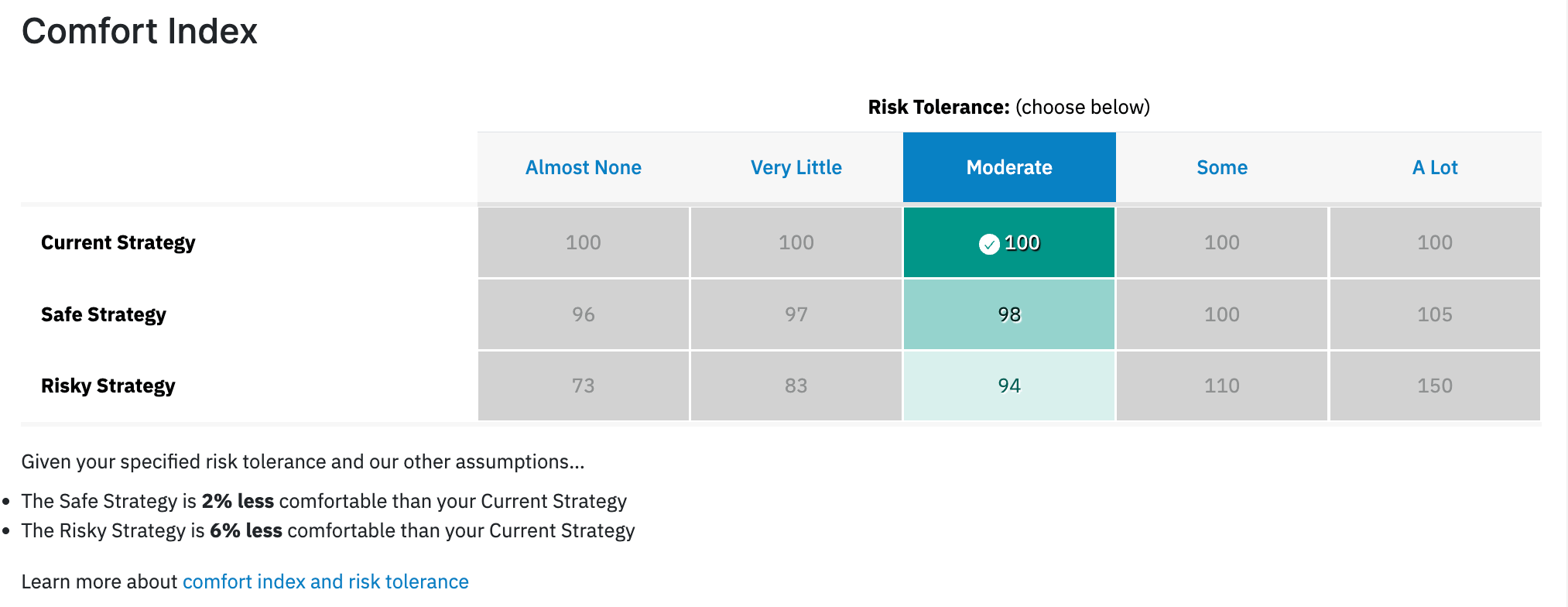
The tables below show, for different levels of Jim’s risk tolerance (what economists call risk aversion), Jim’s expected remaining lifetime Comfort Index under different investment strategies. The tables consider Jim’s welfare if he invests solely in TIPS ladders (the current strategies) assuming TIPS yields are 0 percent (top chart) or 3 percent (bottom) across all maturities. Each table compares Jim’s comfort index from investing solely in a TIPS ladder with investing 20-80 in stocks and nominal bonds on an annual basis (the safe strategy) or 80-20 (the risky strategy).
The Comfort Index is MaxiFi’s shorthand for expected remaining lifetime utility, i.e., average remaining lifetime happiness. The greater Jim’s risk aversion, the less Jim values having a higher living standard and the more Jim fears having a lower one. This reflects diminishing marginal utility. That first handful of heavily buttered popcorn at the movies is sublime. The second is just great. The 15th is, well, close to sickening. Hence, a 50-50 bet on a) no popcorn and b) 20 scoops is a bet Jim would decline.
If Jim has moderate aversion to risk, investing in either the safe or risky strategy dominates investing in TIPS when they are yielding 0 percent. As expected, the higher Jim’s risk aversion, the better the 20-80 stock-bond investment strategy looks compared to the 80-20 stock-bond strategy.
But with a hypothetical 3 percent TIPS ladder, investing solely in TIPS beats investing in even the safe strategy assuming Jim is moderately risk averse. If he’s able to tolerate almost no risk (he’s highly risk averse), the risky strategy is 27 percent worse than investing solely in TIPS. And the safe strategy is 4 percent worse. Thus, in this case, TIPS investing dominates any stock cum conventional nominal bond investing.
The Comfort Index — Investing in TIPS Yielding a 0% Return
The Comfort Index — Investing in TIPS Yielding a 3% Real Return
TIPS, Given Current High Yields, Are Particularly Valuable to the Rich
As indicated, one size fits none when it comes to personal financial decisions. Were Jim to have $100K, not $6 million in assets, investing all of his assets solely in stocks would be optimal even for high degrees of risk aversion. In this case, Jim would be living almost exclusively off his Social Security. Hence, losing all his assets would make no real difference to his living standard. On the other hand, the small chance of making a killing in the market even on a relatively small bet would make buying that lottery ticket, with far better odds than the standard ticket, a reasonable thing to do.
Locking In Your Stock Gains, Selling Inflation-Risk Nominal Bonds, and Buying a TIPS Ladder May Be Just Your Ticket
The stock market is close to all-time high. Nominal bonds are highly exposed to inflation, which, as we’ve just seen, can flare up at any time. And the yield on TIPS is spectacular. You owe it to yourself and, likely, your kids and grandkids, to run MaxiFi and understand whether it’s time to invest in a ladder of TIPS and lock in your future living standard as well as bequests.
Related: The Biggest Problem With Conventional Retirement Planning? It Hides the Risk
