


Options income exchange traded funds (ETFs) are one of the fastest-growing categories in the ETF space and part of that growth is attributable to advisors searching for alternative income sources for clients that aren’t interest rate-sensitive. It’s also the result of retail investors flocking to high-yield products without much investigation into the risks of covered call ETFs and related products.
To be clear, the point of this piece is NOT to indict a particular issuer because when it comes to the risks of covered call ETFs, plenty of ETF sponsors have “warts.” Among the most popular issuers, particularly among do-it-yourself (DIY) investors, of derivative income ETFs is YieldMax. The issuer sponsors more than 60 high-income ETFs, all of which deliver weekly payouts. Even the three single-stock ETFs in the YieldMax® Lite lineup feature distribution rates of 25%.
But one of the issuer’s most famous products is the YieldMax® Ultra Option Income Strategy ETF (ULTY), which is two-and-a-half years old and has $748.4 million in assets under management (AUM). Even with its notoriety and impressive AUM tally, ULTY is an example of a fund underscoring the risks of covered call ETFs.
Understanding ULTY
Full disclosure: ULTY was about a year old before I learned about it and in a case of social media/technology serving some good in the investment research process, I learned of ULTY on Reddit where there’s not only a dedicated YieldMax sub, but one specific to ULTY as well.
Put simply, ULTY is a high-yield actively managed ETF that typically invests in 15 to 30 securities, split between high beta fare, which are used for high options premiums, and lower volatility names that can provide a foundation for stability. The “hooks” for many retail investors are a high distribution rate and weekly payouts.
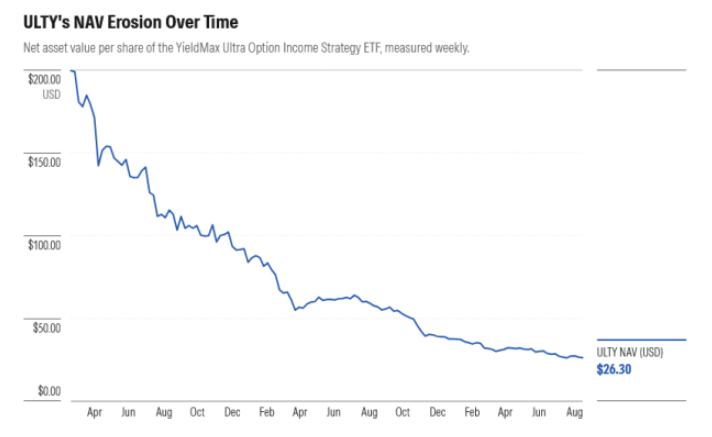
However, the source of the weekly payouts highlights one of the big risks with covered call ETFs. Of ULTY’s last 20 distributions, 15 were 100% return of capital (ROC) and another was 96.1% ROC. Yes, the other four weeks featured 0% ROC, but this ETF frequently is returning investors’ capital to them, potentially highlighting “quirks” in its strategy while subjecting market participants to significant net asset value (NAV) erosion over time.
(Chart courtesy: Moringstar)
“Why the decline in NAV? It’s mainly because such a large portion of the fund’s distributions is classified as returns of capital. Based on the information published on its website, 100% of the fund’s most recent distribution (paid on Sept. 1) was considered a return of capital,” notes Morningstar’s Amy Arnott. “Although YieldMax claims returns of capital are a tax treatment and not necessarily reflective of an economic loss, a fund can’t continuously distribute more income than it earns without eroding shareholder value.”
Remember Another Risk of Covered Call ETFs
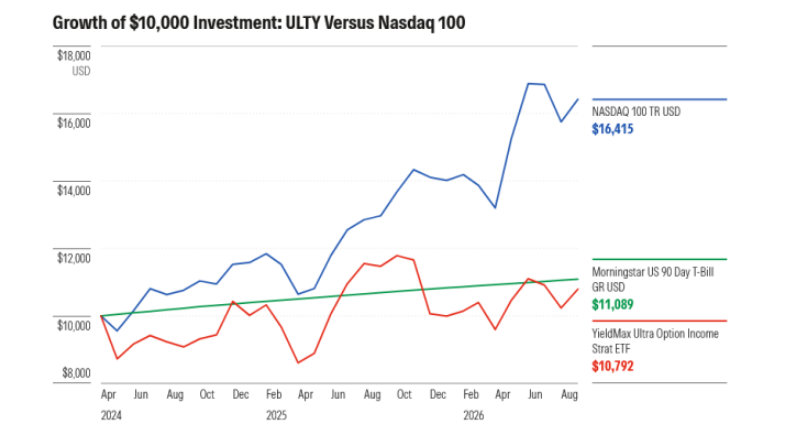
Advisors and experienced investors know that one of the preeminent risks of covered call ETFs is that even the “best of breed” of funds cap investors’ upside participation. It’s simply the price of admission to access the funds’ large income streams. So to that end, it’s not surprising that ULTY has lagged broader equity benchmarks since coming to market.
(Chart Courtesy: Morningstar)
The problem in that chart isn’t ULTY trailing the Nasdaq-100. A lot indexes, including the S&P 500, don’t beat the Nasdaq-100 over long holding periods. The rub is ULTY not keeping pace with short-term T-bills.
“That’s not a great result for a fund that aims to ‘maintain participation in share price gains’ in its underlying holdings,” adds Arnott.
Bottom line: Risks abound with covered call ETFs and other options-based income strategies. ULTY proves as much and prospective income investors owe it to themselves to read the fine print.