


Let’s be clear. There are risks associated with covered call ETFs, but not all covered call ETFs are excessively risky.
However, this is a corner of the ETF market with more than 550 products and nearly $220 billion in combined assets under management, implying that it is vast enough that perfection is hard to come by. The largest Covered Calls ETF is the JPMorgan Equity Premium Income ETF (JEPI). Home to $45.3 billion in assets under management, JEPI is an actively managed ETF with a tame, relatively speaking, rolling 12-month dividend yield of 8%.
Since coming to market, JEPI returned nearly 95%, confirming it’s not the embodiment of the risks of covered call ETFs and that’s a good thing. That’s true of some of the other well-managed, lower-yielding covered call ETFs.
Broadly speaking, these ETFs deliver monthly income and, with some luck and manager acumen, some upside – likely better than bonds, but well below stocks. The point is a sound covered call ETF like JEPI offers clients and investors an alternative or complement to fixed income while not biting off significant risk. However, not all covered call ETFs live up to the diminished risk proposition.
These Covered Call ETFs Carry Big Risks
Ever inventive, ETF issuers have gone down the road of introducing single-stock covered call ETFs and as the chart below confirms, these funds are proving popular – mostly with yield-hungry retail investors.
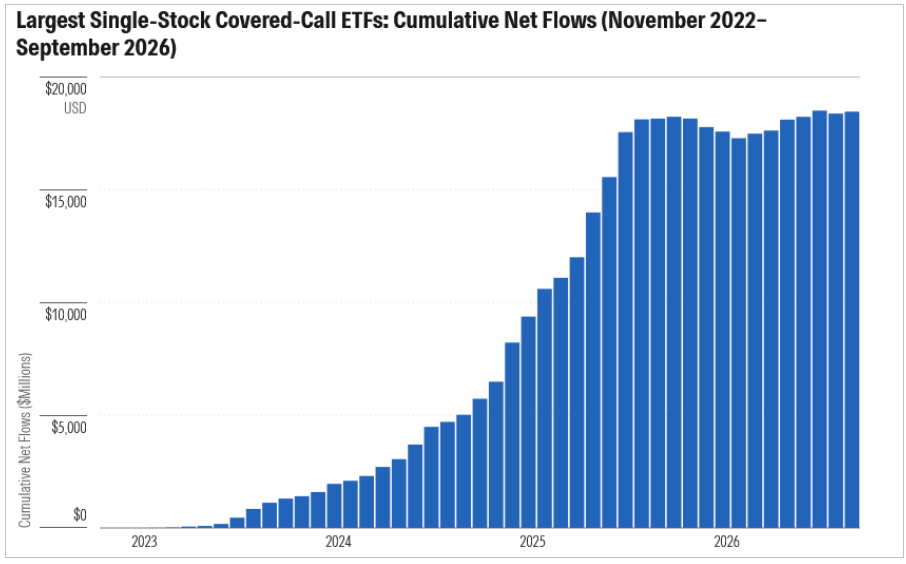
(Image: Morningstar)
Morningstar’s Jeffrey Ptak examined the performances and yields of YieldMax single-stock covered call ETFs, which indeed carry some eye-catching yields. That’s a big reason why so much retail money made its way into these funds, but popularity doesn’t obfuscate the risks of these covered call ETFs. Quite literally, investors are paying for yield.
“These ETFs distributed gigantic sums, $13.1 billion in total, and those distributions far exceeded the net income and gains investors amassed after fees,” observes Ptak. “It appears the ETFs’ expenses, which were around $186 million over this period, ate up more than half the roughly $392 million in income and gains investors made before fees.”
Take the example of the YieldMax® AMD Option Income Strategy ETF (AMDY), an actively managed “designed to generate weekly income by selling call spreads on Advanced Micro Devices Inc (AMD).” It charges 1% per year – high by ETF standards. To its credit, AMDY generated impressive 12-month returns of 157.1%, but not all single-stock covered call ETFs follow that return trajectory, but they all carry high fees.
Chasing Is Another of Risk With Covered Call ETFs
It’s human nature to chase fund performance. Advisors have seen that happen for decades with mutual funds and basic ETFs. It’s also a risk with covered call ETFs because retail investors exude performances for those funds with strong past performance and high yields.
Data confirm that chasing is a very real phenomenon with covered call ETFs. As Ptak points out, 94% of inflows into single-stock covered call ETFs arrived AFTER the funds lobbed off “a distribution yield of at least 50%” and 75% of capital arrivals occurred AFTER the funds posted positive returns.
“If high distribution yields and positive recent returns were correlated with higher, or at least comparable, subsequent returns, then investors could have made out quite well,” adds Ptak. “But I found these ETFs made almost nothing in the average period that came after a very large distribution and a period of positive returns.”
At the end of the day, single-stock options income ETFs may be useful for alternative income purposes, but they’re not applicable for all investors or clients nor do these funds do anything to erase the risks of covered call ETFs.