


There are occasions when embracing an asset class’s or a sector’s weakest links can pay off handsomely for patient investors, but for many market participants, identifying those assets and extracting profits from them is a hazardous endeavor.
A new autocallable ETF makes that objective easier. The Calamos Least-Of Autocallable Income ETF (CAYN), the latest addition to the vaunted Calamos stable of autocallable ETFs, extracts laddered income from the “offenders” in some well-known domestic equity indexes.
The new Calamos ETF is rooted in the well-known “worst-of” structured note strategy. Put simply, worst-of structured notes are income-bearing securities where the interest and principal payments are tied to the worst-performing name in a multi-stock index.
“CAYN links income payments and principal repayment to the weakest performer among SPY, QQQ and IWM, via a weekly ladder of synthetic notes, each with a three-year maturity, 30% downside coupon and principal barriers, and a coupon-memory feature,” according to the issuer.
Those tickers refer to the State Street® SPDR® S&P 500® ETF Trust (SPY), the Invesco QQQ ETF (QQQ) and the iShares Russell 2000 ETF (IWM). So the reference asset for CAYN’s QQQ exposure is likely to be Applovin (APP), shares of which are off more than 60% year-to-date as of Monday, Oct. 19.
CAYN: Improving the ‘Worst-Of’ Proposition
Developed in conjunction with MerQube and Citibank, the new CAYN is not only unique in terms of autocallable ETFs, but it refreshes the worst-of investing concept.
The rookie ETF has a nifty memory feature that essentially sets aside the worst-of assets’ missed coupon payments (when that scenario occurs) and doles out those distributions when “the worst-performing constituent is back above the coupon barrier.”
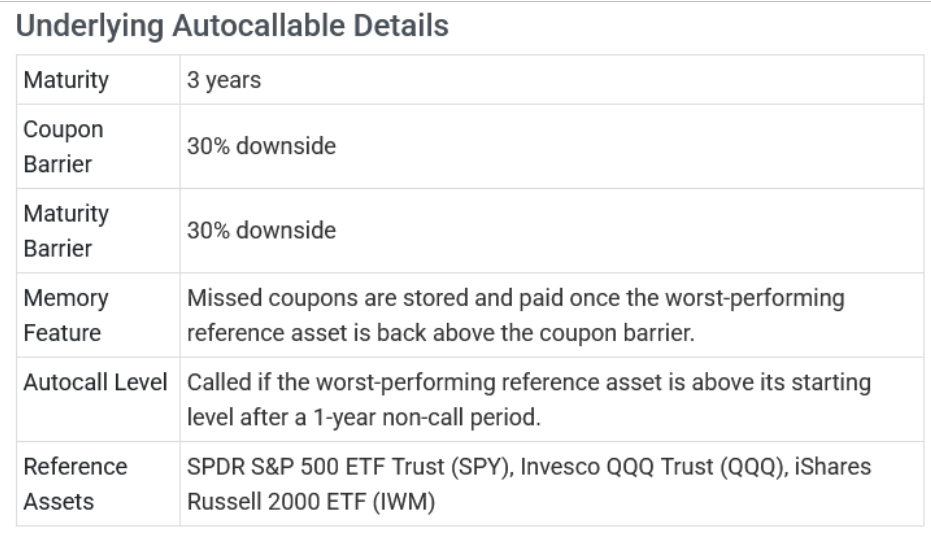
(Table Courtesy: Calamos Investments)
“Rather than investing in a single worst-of autocallable note ("note") or a non-indexed worst-of autocallable ETF, CAYN provides exposure to a weekly laddered index of at least 52 synthetic worst-of autocallable notes, each with a three-year maturity and 30% downside coupon and principal barriers,” notes Calamos, which is the pioneer of the autocallable ETF arena. “When a note in the portfolio is called away, the principal is returned to the fund and reinvested in a new note with the same terms. Each note’s three-year term is designed to allow more time to recover from market declines, seeking to reduce the risk of principal impairment.”
CAYN Ready for This Moment and Beyond
At a time when equity index dividend yields are microscopic and the bond market is awash in challenges, advisors are increasingly attempting to source alternative income on behalf of clients. The marriage of autocallables and worst-of investing presented by CAYN eases that burden because worst-of assets feature higher coupon rates or more attractive payouts. After all, the juice has to be worth the squeeze for end users.
So it can be argued that CAYN may be the beneficiary of good timing – something that’s often hard to come by for new ETFs. More important are DNA and familiarity. CAYN hails from impressive autocallable heritage and when it comes to these type of ETFs, Calamos is a name wealth managers trust.
“CAYN will use the same ‘Structured ETF’ framework that has powered the success of CAIE, CAIQ and CAGE—trading an index on swap, an innovation that the worst-of autocallable strategy has never seen before in the ETF space,” said Matt Kauffman, global head of ETFs at Calamos. “We look forward to expanding the Calamos Autocallable ETF family for investors seeking one of the most popular forms of autocallable income via the ETF wrapper.”
Related: State Street Launches 4 Uncapped Sector SPDR ETFs: What Advisors Need to Know