


Written by: Kevin Flanagan and Maggie Lucier
Key Takeaways
- The 10-year U.S. Treasury yield reached 5.36%, a new 20-year high, as growth, inflation, policy uncertainty and supply pressures reshaped the bond market.
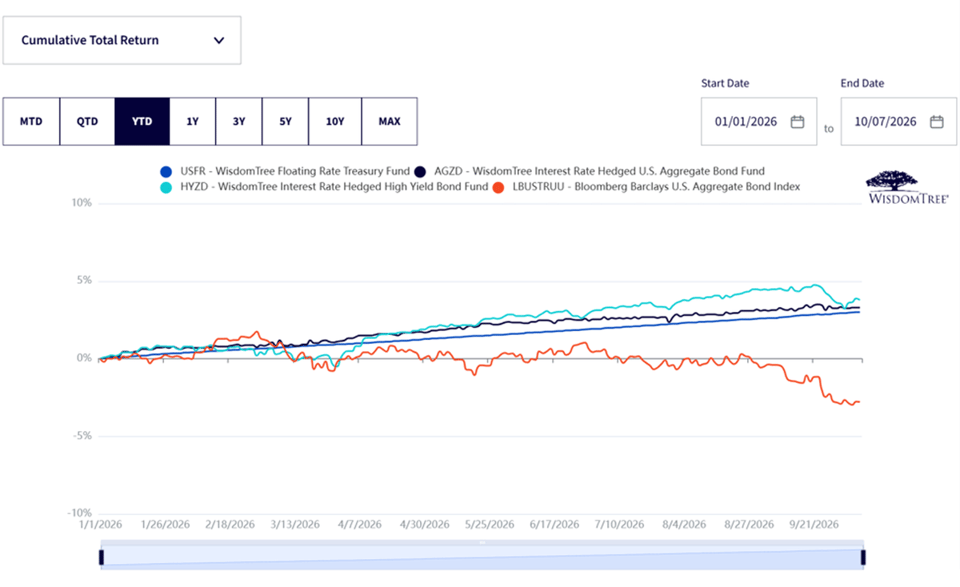
- WisdomTree’s Zero Duration Suite has outperformed the Bloomberg U.S. Aggregate Bond Index year to date.
- Zero-duration strategies could help manage rate uncertainty and volatility, including as part of a barbell approach with longer-duration bonds.
The surge in U.S. Treasury (UST) yields over the past three months or so will go down as one for the ages. In fact, multi-decade high-water marks for longer-dated maturities have put yields at levels a generation of investors have never witnessed before. When Fed Chair Kevin Warsh took the helm back in May, we highlighted how the money and bond markets would be entering into a “New Warsh Cycle,” where investors should consider positioning their fixed income portfolios for the potential of elevated uncertainty, and of course higher rates and volatility.
Our high-conviction solution for bond investors for this “new” landscape has been to utilize the WisdomTree Zero Duration Suite to help portfolios navigate the heightened rate and volatility risk that ultimately occurred. As a refresher, the Zero Duration Suite aims to mitigate interest rate risk and dampen volatility, all while offering varying exposures on the credit spectrum.
USFR: Your Anchor
- 100% Treasury Floating Rate Notes
- Floats with the Fed as rates may be higher for longer
- Anchor allocation in any strategic fixed income portfolio
AGZD: Core
- The Zero Duration Agg
- Investment grade bonds without interest rate sensitivity
- A smarter core bond allocation when the rate outlook is uncertain or tilted higher
HYZD: Core-Plus
- Can be used for high yield income without the duration risk
- Cash flow screen filters out the weakest issuers, only quality left behind
- High yield without the “junk”
As the UST 10-year yield broke above its 2007 peak of 5.32% last week and officially ushered in a new 20-year high of 5.36%, we thought it was an opportune time to “mark-to-market” and check in on our hypothesis since then. As you can see, the suite has more than done its job and has visibly outperformed the benchmark Agg on a year-to-date basis.
Figure 1: Performance from 1/1/26 to 10/7/26—Cumulative Total Return
Source: WisdomTree, as of 10/7/26. Past performance is not indicative of future results. Investment return and principal value of an investment will fluctuate so that an investor’s shares, when redeemed, may be worth more or less than their original cost. Current performance may be lower or higher than the performance data quoted. For the most recent month-end and standardized performance, click the respective ticker: USFR, AGZD, HYZD.
However, one never wants to get complacent in this current and prospective bond market environment. Against this backdrop, it is important to remember how longer-dated UST yields got to where they currently reside in the first place. As we have previously written in What’s Driving Treasury Yields Higher?, it was not one or two forces, but rather a confluence of factors, such as good growth, sticky inflation, Fed (Warsh-related) policy uncertainty and supply considerations (Treasury- and AI-related) that has created an environment where the bond market had to reprice itself in order to better reflect these changing dynamics. In other words, against this shifting investment landscape, concessions need to be made in order to establish a yield level that will attract buyers.
Conclusion
Going forward, we believe the Zero Duration Suite will still be key to help with rate uncertainty and mitigate volatility risks. If you want to take advantage of the UST 10-year being above 5%, we recommend not going long duration without some protection, i.e., a barbell approach. All three of the “ZD” strategies can be used in a barbell that contains a longer-duration position in order to help hedge your duration bet (more on how to specifically position the barbell in an upcoming blog).
But in our opinion, recent history has shown the risks that are associated with trying to perfectly time the top in yields. It is important to note that the aforementioned forces for higher rates are not going away any time soon and will most likely remain in place as we head into 2027, and as a result, we plan on showing up late to the duration party and using these strategies while we get ready.
See the WisdomTree Glossary for definitions of terms and indexes.
Important Risks Related to this Article
There are risks associated with investing, including possible loss of principal. Please read the Fund’s prospectus for specific details regarding the Fund’s risk profile.
USFR: Securities with floating rates can be less sensitive to interest rate changes than securities with fixed interest rates, but may decline in value. Fixed income securities will normally decline in value as interest rates rise. The value of an investment in the Fund may change quickly and without warning in response to issuer or counterparty defaults and changes in the credit ratings of the Fund’s portfolio investments. Due to the investment strategy of this Fund, it may make higher capital gain distributions than other ETFs. The Fund invests in the securities included in, or representative of, its Index regardless of their investment merit, and the Fund does not attempt to outperform its Index.
AGZD: Fixed income investments are subject to interest rate risk; their value will normally decline as interest rates rise. The Fund seeks to mitigate interest rate risk by taking short positions in U.S. Treasuries (or futures providing exposure to U.S. Treasuries), but there is no guarantee this will be achieved. Derivative investments can be volatile and these investments may be less liquid than other securities, and more sensitive to the effects of varied economic conditions. Fixed income investments are also subject to credit risk, the risk that the issuer of a bond will fail to pay interest and principal in a timely manner, or that negative perceptions of the issuer’s ability to make such payments will cause the price of that bond to decline. The Fund may engage in “short sale” transactions of U.S. Treasuries where losses may be exaggerated, potentially losing more money than the actual cost of the investment and the third party to the short sale may fail to honor its contract terms, causing a loss to the Fund. While the Fund attempts to limit credit and counterparty exposure, the value of an investment in the Fund may change quickly and without warning in response to issuer or counterparty defaults and changes in the credit ratings of the Fund’s portfolio investments. Investing in mortgage- and asset-backed securities involves interest rate, credit, valuation, extension and liquidity risks and the risk that payments on the underlying assets are delayed, prepaid, subordinated or defaulted on. Due to the investment strategy of the Fund, it may make higher capital gain distributions than other ETFs. The Fund invests in the securities included in, or representative of, its Index regardless of their investment merit and the Fund does not attempt to outperform its Index.
HYZD: High-yield or “junk” bonds have lower credit ratings and involve a greater risk to principal. Fixed income investments are subject to interest rate risk; their value will normally decline as interest rates rise. The Fund seeks to mitigate interest rate risk by taking short positions in U.S. Treasuries (or futures providing exposure to U.S. Treasuries), but there is no guarantee this will be achieved. Derivative investments can be volatile and these investments may be less liquid than other securities, and more sensitive to the effects of varied economic conditions.
Fixed income investments are also subject to credit risk, the risk that the issuer of a bond will fail to pay interest and principal in a timely manner, or that negative perceptions of the issuer’s ability to make such payments will cause the price of that bond to decline. The Fund may engage in “short sale” transactions where losses may be exaggerated, potentially losing more money than the actual cost of the investment and the third party to the short sale may fail to honor its contract terms, causing a loss to the Fund. While the Fund attempts to limit credit and counterparty exposure, the value of an investment in the Fund may change quickly and without warning in response to issuer or counterparty defaults and changes in the credit ratings of the Fund’s portfolio investments. Due to the investment strategy of the Fund, it may make higher capital gain distributions than other ETFs. The Fund invests in the securities included in, or representative of, its Index regardless of their investment merit and the Fund does not attempt to outperform its Index.
Past performance is not indicative of future results.
U.S. investors only: Click here to obtain a WisdomTree ETF prospectus which contains investment objectives, risks, charges, expenses, and other information; read and consider carefully before investing.
WisdomTree Funds are distributed by Foreside Fund Services, LLC, in the U.S.
This WisdomTree article is provided as part of a paid sponsorship.