


If you’re like me and watch a lot of college football, you’re being “treated” (that word is being used loosely) to a steady stream of election advertising – some of it related to the state you live in and if you’re watching a nationally broadcast game, you’re seeing campaign ads for candidates in other states, too.
That’s a long way of saying Election Day is Tuesday, Nov. 3 and as is the case with all national electoral affairs in this country, Decision Day 2026 has implications for stocks. However, the one of the issues advisors face as it relates to the intersection of elections and investing is that many clients – regardless of political proclivities – get emotionally invested in electoral outcomes, potentially clouding their perspectives about what comes next for their portfolios.
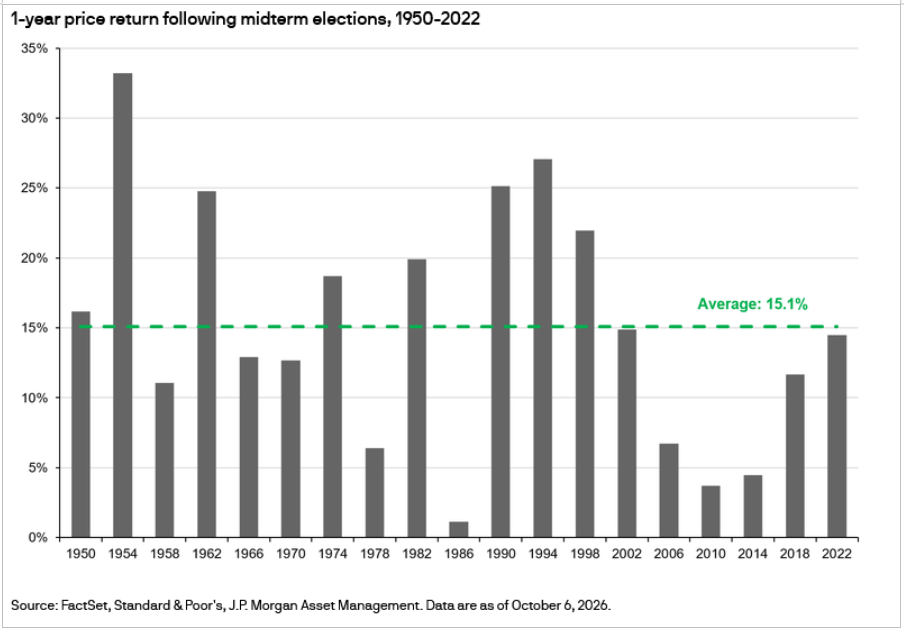
Fortunately, advisors can leverage favorable history to calm clients’ nerves because history confirms the year following midterm elections is the best one for equities in the four-year presidential cycle.
History Is on the Side of Stocks
No one, including advisors, can deny that challenges abound. Even when Election Day comes and goes, inflation will still be high, the Federal Reserve will likely be cruising toward another interest rate hike before the end of the year and it’s possible the war in Iran won’t end simply because Americans are heading to the polls.
All that said, it’s also worth remembering that in financial markets, history doesn’t always repeat, but it often rhymes. That makes the chart below pertinent and encouraging to clients.
(Image Courtesy: J.P. Morgan Asset Management)
For lovers of pure math, the S&P 500 averages a gain of 15% in the 12 months following a midterm election and for all the consternation about political volatility, the index averages a gain of 6.6% in the fourth quarter of mid-term election years.
“While an impressive record, no statistic should be taken in isolation. Past midterm cycles have unfolded against very different economic backdrops, yet the overarching theme is apparent: markets don’t like uncertainty, and elections breed uncertainty,” notes Jordan Jackson, global market strategist at J.P. Morgan Asset Management. “Thereafter, markets gain clarity on the political configuration going forward and refocus on the fundamentals and policies, which matter most for markets. Political calendars do not drive markets on their own, and investors should focus on today’s backdrop, which in our view supports a constructive outlook on risk assets.”
More Than Just History
As advisors know, bullish history doesn’t repeat simply for the sake of doing so. The sequel must be constructed on a solid fundamental foundation.
This time around, that’s entirely possible because as Jackson points out, S&P 500 earnings growth is solid, artificial intelligence (AI) capex is a “meaningful tailwind” to earnings growth and the Fed could prove less hawkish than feared, among other compelling factors.
“In short, history is on the side of investors after midterms, and an environment of solid earnings, steady growth, strong investment and a less aggressive Fed than feared gives us confidence this cycle can follow the pattern,” concludes the strategist. “Rather than trying to trade around the election, investors should stay invested, remain diversified and keep their focus on the longer-term drivers of returns.”
History Is on the Side of Stocks
Related: How Financial Advisors Can Stay Valuable in the Age of AI