

Your LinkedIn profile is your digital storefront.
And just like any storefront, if you ignore it long enough, people notice.
The messaging gets outdated. The offers change. The examples get stale.
Your business evolves, but your profile is still talking about who you were eight months ago.
Not ideal.
So the question isn't whether you should update your LinkedIn profile.
It's how often.
Here’s my general rule:
If you haven’t touched your LinkedIn profile in six months, it’s time to look at it again.
And if something significant changes before then, update it immediately.
Because your profile isn't a résumé you update every three years when you're looking for a job.
It's part of your sales and marketing engine.
Your buyers are looking at it right now.
Your buyers are absolutely checking your LinkedIn profile
This is something I see salespeople underestimate constantly.
You send an email. You leave a voicemail. You send a connection request. You show up in someone’s comments.
What do you think happens next? They look you up.
Modern B2B buyers do their homework before they respond to outreach or agree to a conversation.
And if your profile is outdated, generic, or completely disconnected from your current audience, you’ve already made the conversation harder.
Your profile should communicate who you help, what problems you solve, what makes your approach different, what results you've helped create and why someone should trust you.
Clarity beats clever every single time. If someone has to dig through your profile trying to figure out what the heck you actually do, you’ve already lost them.
So how often should you update your LinkedIn profile?

There isn’t some magical LinkedIn law that says you need to rewrite your profile every 87 days.
Please don't create another ridiculous recurring task for yourself just because someone on the internet gave you an arbitrary number.
Use common sense.
Update your LinkedIn profile whenever something meaningful changes in your business, role, audience, positioning, or results.
Here are some obvious signals that it’s time.
1. Your role changed
New job? Expanded responsibilities? Promotion? Different focus inside the company?
Update your profile. And don't just change the job title.
Look at your headline, About section, Experience section, Featured content, and banner too.
Your entire profile should tell a consistent story.
2. Your target audience changed
This one gets missed all the time.
Maybe last year you primarily worked with founders. Now you're targeting CROs and enterprise sales leaders.
Those are completely different buyers. Different problems. Different language. Different priorities.
Your LinkedIn profile should reflect that.
If your buyer changes but your messaging doesn't, your profile starts attracting the wrong people while confusing the right ones.
3. Your offer changed
Businesses evolve.
You launch new services. You kill old offers. You reposition. You package things differently. You move upstream. You specialize.
Yet I constantly see LinkedIn profiles promoting something the person barely sells anymore.
Stop doing that. Your profile needs to explain what you do now.
Not what you were excited about last year.
4. You have new results worth talking about
Put it on your profile. Buyers want proof.
Not "results-driven professional with a passion for helping businesses grow."
Please. We have enough of those profiles. Show me what you actually did.
Specificity builds credibility. If you have new proof, use it.
At minimum, audit your LinkedIn profile twice a year
Even if nothing dramatic has changed, I recommend doing a complete LinkedIn profile review about every six months.
Think of it like seasonal maintenance for your personal brand.
You probably don't need to rebuild the entire thing. But you should look at everything with fresh eyes.
And here's the important part.
Don't review your profile from your perspective.
Review it from your buyer's perspective.
If the exact person you're trying to reach landed on this profile today, what would they think?
Would they immediately understand why you might be relevant to them?
Or would they see a very impressive list of your job responsibilities and still have no clue why they should care?
Look at:
→ Your headline: Does it clearly communicate your value?
→ Your About section: Does it speak to your current buyer and their problems?
→ Your Featured section: Are you showcasing your best and most relevant proof?
→ Your Experience section: Does it demonstrate impact or read like a corporate job description?
→ Your contact information: Is everything current and easy to find?
→ Your recent activity: Does it look like you're actually alive on LinkedIn?
That last one matters more than people think.
You can have a beautifully optimized profile, but if your last activity was nine months ago, you're not exactly screaming, "I'm an active industry resource."
If you only update three things, start here
You do not need to spend six hours rearranging every tiny section of your LinkedIn profile.
Stop overthinking this.
Start with the three areas that have the biggest impact on whether someone understands your value.
1. Fix your LinkedIn headline
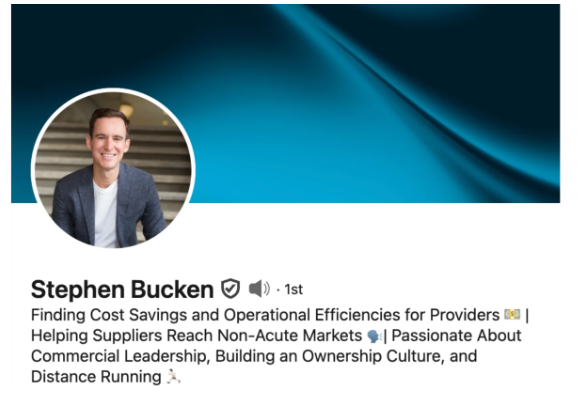
Your headline follows you all over LinkedIn.
People see it when you comment. They see it in search results.
They see it when you send connection requests. They see it before they ever read your About section.
And yet so many people waste it on this:
Account Executive at GrowthWorks
Cool. What does that tell your buyer?
Basically nothing. Instead, tell me what you help accomplish.
For example: Helping Logistics Leaders Eliminate Costly Bottlenecks with Supply Chain AI
Now I understand who you help and why I should care.
If you want a deeper walkthrough, I wrote more about fixing your LinkedIn headline here.
2. Rewrite your About section for your buyer
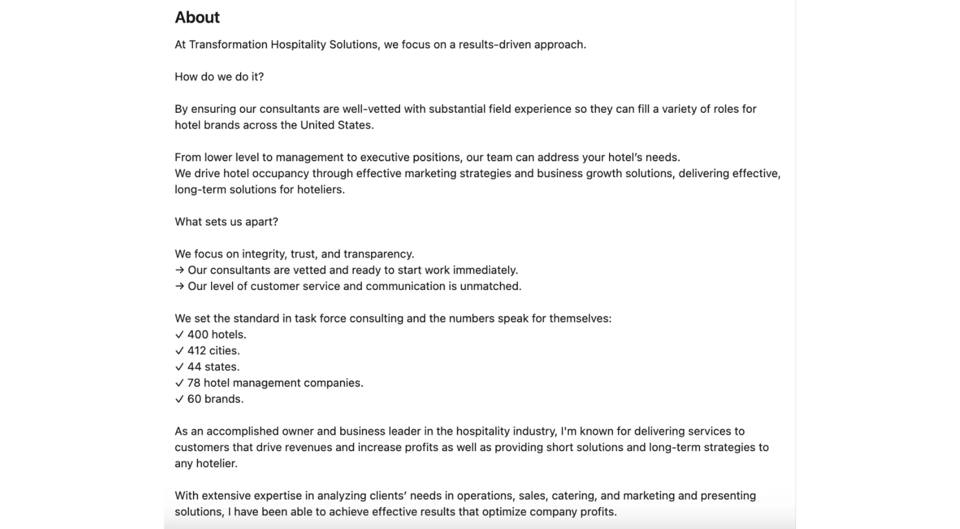
Your About section should not read like your résumé.
I repeat this constantly when I'm training sales teams.
Stop making the entire thing about you.
Yes, it's your profile. Yes, your story belongs there.
But if you're using LinkedIn for business development, the beginning of your About section needs to connect your expertise to the person you're trying to help.
And then tell people what to do next.
Send you a message. Visit your website. Check out a resource. Connect.
Whatever makes sense.
Don't make people work to figure out the next step.
3. Turn your Experience section into proof
Your experience section shouldn’t read like a job description. It should have an impact.
For each role, you should include:
- Who you helped
- What problem they face
- What results you delivered
- How you got there
Show, don’t tell. Use metrics wherever possible to make the impact of your LinkedIn Experience section clear.
Use it.
Don't forget your Featured section
Your Featured section is basically free sales enablement sitting in the middle of your LinkedIn profile. Use it.
You can feature: Case studies. Client success stories. Your best posts. Videos.
Podcast interviews. Webinars. Useful resources. Your website. An offer.
Anything that helps your buyer understand what you know, how you think, or what results you can create.
And refresh it periodically.
If you're still featuring the webinar you promoted 14 months ago while your best case study is buried somewhere on your website, fix that.
Your profile should make research easy for your buyers.
Remember, B2B buyers want to educate themselves.
Help them do it.
Your LinkedIn profile should evolve as your positioning evolves
Most LinkedIn profiles are static.
Someone optimizes the profile once. Checks the box. Moves on.
Meanwhile, their business changes.
Their customers change. Their expertise grows. Their messaging gets sharper. Their results improve.
And LinkedIn is still showing an old version of them.
That's a missed opportunity.
The best LinkedIn profiles are living assets.
They evolve with your business.
I see this constantly when working with sales teams and founders.
Someone updates their profile, and suddenly their outreach works better.
Why?
Because the prospect gets the email or connection request, checks the profile, and the story matches.
Your LinkedIn profile isn't separate from your outbound strategy.
It's supporting it. If you want a faster starting point, run your profile through our Lumi AI Profile Builder.
It can help you generate a stronger headline, About section, and Experience section based on your audience and positioning.
Not sure where to start? Get a custom plan
Rather than guessing which sections need work, get a clear answer.
Answer a few quick questions and get a custom LinkedIn plan built for you with our free LinkedIn Strategist, or connect with me here to learn more.
Related: How To Leverage The “Kevin Bacon Effect” On LinkedIn
