


Your client may already know what they will do with their portfolio if the “wrong” party wins. They may not have told you yet. By the time they call to sell, weeks of headlines, conversations, and imagined consequences may have turned a political preference into an investment conviction.
That is why the most useful election conversation happens before the results arrive. Advisors have an opportunity to interrupt a tempting chain of reasoning: I don’t like this outcome. It will be bad for the country. Therefore, I should get out of the market. Each step can feel convincing without establishing that selling is a sound financial decision.
For resources to help you navigate these conversations and better understand the psychology of investing, explore The Emotional Investor’s advisor resources, including education, behavioral tools, and free resources.
Historical market returns offer a useful way to challenge election anxiety. But how we present that information matters. We want to broaden a client’s perspective without replacing a frightening prediction with a reassuring one.
What the History Actually Shows
The accompanying chart shows that, since 1950, the S&P 500’s average fourth-quarter return has been strongest in midterm election years: 6.6%, compared with averages ranging from 2.5% to 3.9% in the other years of the presidential election cycle.
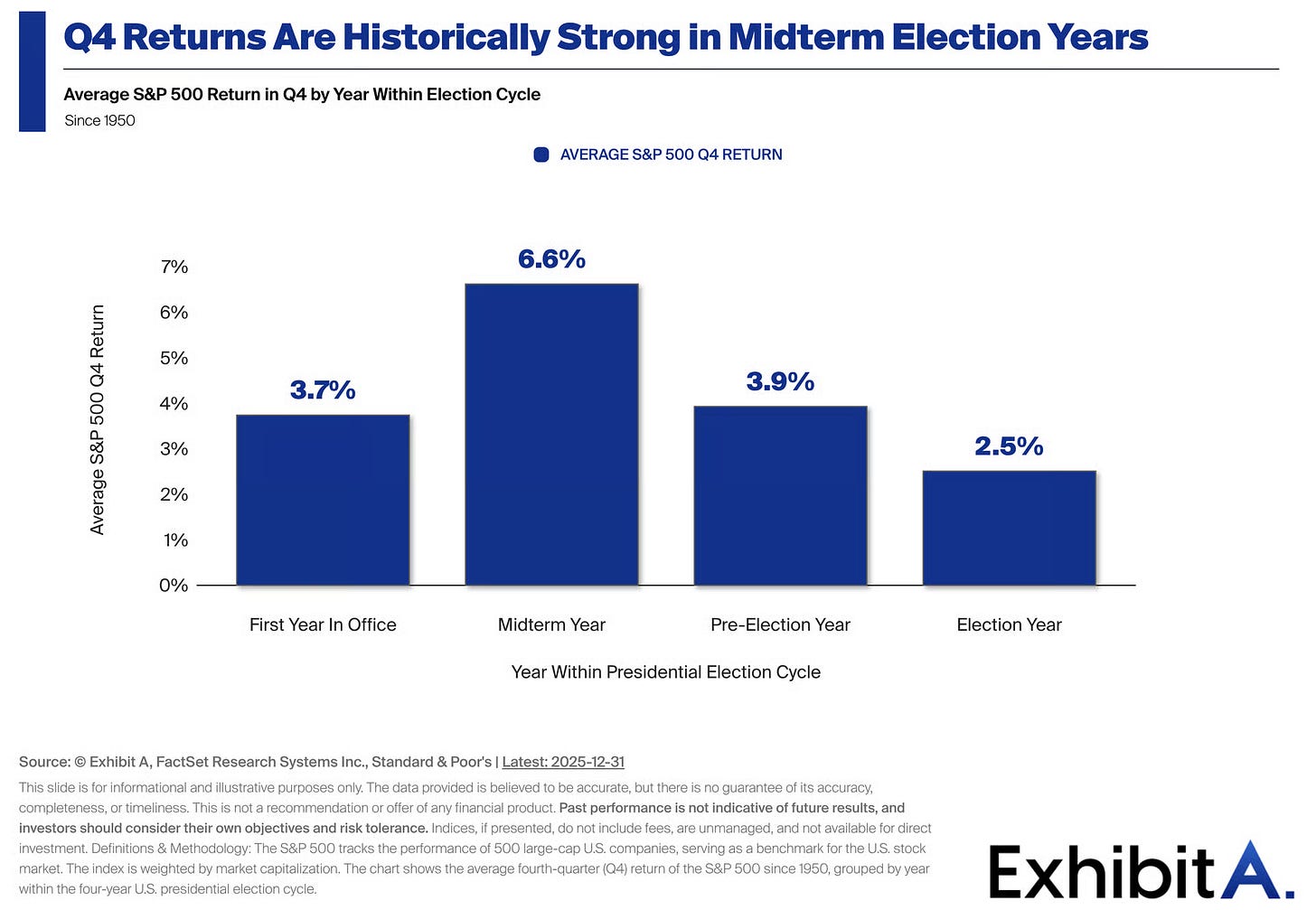
Fourth-quarter returns were positive in 16 of the 19 midterm years from 1950 through 2022—approximately 84% of those observations.
That history can be surprising to someone who assumes an election creates an especially dangerous time to remain invested. It provides a reason to question that assumption.
But it does not tell us what will happen this year.
The distinction matters. An average describes a collection of past outcomes. It is not the return investors should expect to receive in a particular quarter. Similarly, a positive result in 84% of historical observations does not establish an 84% probability of a gain this time.
The most useful message is: Election anxiety has not reliably meant poor market returns.
Don’t Replace One Forecast With Another
A worried client says, “The market will fall if they win.”
An advisor responds, “Actually, the market usually rises during midterm years.”
That may offer temporary reassurance. But if the conversation ends there, the client is still making decisions around a prediction. We have simply supplied a more appealing one.
A better response uses the data to loosen the client’s certainty:
“History gives us a reason to question the idea that an election outcome makes selling the obvious choice. It doesn’t guarantee a good quarter. Let’s look at whether anything has changed in your financial situation that would justify changing your portfolio.”
This moves the conversation toward something the advisor and client can evaluate: the client’s needs, time horizon, and ability to tolerate risk.
Historical evidence is most helpful when it opens the conversation. It becomes less helpful when we use it to close the conversation with a promise.
Why the Exceptions Matter
The fourth quarter of 2018 was one of the exceptions to the favorable midterm pattern.
Concerns extended beyond the election. Investors were weighing slowing global growth, trade tensions, and the possibility that continued monetary tightening would weaken the economy more than anticipated. The Federal Reserve’s December meeting minutes discussed these risks, including potentially greater-than-expected effects from earlier tightening.
That exception is useful because it reminds us that the market responds to many forces at once.
An election may dominate the news without dominating the economic outlook. Interest rates, earnings expectations, trade developments, and changing assessments of growth can all influence prices.
Clients can become so focused on the election that they interpret every market move through it. A decline becomes proof that their political concerns were correct. A rally becomes something temporary or irrational.
Before long, the election story becomes difficult to disprove because every outcome is made to fit it.
An advisor can help by asking:
“What else could explain what the market is doing?”
The purpose is to make room for information the client’s preferred explanation may be leaving out.
Be Careful With the Gridlock Explanation
One possible explanation for favorable midterm returns is that election results resolve some uncertainty. Divided government may also make sweeping policy changes harder to enact, which some investors could view favorably.
That is a plausible explanation, but the chart does not establish it as the cause.
Saying “the market loves gridlock” can sound more certain than the evidence allows. It also invites another prediction: if the election produces gridlock, stocks should rise.
We don’t need to prove why the historical pattern exists to use it constructively. Its value is that it challenges the assumption that political disappointment must lead to investment disappointment.
Ask What the Client Is Trying to Protect
When a client wants to sell because of an election, start by understanding the concern.
“Everything will be terrible” is difficult to discuss. A more specific fear gives you something to work with.
Ask:
- “What do you expect this outcome to change?” Is the concern about taxes, inflation, regulation, economic growth, or something else?
- “How would that affect your financial plan?” Help the client connect the concern to their circumstances.
- “Has anything changed in your need for this money?” A political development does not automatically change a retirement date, spending need, or investment horizon.
- “If you sell, what would have to happen for you to reinvest?” Leaving the market creates a second decision that may be even harder to make.
That final question deserves attention.
A client may believe selling will provide relief. But after selling, they still face uncertainty. If stocks rise, buying back can feel like admitting a mistake. If stocks fall, the same frightening headlines may make reinvesting feel even less appealing.
The decision to leave can create a new problem without resolving the original fear.
Give the Client a Process Before the Results
Election preparation should include an agreement about how investment decisions will be made.
You might say:
“You may feel strongly about the outcome, and we can talk about those concerns. Before making a portfolio change, let’s review what it would accomplish for your plan, what risks it would introduce, and what would guide the next decision.”
That gives the client a useful action to take when emotions rise: contact you and review the decision together.
It also leaves room for legitimate changes. A new policy may eventually affect a client’s taxes, business, or planning needs. Those developments deserve analysis when the details become clear.
The standard is whether a change serves the client’s financial goals.
Clients do not have to feel optimistic about an election to follow a sound investment process. They can hold strong political convictions and still recognize the limits of what those convictions tell them about future returns.
Our role is to help them preserve that distinction—especially when it feels hardest to do so.