


AI-Heavy Stocks Are Heading South
The Nasdaq Composite has fallen by 8% since it peaked on October 6th with companies investing heavily in AI leading the decline. Nvidia is the heavyweight of AI heavyweights. Over 90 percent of its revenue comes from data centers, with AI accounting for much of that business. Nvidia’s stock is down 13% since October 6 — an average decline of a half percent per day.
This week, Google put that pace to shame. Its stock dropped by 13% between 10 AM Thursday and 4 PM Friday, wiping out $500 billion in shareholder value. The primary culprit, in the FT’s telling, was Google’s Wednesday quarterly report, which revealed the company had invested an additional $51 billion in AI in the prior three months and planned to make even larger AI investments in the near term. Shareholders responded by hitting the sell button, effectively telling Google management that it viewed investing one more dollar in AI as no different from shredding ten.
Oracle — the Oracle of AI Financial Doom?
Oracle jumped on the AI bandwagon, hook, line, and sinker starting in 2023, borrowing massive sums, on and off the books, to build and lease ginormous data centers. Its off-the-books borrowing is run through SPVs. As we saw in the run-up to the Great Financial Crisis, the special purpose of Special Purpose Vehicles is to hide the bacon, i.e., what a company actually owes. This, of course, is shades of Bear Stearns’ implosion within a year of its two highly leveraged SPV “hedge” funds, specializing in subprime mortgages, collapsing.
As Oracle jumped on the bandwagon, investors jumped off. The company’s current share value is half of what it was a year back. As for its debt, S&P Global rates it at BBB, just over junk. Yes, the market believes Oracle can live another day. Its $400 billion market cap is down, but hardly out. But this valuation rests, in large part, on the success of a single customer, OpenAI.
OpenAI has placed data-service orders from Oracle totaling some $300 billion. But what if the extraordinary, industry-wide AI risks described in Anthropic’s newly disclosed IPO prospectus materialize? These include the risk of AI companies “practicing medicine without a license.” This is the allegation in a lawsuit filed against OpenAI for allegedly coaching, via ChatGPT, an epilepsy patient to quit her meds, which allegedly caused her death.
If, thanks to medical or financial class action malpractice lawsuits or all of Antropic’s 93 pages of other listed risks, OpenAI isn’t able to pay Oracle, Oracle won’t be able to pay the data centers, and the data centers won’t be able to pay their creditors, which, gee whillikers, include Oracle and Nvidia not to mention banks, private equity and credit funds, life insurance companies, pension funds, sovereign wealth funds, endowments, and, well, who knows.
The exposure of life companies to private equity and private credit funds invested directly or indirectly in AI is particularly concerning. As discussed here, life companies issue cash-surrender policies — investment vehicles sold under the names whole life, universal life, variable life, and endowment life insurance as well as fixed deferred and variable deferred annuities. Unlike checking and savings accounts issued by banks, these policies aren’t insured by the FDIC. But like demand and time deposits, investors have the option to demand back (run for) their money.
In the insurance context, this means surrendering, i.e., cashing out, your insurance policy. So, if AI heads south leading private equity and credit to head south, life and annuity cash-surrender policyholders may run to cash out their policies. No one knows the size of uninsured cash surrender policies. The American Council of Life Insurance (ACLI) won’t tell you. But today’s total appears to be well north of $6 trillion — the 2008 total privately disclosed to me by a top ACLI official when I was writing my book, Jimmy Stewart Is Dead. In short, just as we saw totally unexpected cracks in financial dikes open in the Great Recession, we can expect a crash of AI-heavy tech companies to burst lots of dams, some quite massive.
To summarize, the roughly $2 trillion post-2020 AI investment boom has created a chain of incestuous financial obligations whose ultimate repayment depends on a small number of companies generating extraordinary future revenues. If those revenues don’t show up? Well, we’ve seen this movie before. Stocks can drop and keep on dropping. In January 2007, Bear Stearns stock was valued at $172 a share. Fourteen months later Morgan Stanley purchased the nation’s 85-year-old, storied bank for $2 a share.
I’m certainly not the only financial pundit raising the AI alarm. Read this discussion by fabled financial analyst, John Mauldin. Pay particular attention to this discussion of Coreweave, the neocloud AI provider. The market now wants 11% to insure Coreweave’s debt.
Anthropic’s and OpenAI’s IPOs
Anthropic will go public in just over two weeks at a projected market value of $1.5 trillion. That’s very rich for a company that has yet to make a profit, reported an $81 billion loss for the first half of the year, and spent a third of its 300-page IPO prospectus describing risks that included Claude’s potential for causing “catastrophic or existential risks to humanity”. I’m
OpenAI is also going public next year. Its asking price is a modest $1.25 trillion. That’s ambitious given it too has yet to make a profit, is hoping 2026 losses won’t exceed $17 billion, and is currently having trouble raising more than $11 billion of the $30 billion targeted in its current funding round.
Competing with AI Models that Are Free
In September, Bain & Company projected that AI would need to generate $6 trillion in annual revenue to justify its assumed annual $1.5 trillion in investment. That’s over 11 times the industry’s current revenue. But revenue is not profits. And its expected future profits that underlie AI’s tremendous equity valuations. The elephant-in-the-room question is how US AI companies will make tremendous profits when there are 8 US, 11 Chinese, and 17 non-US and non-Chinese large-scale AI models competing with one another. Roughly 25 of these 36 models are open weight meaning anyone can download and use for free the models’ billions of parameters, indeed, use them to build their own models. DeepSeek, one of China’s most powerful AI engine, is open weight. It’s hard to see why the market would spend $6 trillion a year paying for something it can get for free.
The Greatest Recession of 2027
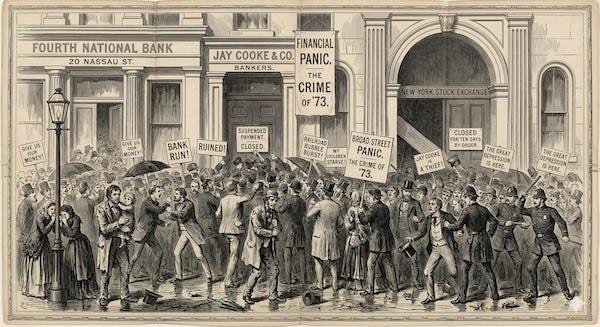
As the brilliant, in both the British and American senses of the word, Paul Kedrowsky makes clear in this Economics Matters podcast, infrastructure overbuilding has characterized essentially all tech revolutions, including railroads, electricity, automobiles, radio, airlines, the internet, fiber, solar, and semiconductors. AI tokens, whose price has fallen in half this year is just the latest example. Many tech-capacity overbuilds have led to spectacular stock market declines. Massive overbuild of railroad track lead to the Panic of 1873 and The Long Depression and the Panic of 1893 and The Depression of 1893.
What Fraction of Gamblers Keep Gambling After Doubling Their Money?
Gemini’s answer to this question, based on this and other studies, is over 99%! Its explanation? Winning is intoxicating and addictive. ChatGPT differs. Its answer is less than 5%. Claude suggests it’s less than 50%. Muse says it doesn’t know.
The S&P is now twice as high as it was on January 5th, 2023. So, given dividends, had you invested $1000 back then and kept your money on the table, you’d have doubled your money. Gemini says two things are running through your brain. First, you think your gain isn’t yours. It’s the house’s. This is the so-called House Money Effect, which entails believing that you are playing with the S&P’s money, not your own money. Second, extra dopamine is running through your brain.
In short, many if not most of us are partially if not wholly addicted to the stock market — the stock market whose close-to-all-time-high current valuation is roughly 45 percent based on the success of AI — AI that can’t agree, from one four hundred-billion-parameter model to the next, whether the answer to a simple question is 99%, 5%, or no clue! As for answering tough personal finance questions, read this column and its links.
Financial Methadone — TIPS (Treasury Inflation-Protected Securities)
I’m not a financial adviser and I’m not authorized, certified, or otherwise approved to provide financial advice. In particular, I don’t have one of FINRA’s (The Financial Industry Regulatory Authority’s) recognized 130 certifications, including CFP, RIA, CFA, CIMA, CPWA, CIC, and CIRP. EPhDs (Economics PhD) isn’t on this list.
What I do have is an economics-based personal financial planning software company, which I founded in 1993. Last year, our program, MaxiFi Planner, was named “Best Personal Financial Planning Software” by Bankrate. The program has been used, over the years, by tens of thousands of households. It’s being taught to graduate students in finance at MIT, hordes of undergrads studying personal finance at Harvard and (this Spring) at Boston University, and is being used by an increasing number of professional advisers — All for a reason. As discussed here, economics financial suggestions are based on a century of economic science developed by the fathers of finance. Its principles and answers are night and day different from those provided by Wall Street’s conventional financial planning.
Let Economics, Not Wall Street, Help Secure Your Financial Future
I suggest you give MaxiFi a try. We offer a free, two-week trial of a simplified version of MaxiFi. Sign up with your credit card and cancel within two weeks if you don’t wish to convert to the full version. (Cancel by clicking Account or contacting customer support here.)
But the real reason I want you to try MaxiFi, actually the full version — is to analyze your holdings in the stock market and compare them with holding TIPS — US treasuries that are protected against inflation. This article, which has had over 54,000 views, shows that, given their exceptionally high current yield, a TIPS ladder — a portfolio of TIPS, which when held to maturity, will secure your future living standard. (This assumes Uncle Sam doesn’t default on federal debt, which is extremely unlikely since it would implode the global financial market.)
Risky Investing Is an Option, Not a Starting Point. The Starting Point is Safety-First Investment
Nothing in economics remotely suggests you need to invest in the stock market, let alone this stock market, which seems poised to crash and burn. Nothing in elemental finance, let alone the track record of stock markets, guarantees that a market crash will be followed by a rebound any time soon. The Japanese stock market peaked and crashed in 1989. Thirty years later it was worth 55 percent of its 1989 value measured in real Yen.
Your Option — Invest in AI Safely by Holding TIPS
As I discussed in this column, the yield on TIPS appears to be historically high for one reason only — investors are so sure that the stock market, aka the AI market, will continue to excel that bonds of all types have to offer a high yield (sell for a low price) to compete. You can now lock in an above 3% real return on 30-year TIPS and, thus, effectively lock in the high expected return on AI without taking on the risk of an AI-driven stock market crash.