


**Karin, “It’s not that my team is resistant to change. In fact, it’s almost the opposite. It feels like all we’ve been doing is changing. **New priorities. New systems. New structures. New expectations.
And it’s not that this next change is a bad idea. I think it’s probably the right thing to do. But I’m tired. My team is tired. I’m not sure how to rally them through one more major change. What should I do?” #AskingForAFriend
We hear some version of this question in nearly every leadership development program we faciliate.
Your team may understand why the organization needs to evolve. They may even support the new direction. But after repeated reorganizations, technology rollouts, leadership transitions, shifting priorities, and demands to do more with less, their capacity to absorb another change is running low.
That’s change fatigue.
What Is Change Fatigue?
Change fatigue is the cumulative exhaustion, frustration, and disengagement employees experience when they face frequent, overlapping, or poorly managed organizational changes.
Resistance to change often sounds like:
“I don’t understand this change.” “I don’t agree with this change.” “I don’t believe this will work.”
Change fatigue sounds more like:
“I understand why we’re doing this. I just don’t have the energy for another transition.”
That distinction matters.
If you treat change fatigue like resistance, you’ll be tempted to sell harder, add more urgency, or deliver another enthusiastic presentation.
But your team doesn’t need more convincing. They need empathy, clarity, capacity, agency, and evidence that their effort will lead somewhere worthwhile.
How Can Leaders Reduce Change Fatigue?
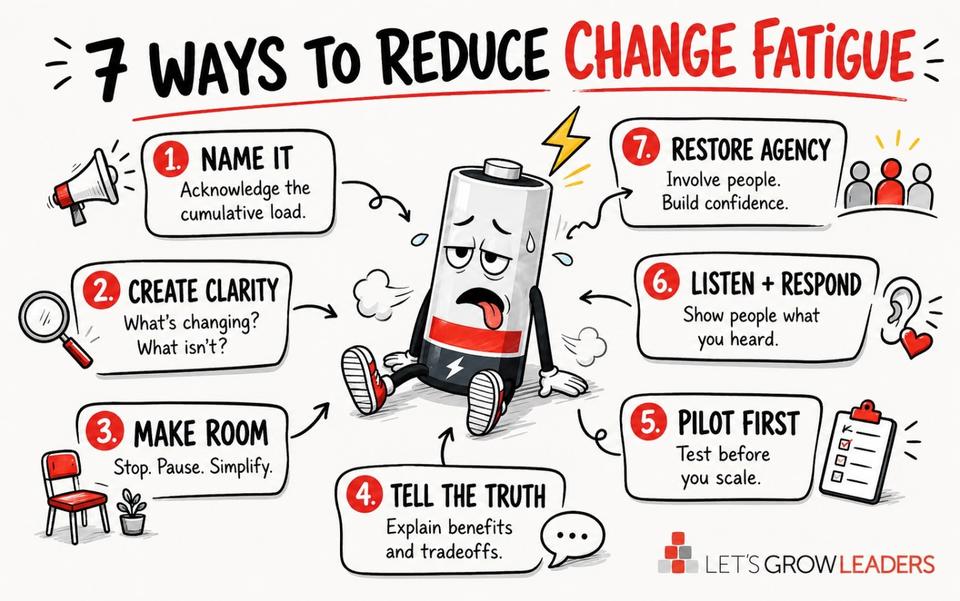
To reduce change fatigue, acknowledge the cumulative impact of repeated change, create clarity about what matters most, remove or pause competing priorities, communicate honestly about benefits and tradeoffs, pilot changes before scaling them, respond visibly to employee feedback, and rebuild confidence through meaningful progress.
Here are seven practical ways to do that.
1. Acknowledge the Change Fatigue
When your team is exhausted, the worst thing you can do is arrive with toxic positivity and a shiny sales pitch.
People know when they’re tired. They know when you’re tired, too.
Name what’s happening.
You might say:
“I know this is another significant change after a year filled with transitions. Before we talk about implementation, I’d like to hear how you’re feeling about it.”
Or:
“You’ve put considerable effort into adapting to the last several changes. I don’t want to pretend this one won’t require more from us. What concerns you most?”
Give people space to acknowledge what they’re losing.
A reorganization may disrupt relationships they worked hard to build. A new system can make experienced employees feel like beginners. A changed strategy may cause people to question whether their earlier effort mattered.
You don’t need to agree with every reaction or solve every emotion. Start by showing that you see the human impact.
And it’s okay to be authentic about your experience without complaining or blaming.
“I’m feeling the pressure of all these pivots, too. It’s a lot. I also believe we can find a thoughtful way through this together.”
Empathy doesn’t weaken your leadership. It gives people a reason to trust what you say next.
2. Create Clarity in a Shorter Timeframe
Change fatigue grows when everything feels uncertain.
You may not know exactly how the next six months will unfold. Your team still needs to know what matters today.
Help them distinguish:
- What we know.
- What we don’t know yet.
- What is changing.
- What is not changing.
- What matters most right now.
- When we expect to know more.
Narrowing the timeframe makes change more manageable.
Try:
“I don’t know exactly what the next six months will look like. I can tell you what we need to accomplish this week, what decisions have already been made, and what is still open for your input.”
Also establish a predictable communication cadence. If you can’t give people certainty about every outcome, give them certainty about how and when they will receive updates.
Silence creates a vacuum. And employees rarely fill that vacuum with the most optimistic explanation.
A consistent communication rhythm reduces unnecessary speculation and gives people a reliable place to bring their questions.
3. Create Capacity Before Adding More Change
One of the biggest causes of change fatigue is simple: organizations keep adding new priorities without removing old ones.
A new initiative is announced. The previous initiative remains. The everyday work still needs to get done. And somehow, employees are expected to absorb all of it with the same time, staffing, and energy.
Before asking, “How do we get everyone excited about this change?” ask:
“What are we going to stop, pause, simplify, or do differently to make room for it?”
Every significant new yes requires a conversation about what becomes no, not now, or no longer necessary.
Get clear about the Most Important Thing. Which outcomes genuinely matter most? Which activities directly support them? Which meetings, reports, projects, or approval processes can you eliminate?
You might tell your team:
“This new priority matters. And I don’t expect you to simply pile it on top of everything else. Let’s identify what we can stop or adjust to make room for it.”
If you can’t remove the work yourself, advocate upward. Show senior leaders the capacity tradeoffs and ask for a decision.
Protecting your team from conflicting priorities is not resistance to change. It is responsible leadership.
4. Tell the Truth About the Benefits and Tradeoffs
Leaders often lose credibility by trying too hard to make every change sound wonderful for everyone.
Of course, employees want to understand what’s in it for them. But most also care about what the change means for their coworkers, customers, leaders, and organization.
Give them the whole story.
Explain:
- Why the change is necessary.
- Why it is happening now.
- Who will benefit and how.
- What could happen if nothing changes.
- What will be difficult.
- What tradeoffs you considered.
- What safeguards or support you’re putting in place.
If the primary benefit is greater efficiency, say that. If the organization needs to reduce costs, be honest. If a new AI tool could make some work easier while also requiring careful human review, explain both realities.
Don’t manufacture a cheerful “what’s in it for you” story that ignores legitimate consequences.
People are far more likely to trust a difficult truth than an obvious spin.
5. Pilot the Change Before You Scale It
Sometimes change fatigue is not caused by too much necessary change. It’s caused by too much poorly planned change.
Employees become cynical when leaders repeatedly launch half-baked initiatives, overlook predictable problems, and then quietly replace them with the next big idea.
Think the change through before asking everyone to adopt it.
- Test it with a small, representative group.
- Include people who will use the process every day.
- Ask what could go wrong.
- Establish quality and customer-impact safeguards.
- Take the feedback seriously.
- Improve the approach before expanding it.
Don’t limit your pilot to the most enthusiastic early adopters. Include a few credible skeptics and people whose work will be most affected.
If the change doesn’t work in the real world, you want to know before thousands of employees are frustrated by it.
Piloting may feel slower at first. But a thoughtful test builds confidence, uncovers hidden obstacles, and prevents the exhausting cycle of launch, failure, apology, and relaunch.
Sometimes you need to go slow enough to go fast well.
6. Build Listening Posts—and Show What You Heard
An employee survey at the end of implementation is not a listening strategy.
Create simple, accessible ways for people to share what is working, what is creating friction, and what needs attention. For example, a curiosity tour is a great approach to learn what's going on.
Your listening posts might also include:
- Brief questions during team meetings.
- Manager check-ins.
- Office hours with change leaders.
- Cross-functional employee groups.
- Pilot-team feedback sessions.
- A shared channel for questions and recurring issues.
- Short pulse surveys at meaningful milestones.
Ask:
“What’s working well that we should build on?”
“Where is this change making the work harder than it needs to be?”
“How can we address this concern and still accomplish the purpose of the change?”
Then close the loop.
Tell employees:
- What you heard.
- What you learned.
- What you changed.
- What you cannot change—and why.
- What happens next.
Use your 5×5 communication approach: reinforce the most important messages five times, five different ways.
Listening without visible response increases cynicism. People conclude that leadership asked for feedback to create the appearance of inclusion—not because anyone intended to act on it.
7. Restore Agency and Build Confidence Through Progress
No one wants change done to them. Even change done “for them” can feel disempowering.
With them goes much further.
Be clear about what has already been decided and where your team has meaningful influence.
You might say:
“The decision to adopt this system has been made. What we can shape together is how we implement it, what support people need, and how we identify problems early.”
Ask employees:
- What is already working that we should preserve?
- What would make implementation easier?
- What risks should we prepare for?
- What support or training would be most useful?
- What is one improvement we could test immediately?
- What do you suggest we do next?
Then create a few confidence bursts—small, visible signs that the team can make the change work.
Celebrate practical progress, not just final outcomes. Share stories from credible employees, especially those who were initially tired or skeptical.
A respected supervisor explaining, “I wasn’t convinced at first, but this adjustment saved my team three hours last week,” will have more influence than another polished slide from the project team.
The goal isn’t to pressure employees into providing testimonials. It’s to make genuine progress visible so people can see that their effort, feedback, and learning are making a difference.
Change Fatigue Requires Leadership, Not More Motivation
You can’t eliminate the need for change. Markets shift. Customer expectations evolve. Technology advances. Strategies need to adapt.
But you can change how people experience change.
Start with connection by acknowledging the human impact. Create clarity about what matters now. Stay curious about concerns, risks, and better possibilities. Build commitment with meaningful ownership and specific next steps.
Most importantly, don’t ask exhausted people to absorb infinite change through personal resilience alone.
Create capacity. Remove conflicting priorities. Respond to feedback. Show people that their effort leads to learning and progress.
Your team may not be resisting the future.
They may just need a more human-centered way to get there.
Frequently Asked Questions About Change Fatigue
What causes change fatigue at work?
Change fatigue is often caused by frequent or overlapping initiatives, unclear priorities, poor communication, inadequate resources, limited employee involvement, and repeated changes that never seem to produce meaningful results. It becomes worse when leaders add new work without eliminating old expectations.
What is the difference between change fatigue and resistance to change?
Resistance to change usually involves concerns or disagreement about a particular change. Change fatigue is cumulative exhaustion caused by experiencing repeated transitions. An employee can believe a change is necessary and still feel too depleted to embrace another major adjustment.
Is change fatigue the same as burnout?
They can overlap, but they are not identical. Burnout can result from chronic workload, stress, or lack of support across many aspects of work. Change fatigue is specifically connected to the cumulative demands of repeated organizational transitions, shifting priorities, or poorly managed change.
How can managers recognize change fatigue?
Common signs include declining enthusiasm, cynicism about new initiatives, slower adoption, reduced participation, frustration with shifting priorities, increased mistakes, passive compliance, and comments such as, “This will be replaced by something else next month.”
How can leaders reduce change fatigue when the organization cannot slow down?
When the pace of change cannot decrease, leaders can reduce the burden by clarifying priorities, sequencing implementation, eliminating unnecessary work, creating predictable communication rhythms, involving employees in how changes are implemented, and providing sufficient training and support.
What should a leader say to a team experiencing change fatigue?
Acknowledge the cumulative impact and avoid overselling the new initiative. You might say:
“I know this is another significant change after an already demanding year. I want us to be thoughtful about what we stop, what support you need, and how we implement this without creating unnecessary strain.”
Related: Your Senior Team Isn’t Avoiding Accountability—They’re Avoiding Risk
