


Written by: Will Smith and Scott Schachter
Investors concerned about market turbulence don’t have to sacrifice return potential to reduce risk. Historically, short-duration high-yield bonds have delivered returns neck-and-neck with those of the broader high-yield market but with substantially less volatility. The recent rise in yields makes today an especially compelling entry point.
A Stronger Historical Risk/Return Trade-Off
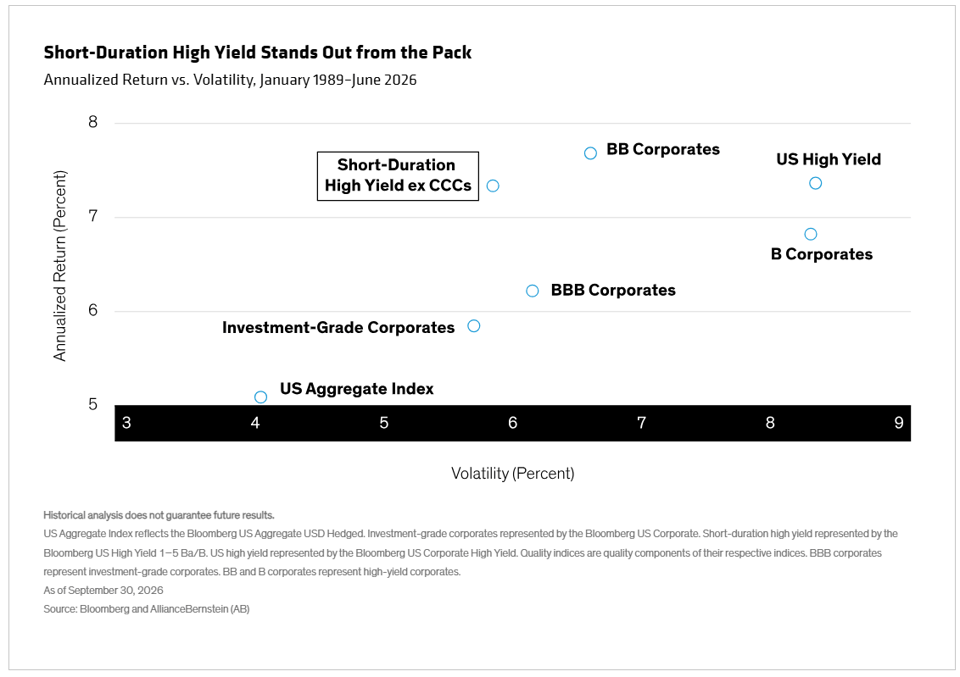
For income-oriented investors looking to keep a lid on volatility, short-duration high-yield bonds have a strong track record. Over nearly four decades, short-maturity high-yield bonds (ex CCC-rated debt) generated returns on par with the broader high-yield market—but with just two-thirds of the volatility. Short-duration high yield even outperformed investment-grade BBB-rated corporates on both measures (Display).
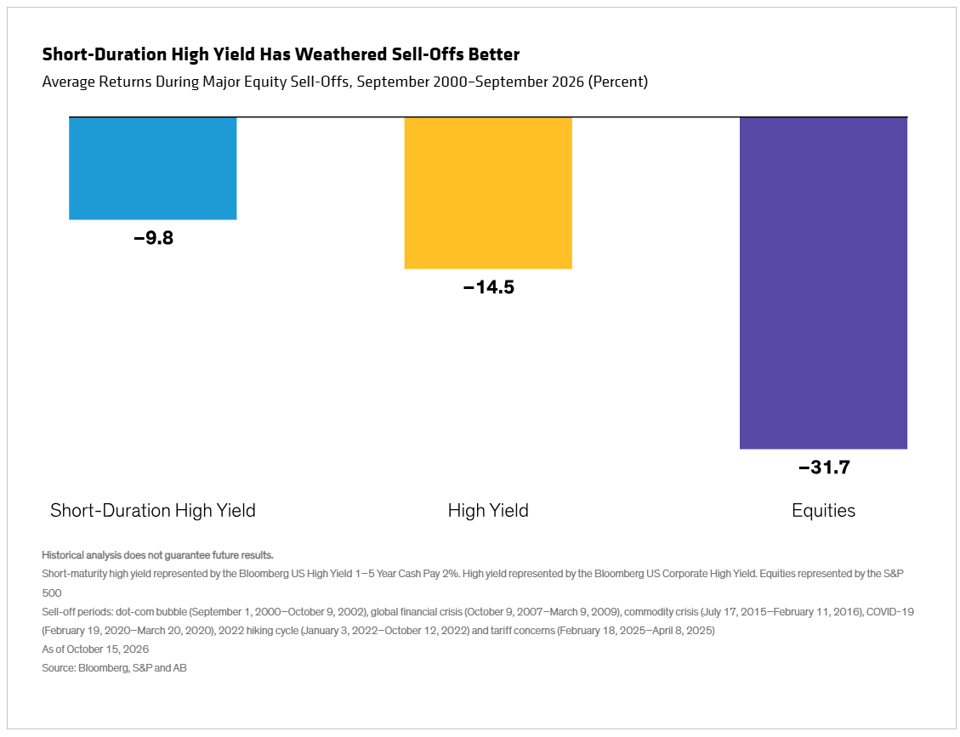
But short-duration high-yield bonds really come into their own during periods of extreme market stress. Across major sell-offs, short-duration high yield historically experienced around two-thirds of broader high yield’s average drawdown and less than one-third the decline of equities (Display).
Cutting Risk on Two Fronts: Maturity and Quality
Two areas of the high-yield bond market have been outsized sources of volatility historically, as well as in 2026: long-duration bonds and the lowest-rated credits. Limiting exposure to longer bonds and CCC-rated debt may help investors capture much of high yield’s return potential while limiting downside risk.
Long-duration bonds are more sensitive to rate and spread changes; thus, shorter-duration bonds provide a potential buffer against market turbulence both when rates rise and when spreads widen. Shorter-dated credits also give investors better visibility into near-term financial risks, allowing them to more easily avoid bonds that might default.
The lowest rung of the high-yield universe carries meaningfully more default risk, with CCC-rated credits historically accounting for around 80% of defaults. As of September 30, more than 20% of CCCs traded at distressed levels, with spreads of 1,000 basis points or more—implying significant potential default risk and underscoring the need for stringent due diligence and strong, research-driven conviction when identifying attractive opportunities in this rating bucket.
Yields Above 8% Create an Attractive Entry Point
The recent backup in yields makes this an especially compelling time to consider short-duration high yield, in our analysis. In late September, the Bloomberg US High Yield index climbed above the 8% yield threshold for the first time since April 2025’s “Liberation Day” sell-off. The recent back-up in yields was driven mostly by the increase in Treasury yields; widening spreads accounted for only 25% of the move higher, with the lion’s share driven by CCC-rated debt.
It’s rare for the benchmark yield to reach this level. Since the global financial crisis, the US high-yield index has crossed above the 8% threshold only eight times, including recently (Display).
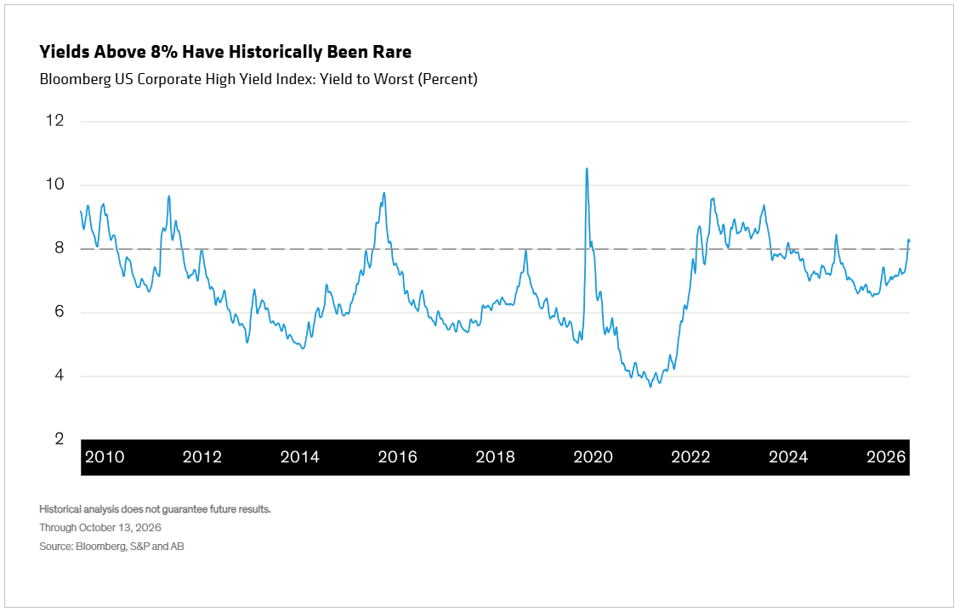
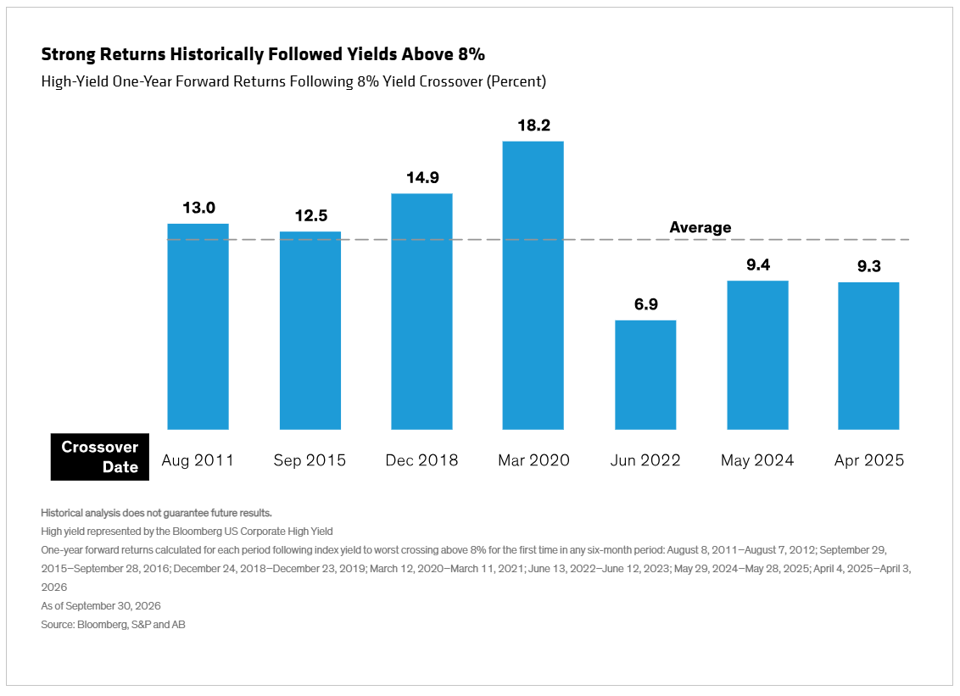
As we see it, this 8% threshold is significant and could trigger potential buyers to shift into the asset class. Historically, returns for the year following a crossover above this threshold have been exceptionally strong, averaging 12% (Display). Further, yield to worst has historically been a good predictor of future returns over the following five years.
Pursuing attractive returns doesn’t require assuming undue risk. By selectively emphasizing shorter maturities and higher-quality credits, investors can lock in today’s high yields while keeping potential volatility and drawdown risk in check. In today’s high-yield market, shorter may indeed be smarter.
Related: How to Stop FOMO From Driving Your Investment Decisions