


In a week full of palace intrigue, Nvidia’s star CEO departed and Nvidia’s meteoric stock ran aground. Jensen’s rockstar status and Nvidia’s record as the world’s most successful company atop the world’s largest technological revolution have the world’s investors asking, “After such a cascading decline, is now the time to buy?" Great question! Read on for the answer.
The Full Story
In case you missed it, Jensen Huang, the CEO of Nvidia and patron saint of AI, resigned this week after a Tom Clancy novel series of unfortunate events. I’ll leave the telling of that tale to more gifted fiction writers and respond with facts to the many inquiries I received from our investors asking whether we could or should profit from the pain. Leaving the moral opining for others, here is my investment opinion:
Since the end of September, Nvidia has lost nearly $2 trillion or roughly a third of its market value.
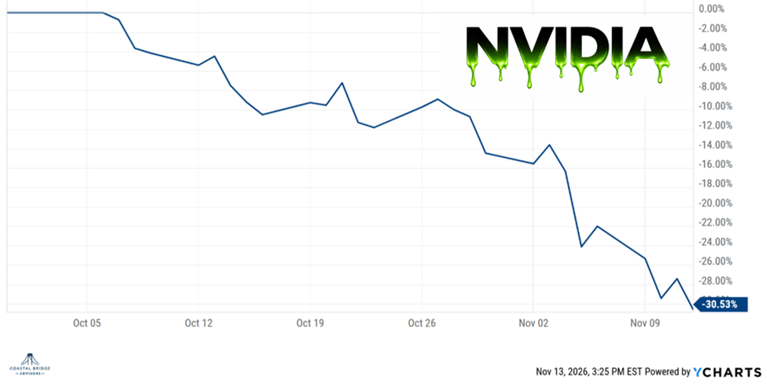
Keen chart watchers will note that the Chinese spy story didn’t break until October 29th, well into Nvidia’s drawdown. Either the spy scandal wasn’t unknown or what was known wasn’t very encouraging. I suggest it’s the latter. While Nvidia’s revenues and profits have surged over the past two years, its margins have flatlined:
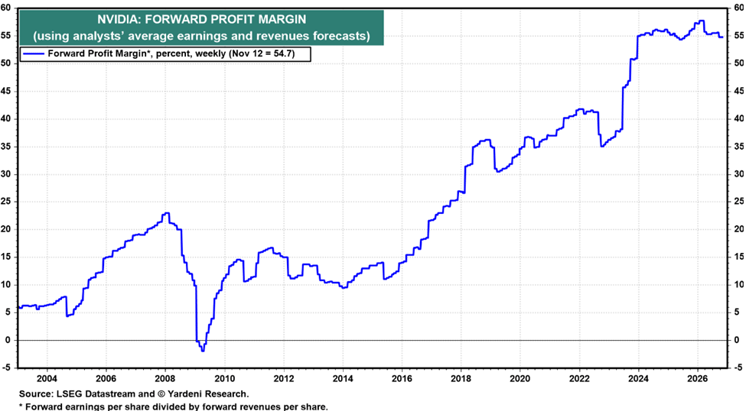
Between 2016 and 2024, the best expression of Nvidia’s financial dominance was its evolution from being a semiconductor stock with 10% margins to becoming the AI juggernaut with 55% margins. With their relentless innovation, CUDA software supplement, and an asset light structure, perhaps Nvidia has reached a sustainable and heroic plateau where it keeps 55 cents of every $1 sold, or perhaps these juicy margins simply invite incumbent or upstart competitors to squeeze.
Price to earnings ratios reflect confidence in future earnings prospects. Let’s examine Nvidia’s P/E trend:
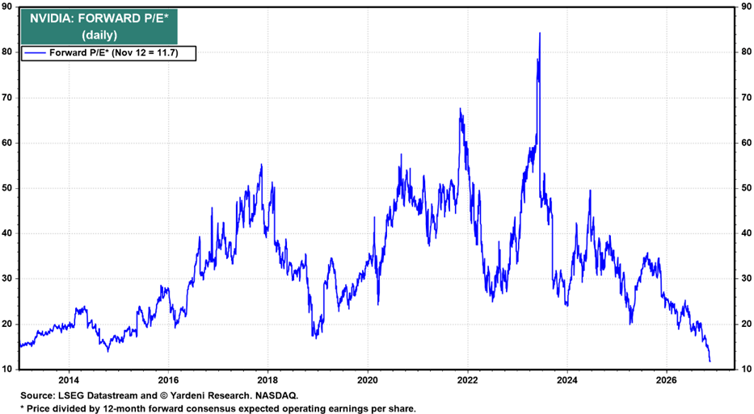
Note that confidence in Nvidia’s prospects as expressed by its P/E ratio has fallen consistently since the end of 2025, well before the Chinese spy story broke. Either the market anticipated Jensen’s moral failings, or the market repriced Nvidia back to being a semiconductor stock from being an AI juggernaut. In other words, Nvidia already had a set of mounting problems before Jensen’s set of mounting problems.
Sadly, Jensen isn’t the first CEO removed for alleged bad behavior. In some previous instances, forward stock performance lagged as leadership reformed:
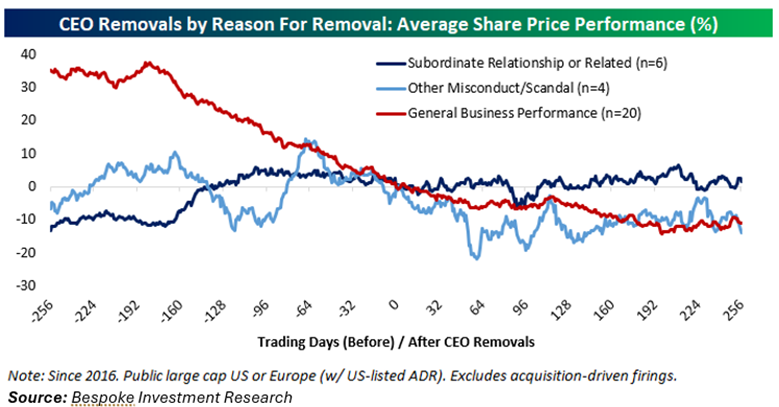
Colette Kress now leads Nvidia having been promoted from CFO. While Jensen achieved rockstar status as an aggressive entrepreneur, Colette has achieved respected status as a disciplined financial manager. Jensen’s departure led to a rapid 15% discount in the stock, Colette’s management from here will directly drive stock performance. Unfortunately for Colette, expectations couldn’t be higher. Over the next twelve months, analysts estimate Nvidia’s earnings will grow 75%. Over the next five years, analysts expect Nvidia’s earnings will grow 50% per year, on average. While those numbers may befit a category killer with a rockstar at the helm, I suspect a company under competitive threat, investigative burden, and less aggressive stewardship may disappoint. Furthermore, Nvidia’s rise to becoming the most valuable company in history, paired with its ethos of employee ownership, may have created more millionaires than any company in history. A recent report proposed that half of the staff may have net worths above $25 million. Should confidence wane, insider departures or stock dispositions could create internal selling pressure and a negative talent cycle, further burdening share values. After a meteoric rise for Nvidia, gravity may now be the better bet.
Play this Way
For those prone to play Nvidia anyway, I have a suggestion. Overlooked announcements from other technology stalwarts this week like Applied Materials, Cisco, Cerebras, and CoreWeave, reinforced the AI boom’s continuance. Each company beat estimates and raised forward guidance. AI demand continues to outstrip AI supply, supporting the macro environment, lifting the S&P 500 2.5% on the week. It’s attempting to correctly pick winners and losers in the micro-environment that raises the risks of failure. On the week, the SOX semiconductor index rose 9%, while Nvidia’s stock fell 13%. Nvidia holds a 10%+ weighting in the SOX index. Should shares recover, owners of the SOX index could be rewarded. Should they fall further, gains may transfer to other semiconductor companies as they did to Broadcom and AMD this week (up 18% and 19%, respectively).
My best advice of all… resist the urge to wager… and hire Coastal Bridge Advisors instead!