


As election season sprints to a finish, political headlines and party messaging imply that a shift in congressional control could dramatically alter the direction of the country in ways that could impact the economic and investing landscape. Investors should be skeptical of that narrative.
Prediction markets currently assign a 64% chance that Democrats will sweep both the House and Senate, with a 28% chance of the Democrats only retaking the House (as of 10/7/26). While the House shifting to the Democrats is largely expected, the Senate will be harder to predict. Regardless of the final results, the most likely outcome of the midterm elections won’t be sweeping change in policy.
No matter your political persuasion, more of the same, i.e. consistency and predictability, is good for markets.
Even if Democrats were to gain control of both chambers of Congress in the midterms, they would almost certainly fall well short of a filibuster-proof majority in the Senate. A narrow majority of 52 or 53 seats would allow them to control committee assignments and legislative priorities, but it would not provide enough votes to pass controversial legislation without bipartisan support. A new Congress would also remain far short of the threshold needed to override a presidential veto.
That significantly limits the range of potential policy changes. Proposals to reverse prior tax cuts, enact sweeping regulatory changes, or dramatically alter fiscal policy would face steep political and procedural hurdles that aren’t likely to be overcome. Anyone hoping for a major shift in Washington’s policy direction will be disappointed.
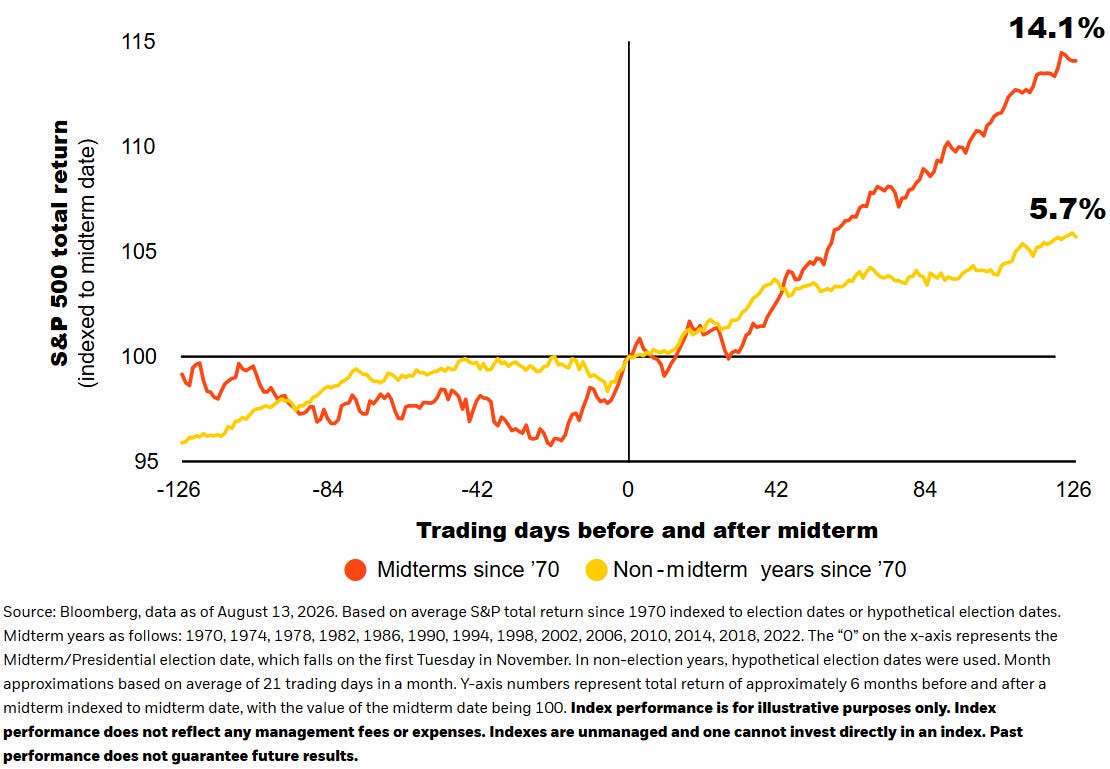
Investors, however, shouldn’t be. While midterm election years usually post weaker performance than other years, there is typically a post-election tailwind heading into the following year.
S&P 500 total return performance, since 1970 indexed to midterm date
Source: BlackRock
The same logic applies to U.S. trade policy. Congress has the authority to reclaim greater control over tariffs and trade decisions from the executive branch through legislation. In practice, assembling the votes necessary to amend IEEPA or sections of other past trade laws would be extremely difficult. As a result, investors should not expect meaningful changes to current trade policy through legislative means. If the courts step in again to weigh in on the legality of the White House’s tariff policies, expect another drawn-out fight and mixed results.
The market tends to hold its breath in the months leading up to the midterms, but surprises before and after election night can still trigger short-term volatility. If results deviate significantly from expectations, investors could see a knee-jerk reaction in sectors that are viewed as particularly sensitive to tax or regulatory policy. Small-cap stocks, for example, benefited disproportionately from previous corporate tax cuts and could face temporary pressure if investors begin pricing in the possibility of higher corporate taxes.
The key word here is temporary. Markets can and often do react first and analyze later. Rarely does all the necessary information become available to make an informed decision, but investors have to decide how to position themselves regardless.
History shows that investors frequently overestimate the speed and magnitude of policy changes following elections. Even when major legislation is eventually enacted, implementation can take years. Corporate tax changes, regulatory reforms, and trade initiatives rarely move from campaign rhetoric to economic reality overnight, and even when they do come to fruition, they are often watered down.
For long-term investors, the most important details are what the election is unlikely to change. The Federal Reserve will continue setting monetary policy based on inflation and economic conditions, and won’t be impacted by shifting congressional tides. Corporate earnings will be the primary driver of stock prices, and we’re already seeing some lift in anticipation of Q3 results. Consumer spending, labor markets, and economic growth will continue to matter far more than the partisan makeup of Congress.
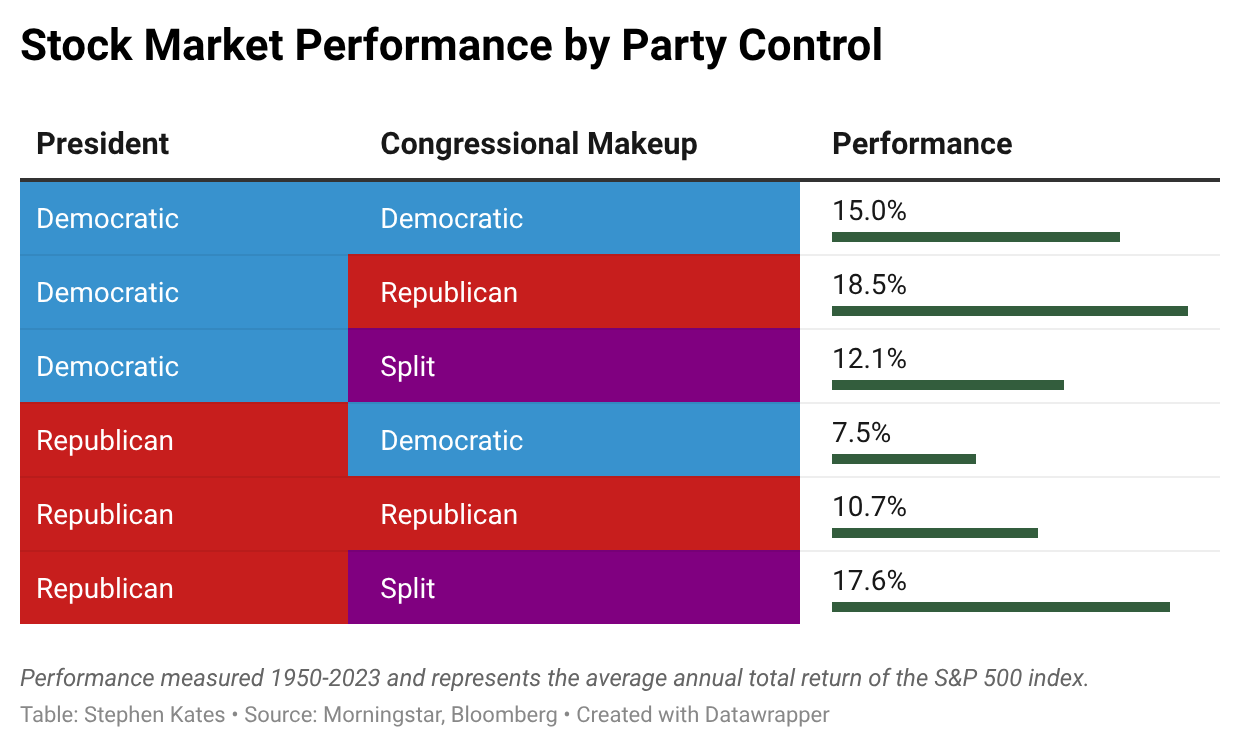
Narrowly divided government typically means less is accomplished. Ironically, that is good for investors and shows up in the historical data as one of the best environments for growth. Gridlock tends to reduce policy uncertainty, which markets generally appreciate. Businesses can make investment decisions with greater confidence when the rules of the game are unlikely to change dramatically.
The downside is that gridlock also makes it harder to address long-term fiscal challenges, which are a major risk for the US today and contributing to the sharp increase in Treasury yields. Rising deficits and a growing national debt require difficult compromises that neither party appears eager to make. Close contests mean that politicians will be less likely to make a stand on issues of real importance. The jockeying for control means neither party wants to make unpopular but responsible decisions that might jeopardize their electability.
Investors should welcome the predictability that comes from a legislative stalemate today, but the country’s debt burden remains a problem that Washington continues to postpone rather than solve. Both Congress and investors will need to reckon with looming national problems eventually, but neither national debt nor legislative changes are likely to have an acute impact on the next 12 months of performance.
Related: Rising Yields Are Testing Stocks. Can the Economy Hold Up?
