

Tesla’s profit fell 43% last quarter. The company cut its spending plans. And the stock fell on the news.
But I came away from the report more confident in Tesla’s long-term story than I was going in.
In late July, when I wrote my last Grow or Die piece on Tesla, I warned that Tesla’s profits would shrink for a while as it poured money into robots, robotaxis, batteries, and chips. That didn’t worry me then, and it doesn’t now.
The real question was never whether profits would dip dramatically. It was whether all that spending would start turning into real products while the core business kept paying most of the bills.
The third-quarter report Tesla released on Wednesday was a good test of that. Here’s what it showed.
The quick numbers
Revenue came in at $28.05 billion, flat with a year ago.
Tesla delivered 486,532 vehicles—its second straight quarter above 480,000—and way more than the 462,000 or so Wall Street expected. CFO Vaibhav Taneja said Tesla ended the quarter with its biggest order backlog in four years, and that deliveries are now limited mainly by how fast it can build.
Operating income, the profit from actually running the business, was $718 million. That works out to an operating margin of 2.6%. So Tesla kept 2.6 cents of every sales dollar after paying to run the company. That’s up from 1.4% last quarter, but down from 5.8% in the same quarter last year.
Now, about that 43% profit drop I mentioned above. Net income under standard accounting rules (GAAP) fell to $787 million as Tesla’s operating expenses jumped 39% to $4.8 billion. Much of the extra money went to research and development (R&D) for AI computing, chip development, and getting the Optimus humanoid robot, the new Megapack 3 battery, and the new Semi truck ready for mass production. Taneja said this spending will keep rising until those products are commercialized.
In other words, this is another case of Tesla choosing to spend to build a much bigger and better business for the long-term.
Free cash flow, what’s left over after running the business and paying for new factories and equipment (capex), swung to positive $1.5 billion in Q3 from negative $1.1 billion in Q2. Tesla ended September with $45.4 billion in cash and investments.
Part of that free cash flow came from Tesla spending less on capex than expected. That’s the number that spooked investors. I’ll talk about that in just a bit. First, the good stuff.
FSD: now the biggest reason people buy a Tesla
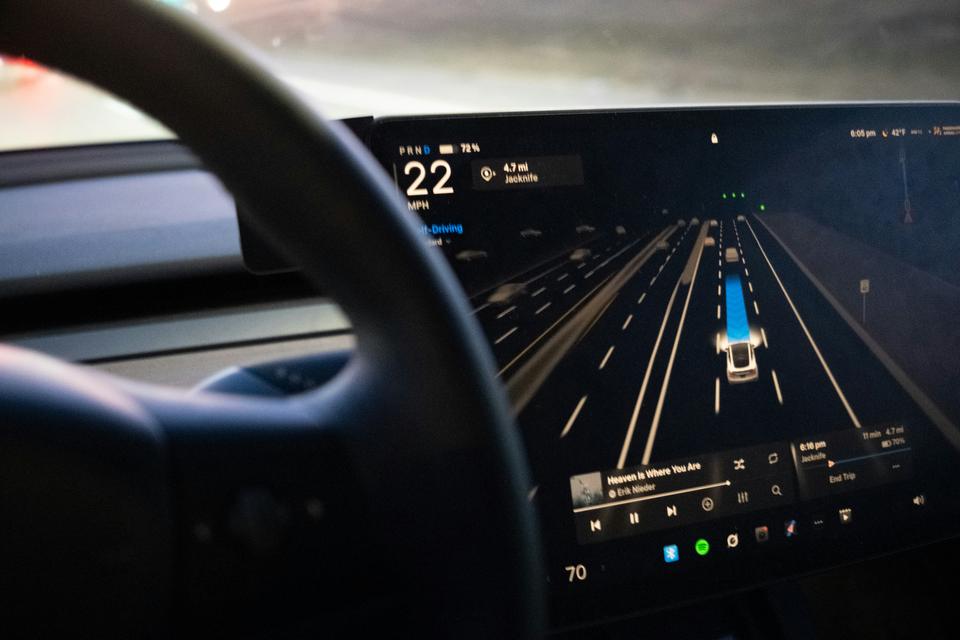
FSD (Full Self-Driving), Tesla’s autonomous vehicle AI software, has become the biggest reason folks walk into showrooms. Elon Musk said customers are essentially buying FSD with a car attached.
Regulations still require FSD to have an attentive driver behind the wheel. But practically speaking, it doesn’t need one. I know people who use FSD every day and say they haven’t had to touch their steering wheel in months.
If anyone tells you self-driving cars haven’t been solved yet from a tech standpoint, they’re mistaken.
In Q3, more than 75% of new Tesla buyers in North America signed up to pay for an FSD subscription right off the lot. That’s about 20 points higher than Q2.
Every new Tesla already comes with a free month of FSD. But three out of four buyers didn’t wait for the free trial to run out before deciding. They committed to it on day one.
Taneja said folks now walk into US showrooms asking for an FSD test drive, not a Model 3 or Model Y test drive. Musk said demand is running well ahead of production, and that FSD is the biggest reason. It’s also the reason my next car is going to be a Tesla.
Globally, more than 1.7 million customers now pay for FSD, up from under 1.5 million in Q2. And for the first time, half of them are on monthly subscriptions rather than one-time purchases.
Tesla has stopped selling FSD as a one-time purchase in most markets, so essentially all the growth now comes from monthly subscriptions. That’s steady, predictable recurring software revenue.
On the Q3 call, one analyst laid out some interesting math. He estimated Tesla makes about $7,000 of gross profit when it sells a car. FSD then adds more than $1,000 a year after that. So over a car’s life, FSD could at least double the gross profit Tesla earns from each vehicle. Taneja said those numbers were correct and that Tesla will start sharing more FSD metrics as it scales further.
The next leg of growth for FSD is international. It’s now approved in many European countries, including four more during the quarter. And Musk hopes for EU-wide approval within a few months.
Regulators control the clock here. In the meantime, Tesla is offering incentives on some cars in Europe to get more FSD-ready vehicles on the road before the broader approval lands.
Meanwhile, there’s nothing close to a competitor for FSD in any car you can buy today.
Robotaxi: the rollout is picking up steam
FSD is the product you buy. Robotaxi is the version with nobody in the driver’s seat at all.
Tesla’s unsupervised robotaxi service runs now runs in six cities. Cybercab, a two-seat car with no steering wheel or pedals, was the vehicle purpose-built for this job. It started carrying paying passengers in Austin on September 4.
In Q3 Tesla reached nearly two million cumulative unsupervised miles for its Robotaxi service. And the company says it’s seeing double-digit growth every week.
Why that’s so meaningful: If something grows 15% a week, it doubles about every five weeks. Keep that up for a few months and small numbers become very big very fast. That’s what exponential growth looks like. And Musk said the weekly mileage chart looks “like a rocket going to orbit.”
What’s next for the Robotaxi service:
- Dallas – Cybercab launches there next month
- More cities – Phoenix, Las Vegas, Jacksonville, and San Antonio don’t have firm dates but are all coming “soon” according to Tesla
- Longer hours and faster roads – The service started at 6am to 9pm and is moving to 2am. Tesla is aiming for 24/7 operation, plus highways and higher speed roads, by year-end
- Customer-owned cars join the fleet – Around Q2 of next year, Tesla expects to start letting some customer-owned cars join the robotaxi network
Musk expects Robotaxi revenue to become noticeable around Q2 2027 and “a big deal” by Q3 or Q4 2027. Tesla is not yet at its target cost of 30 cents per mile, but Taneja said he sees a clear path there as the fleet scales.
Tesla is also pricing rides below traditional rideshare. That makes sense because there’s no driver to pay, Tesla builds the car itself, and it does so at a cost that’s way below that of a Waymo.
Cybercab was designed to scale. It has 50% fewer parts than any other car Tesla has ever built. Fewer parts means fewer things to go wrong, both on the assembly line and on the road.
Optimus: real production, and an honest timeline
Musk spent more time on Optimus, Tesla’s humanoid robot, than on anything else in his opening remarks. Here’s the gist of what he said.
Tesla has started early production on its high-volume Optimus line at its Fremont, California factory. These robots are the first production-quality Optimus models Tesla has made. And most of the equipment for a line built to make a million robots a year is already on site.
That’s real progress. A year ago, Optimus was hand-built prototypes.
But Musk was straightforward about how long the next part takes. Getting that line up to full speed, about 20,000 robots a week, will take at least a year and maybe longer. And he expects Tesla to start delivering Optimus to outside customers around the end of 2027.
The hardest remaining part is the hand. Your hand is a marvel of engineering. It’s soft enough to pick up an egg, strong enough to grip a hammer, covered in sensors, and it repairs itself when it gets worn. A robot hand has to do most of that without self-repair, for thousands upon thousands of hours, without wearing out.
There’s also the brain. Tesla has billions of miles of real driving data to train FSD. There’s no equivalent mountain of data for a humanoid robot. So Tesla plans to build on the order of 10,000 to 20,000 robots and let them practice tasks over and over, in simulation and the real world. The company calls this the “Optimus Academy.”
The next milestones:
- A video within a month or two – Musk said it will show Optimus doing tasks that weren’t preprogrammed, not a canned demo
- A new chip around April – Tesla’s next-generation A15 chip is due in Optimus around April 2027. It has about 10X the computing power of the current chip. A humanoid has far more joints and possible movements (degrees of freedom) than a car, so it needs much more brainpower.
- A second factory – Tesla started building another Optimus factory in Austin, designed to make even more robots than Fremont.
The first customers will likely be industrial: dangerous or dirty repetitive jobs companies want done around the clock. Home robots come later.
Yes, Optimus is taking longer than the company originally hoped. Designing and building brand new hardware from scratch as complex as this always does. But it’s moving from prototypes to a real production line.
I think 20 years from now humanoid robots will be the biggest product and the biggest market on Earth. Lots of folks much smarter than me think the same. And Tesla has everything required to be the biggest player in that market.
Energy: Megapacks are becoming AI infrastructure
This is the part of Tesla most folks still overlook, and it may be the most important near-term story.
Tesla’s Megapack is a battery about the size of a shipping container. Utilities and other companies use it to store large amounts of electricity. Lately, the biggest buyers are AI data centers.
Here’s why. When an AI data center trains a model, its power draw can plunge about 70% in a tenth of a second, and then surge right back up. Think of thousands of houses flipping every light and appliance off and on at the same instant, over and over. Power grids hate that kind of thing. Megapacks act like shock absorbers, soaking up and smoothing out those swings.
Taneja said data center demand is “extreme.” Musk said Tesla is almost sold out of Megapacks for all of 2027 already.
A nice chunk of that demand is coming from SpaceX for use in its AI data centers. It bought $221 million of Megapacks from Tesla in Q3 and $626 million in the first nine months of the year. Tesla has also billed SpaceX for another $588 million of Megapacks that haven’t been delivered yet. And SpaceX is lining up for a lot more.
Two things about Q3’s energy numbers you should be aware of:
First, energy revenue fell 16% year-over-year to $2.9 billion, even though deployments rose 10% to 13.7 gigawatt-hours. That was Tesla’s second-best quarter ever in terms of deployments but still fell a bit short of analysts’ expectations.
Tesla said tariff-related refunds to customers were part of the revenue decline. And given the sold-out backlog through 2027, I read the deployment shortfall as a supply issue, not a demand one.
Second, energy gross margin jumped from 20.4% to 33.1%. That looks great, but we shouldn’t extrapolate it. Taneja said the jump came mainly from one-time items: tariff refunds Tesla recognized in the quarter, plus an agreement with a battery cell supplier to reimburse certain warranty costs. Tesla has said it expects energy margins in the low-to-mid 20% range over the long run, though management now says it expects selling prices and margins to keep improving as demand stays hot.
The capex cut that spooked investors
Now the number that weighed on the stock following the Q3 print.
Tesla’s capital expenditures (capex)—what it spends on factories, equipment, and computing infrastructure—were $4.7 billion in Q3. Analysts expected almost $8 billion. Tesla also cut its full-year 2026 capex guidance to about $20 billion, down from more than $25 billion. That’s a reversal. Back in April, Tesla had raised the target from $20 billion to more than $25 billion.
For most companies, spending less and generating more cash would be good news. But Tesla’s stock isn’t priced like a car company’s. It’s priced on robotaxis, Optimus, energy, and chips. Capex is one of the few hard numbers showing how fast those futures are being built. So some investors read the cut as a sign the ramp is slowing down.
Tesla’s official explanation was that it’s “managing our capital deployment efficiently.” Musk said capex is “ending up being a little lower than we anticipated.”
I see it mostly as a timing issue, a matter of how fast Tesla can physically put money to work in markets with increasingly tight supplies.
Think about building a house. You can have the money for the roof in the bank, but you can’t pay the roofers until the walls are up. Factories essentially work the same way. Equipment must be built, shipped, installed, and tested. And when a product’s design is still changing, you don’t want to buy all the tooling yet. Musk told us parts of Optimus, especially the hand, are still being refined. It would be foolish to buy a million robots’ worth of hand-making equipment when it’s still being redesigned.
And everything Tesla said on the call points to capex going up, not down:
- Taneja’s outlook – He said capex will keep expanding over the next few years as Tesla adds robotaxis, Optimus capacity, solar manufacturing, AI computing power, and a chip fab.
- New borrowing capacity – In Q3, Tesla secured the ability to borrow up to an additional $30 billion, specifically to support expected capex growth in 2027 and 2028.
- Chip fab spending – Tesla has already placed most of the equipment orders for its research chip fab. Musk said chip spending becomes “more meaningful next year” and reaches the tens of billions of dollars in 2028.
- A second Optimus factory – Construction has begun on the much bigger Austin Optimus factory.
- Tariff refunds – Tesla is reinvesting the money from tariff refunds into expanding US production.
- A bigger Q4 – Even the lowered $20 billion target implies a meaningful step up in spending this quarter compared with Q3.
In other words, I fully expect capex to ramp hard into 2027 and 2028. We should get a much clearer picture when Tesla reports Q4 early next year.
The potential SpaceX merger
On SpaceX’s Q3 call earlier this week, Musk confirmed that SpaceX and Tesla have each formed special committees of independent board members to evaluate a merger. He said he thinks it’s a good idea but can’t take part in the talks, and that a deal may not happen. On Tesla’s call the following day, he declined to say more about it.
I’ve argued for quite some time that this combination makes sense, as have many other analysts and investors who watch both companies.
Tesla and SpaceX already function less like two separate companies and more like different organs in the same body. And the ties grow deeper every quarter.
- Chips – They’re building the Terafab chip plant together in Austin. Musk said they still have to work out who pays for what, a question that gets much simpler under one roof.
- Batteries – SpaceX is one of Tesla’s biggest Megapack customers, powering its AI data centers.
- Connectivity – Starlink, SpaceX’s satellite internet service, is built into Tesla’s Cybercab. And SpaceX’s Grok AI is coming to Tesla’s cars.
- People – Tesla’s head of materials engineering holds the same job at SpaceX. Tesla’s vice president of AI software runs a joint venture with SpaceX called Digital Optimus (also called Macrohard) connecting Tesla’s physical AI (robotaxis and Optimus robots) with SpaceX’s back-end data center capacity and AI infrastructure. And engineers move between the two companies regularly.
- Ownership – Tesla already owns a small stake in SpaceX from a $2 billion investment earlier this year.
The bigger business case goes like this: Tesla builds physical AI, the cars and robots that think and act in the real world. SpaceX builds the back end those machines need to run around the clock: the data centers, the satellite internet, and soon, AI computing in orbit. One investor quoted by The Wall Street Journal argued that without a merger “the brains of everything that runs Tesla” would belong to another company.
Most analysts expect an all-stock deal, with SpaceX, the larger of the two (and where Musk controls about 80% of the voting rights compared to his 20% or so control at Tesla), as the buyer. If that happens, Tesla shares would simply convert into shares of the combined company. That’s the potential “automatic upgrade” I wrote about in July.
Again, this is not a done deal. Real hurdles remain. Tesla shareholders would have to approve it, something Musk himself called a challenge. In my view, the biggest hurdle is China. I walked through why in yesterday’s SpaceX piece.
Timing matters too. According to Bloomberg, there’s a push to announce a deal in the first half of 2027 so it can close while Trump is still in office. His term ends January 20, 2029.
I think there’s about a 90% probability that Tesla and SpaceX combine by the end of 2028.
A few more things worth mentioning
The core car business looks healthier. Automotive gross margin excluding regulatory credits rose to 18.1% from 16.3%, above the mid-teens level I’ve been watching for. And backlog is at a four-year high.
Tesla also began producing its long-awaited Semi electric truck at a factory in Reno, Nevada. A shipping group including PepsiCo and Microsoft has picked Tesla for an initial order of 2,500 trucks.
On the Terafab front, the research fab in Austin will start installing equipment in the first half of 2027, with a first test chip hoped for around May or June. Musk’s goal is useful chips in volume around the second half of 2028. That would be beyond insanely fast by chipmaking standards. Likely unprecedented. But with the combined engineering and manufacturing chops of Tesla and SpaceX, plus Intel’s (a partner in the joint venture) chipmaking know-how, who knows.
What to watch
Four main things I’m watching from here:
- Robotaxi scale, and regulators – I’m watching for the Dallas Cybercab launch next month, more cities, 24/7 service, and highway driving by year-end. Then for customer cars joining the network around Q2 2027. Federal safety regulators still have open reviews of FSD and Cybercab. Tesla has published safety data for both FSD and its unsupervised robotaxis, and I want to see updated federal safety standards for fully driverless cars. What I don’t want to see is a forced pause, a recall, or a serious accident.
- Optimus milestones – In order: the non-scripted video in the next month or two, the A15 chip around April, the Fremont line steadily ramping, and first deliveries to outside customers around the end of 2027.
- Capex turning back up – I expect 2027 capex to climb meaningfully. If it doesn’t, and the slower pace starts to look like a retreat rather than timing, that would change my thinking.
- Megapack production – Demand isn’t the issue. Production is. I want to see deployments climb as factories ramp, and energy margins hold up once the one-time boosts I mentioned earlier fade.
Final comments
I think Tesla’s stock will remain volatile.
Building cars, robotaxis, Semi trucks, humanoids, batteries, solar systems, and chips all at the same time will inherently look messy from the outside at this stage. It’s an enormous undertaking, the scale of which has never been tried before, and it’s bound to make for some messy financial results along the way.
Big visions take years to play out, and the road is never smooth. The trick is being able to identify the difference between temporary growing pains and a business that’s truly losing its way.
Personally, I remain firmly long-term bullish on Tesla, its vision, and its strategy to get there.
Related: Micron Is Up 549%. Here’s Why the AI Memory Boom May Have Much Further to Run