


In theory, investing isn’t supposed to be about what’s fashionable now. Let Vogue handle that. Equity investing should be about not only what’s working now, but will work in the future.
Blame it on human nature, but market participants, even the pros, have a tendency to get caught up in what’s hip now. That’s certainly the case with artificial intelligence (AI) stocks, a glitzy, glamorous corner of the market that has undoubtedly rewarded investors.
Well-deserved as it is, the adulation lavished upon AI equities has arguably come at the expense of sleepier investing strategies, including dividends. That’s the case with dividend growth stocks, which despite their all-weather status and other long-term advantages, are taking back seats to “sexier” segments.
Actually, it is those high-octane stocks that make dividend growth names appealing today because those two concepts can be paired for diversification and income purposes.
Consistency for the Win
The consistency offered by dividend growth stocks can even out some of the bumps that are inevitable when equity portfolios lean heavily into pure growth fares.
“Companies committed to the consistent return of shareholder value typically demonstrate quality traits like balance sheet strength and reliable cash flow, which can help them withstand economic uncertainty,” according to State Street Investment Management. “And dividend growth strategies that focus on firms that have consistently increased their annual dividend payouts each year can help investors meet market uncertainty with enhanced equity income, improved diversification, and lower market drawdowns.”
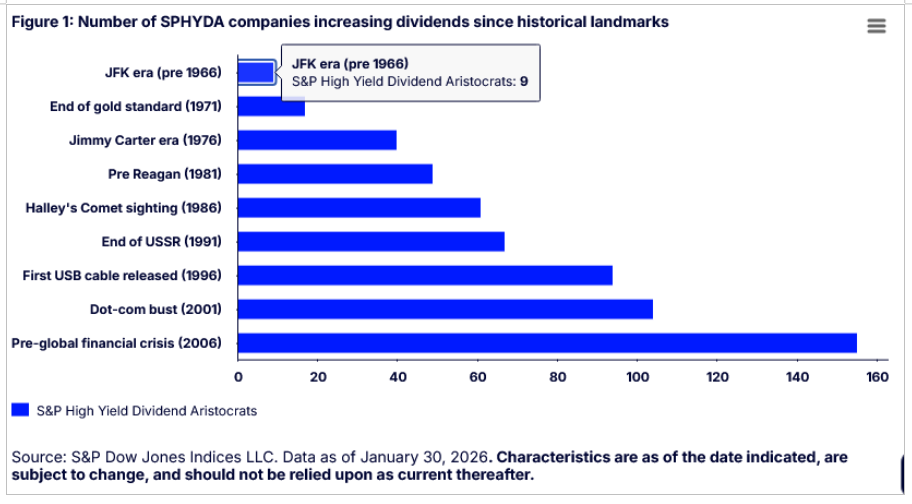
The asset manager explores the virtues of the S&P® High Yield Dividend AristocratsTM Index (SPHYDA), the underlying gauge for the popular SPDR® S&P® Dividend ETF (SDY). That index requires components to have boosted dividends for 20 consecutive years and then weights those stocks on yield. Many of the index’s 155 holdings far exceed that requirement.
(Image: State Street)
“Track records like this demonstrate these firms’ consistent ability, and willingness, to return greater shareholder value across different market regimes, economic environments, and macro cycles,” adds State Street.
In other words, SDY features the all-weather approach and durability that’s gone underappreciated amid all the AI hype.
A Good Time To Revisit Dividend Growth
At a superficial level, SDY and the SPYHDA index aren’t going to thrill anyone. Those are the breaks when a fund and its index devote 47% of their respective weights to industrial, consumer staples and utilities stocks. However, those sectors, among others, are reliable sources of dividend growth.
That’s all the more meaningful at a time when the S&P 500 yields just 1.1%, meaning it’s the income offered by the broad market gauge isn’t keeping pace with inflation. Fortunately, dividend growth has a documented track record of inflation fighting and, in the cases of SDY and its index, yield premiums over the broader market.
“But SPHYDA, given its focus on reliable dividend payers, has a trailing 12-month dividend yield of 2.8%.That rate is above the market’s historical payout and measures of inflation—indicating the potential for both enhanced nominal equity income and enhanced real equity income,” adds State Street. “SPHYDA has produced a consistent yield premium over the market—an average trailing 12-month yield of 2.8%, ranging from a low of 2.5% to a high of 3.9%.”