


Written by: Christopher Gannatti, CFA
Key Takeaways
- The WisdomTree Enhanced Commodity Strategy Fund (GCC) overweights industrial metals by 5 to 9 points versus major commodity benchmarks amid tightening copper and aluminum supply.
- Energy remains underweight in the strategy, which tilts toward refined products like diesel and gasoline rather than crude oil, based on more favorable roll yields.
- Gold fell nearly 17% from January’s highs above $5,405 an ounce before stabilizing in the low-$4,000s, reinforcing precious metals’ defensive role in the portfolio.
Ask most investors what commodities are “doing” right now and might get a one-line answer, possibly about gold. That risks oversimplifying the commodity story that we have actually seen in 2026. It could be more useful as a mental model to be thinking about four genuinely different stories running at once, each with its own supply picture, and each moving largely independently of the others.
Broad commodity benchmarks have shown low to moderate correlation with equities and fixed income over the past three decades, which is part of why the asset class functions as a portfolio diversifier rather than simply a directional bet.1 The more interesting diversification, however, may be across the different returns inside the commodity complex itself, specifically energy, industrial metals, precious metals and agriculture. Each of these is responding to different economic engines, and doing so at different points in the cycle. Sitting firmly in the second half of 2026, all four are telling visibly different stories.
The WisdomTree Enhanced Commodity Strategy Fund (GCC) is built around a deliberately broad exposure across energy, industrial metals, precious metals and agriculture, plus a small allocation to bitcoin, with sector weights set based on the fund’s own research view rather than a fixed formula tied to production or consumption volumes. Within that structure, a monthly process selects which futures contracts to hold based on expected carry, aiming to capture the more favorable side of the futures curve each month rather than rolling passively into the front, the way most standard commodity indices do. That combination of active sector weighting and carry-aware contract selection is what produces the tilts worth walking through sector by sector.
Industrial Metals: The Tightest Story on the Board
If there’s one sector where the data may appear the most unambiguous, it’s industrial metals. 2026 copper forecasts have centered on a meaningful projected deficit outside China, with pricing models built directly around how many days of consumption the refined copper balance can cover.2 High-frequency industry data through mid-August has told a consistent story on the ground within a few industrial metals:
- Exchange inventories for copper have been sliding toward multi-decade lows.3
- Smelters of copper have run into real supply constraints even as major miners signal they’re no longer chasing aggressive volume growth.4
- Aluminum has traded near multi-year highs even as regional smelter capacity works toward a slow return through 2027.5
- The World Bank’s own metals and minerals index rose 13% in the first quarter of 2026 alone, with supply concerns tied in part to Middle East conflict disproportionately hitting aluminum.6
As of GCC’s most recent published sector weights, industrial metals sit roughly 5 to 9 percentage points above where Bloomberg Commodity Index and the S&P GSCI Index place the sector, respectively.7 Industrial metals earn that larger weight because they’re tied to the metals-intensive reality of electrification and infrastructure buildout, a demand thesis that predates this year’s headlines and happens to be getting validated by current physical tightness rather than the other way around.
Precious Metals: Ballast, Not a Bet
Gold’s own 2026 has been more two-sided than the “record highs” headlines suggest. After reaching intraday highs above $5,405 an ounce in late January, prices fell nearly 17% into March, before finding a floor in the low-$4,000s, supported by continued central bank buying and geopolitical fragmentation even as a stronger dollar and higher yields have weighed on the metal. That’s not a broken thesis; it’s a metal doing what precious metals tend to do during genuine macro uncertainty, trading defensively rather than moving in a straight line.8
This is where an overweight to precious metals earns its keep in a way that’s easy to undersell. It’s there because precious metals have historically held up, sometimes meaningfully, during the specific stretches when equities sell off hardest, which is exactly when a portfolio needs an offsetting asset most. A tilt built for that job doesn’t need gold to be making headlines to be doing its job; it needs to be there when the rest of the portfolio isn’t.
Energy: The Loudest Sector, and a Structural Twist Most Investors Miss
Energy is where the current news flow is loudest and least resolved. The International Energy Agency’s most recent monthly report has pointed to a rapidly deepening supply deficit, projecting a 1.8 million barrel-per-day shortfall for the third quarter, more than double the prior month’s estimate, with the ongoing closure of the Strait of Hormuz cited as the central disruption.9
Here’s the more interesting structural point. A carry-aware approach, like GCC, underweights energy overall, and that’s a deliberate choice. Energy sub-sectors have historically moved closely together, so holding several at once buys less diversification than it appears to. Natural gas in particular has also been a persistent drag, thanks to negative roll cost over time.
Within energy, the weighting looks different too. Rather than concentrating in raw crude oil the way a standard benchmark does, this approach tilts toward refined products, such as diesel, low-sulphur gasoil and gasoline. That’s not a tactical call on the Strait of Hormuz, rather it’s where the roll-yield selection process has found the more favorable curve, month after month.
But the two can align. Refined-product markets have tended to stay tighter than crude during periods of geopolitical stress. When that happens, this kind of energy exposure looks meaningfully different from the crude-heavy story most investors picture when they hear “energy commodities.”
Agriculture: The Quiet Story, Which Is the Point
If industrial metals is the loud story right now, agriculture is the quiet one, and that’s precisely why it belongs in the basket rather than being left out.
- Cocoa has faced real, ongoing supply disruption, with unusually heavy West African rains and a strengthening El Niño pattern weighing on the region’s harvest outlook.10
- Wheat has firmed on drought conditions across the U.S. Great Plains and renewed disruptions to Black Sea shipping routes.11
- Beef and cattle markets have told the opposite story, easing off multi-year highs as herd rebuilding gets underway.12
None of this shows up in a headline “commodities are up” or “commodities are down” story. It’s sub-sector dispersion that a single-commodity investor would likely miss entirely, and exactly what a diversified basket exists to capture, whichever direction any individual crop happens to be moving.
The Mechanism behind the Mental Model
The lever that may matter most here is carry, knowing that every futures contract eventually has to be rolled into a new one as it nears expiration, and the shape of the curve at that moment, rising or falling as you move further out, determines whether the roll helps or hurts returns. Standard benchmarks generally roll into the front of the curve regardless of shape. A carry-aware approach instead selects, from the liquid maturities available each month, the one offering the most favorable expected roll, informed by whether a given commodity is in contango or backwardation.
There’s one more piece worth naming honestly rather than treating as a footnote: a small allocation, presently under 5%, to bitcoin, held through exchange-traded products rather than direct ownership. The logic mirrors the rest of the portfolio, in that bitcoin’s pattern of returns has shown low historical correlation both to traditional financial assets and to the individual commodity sectors already in the mix.13
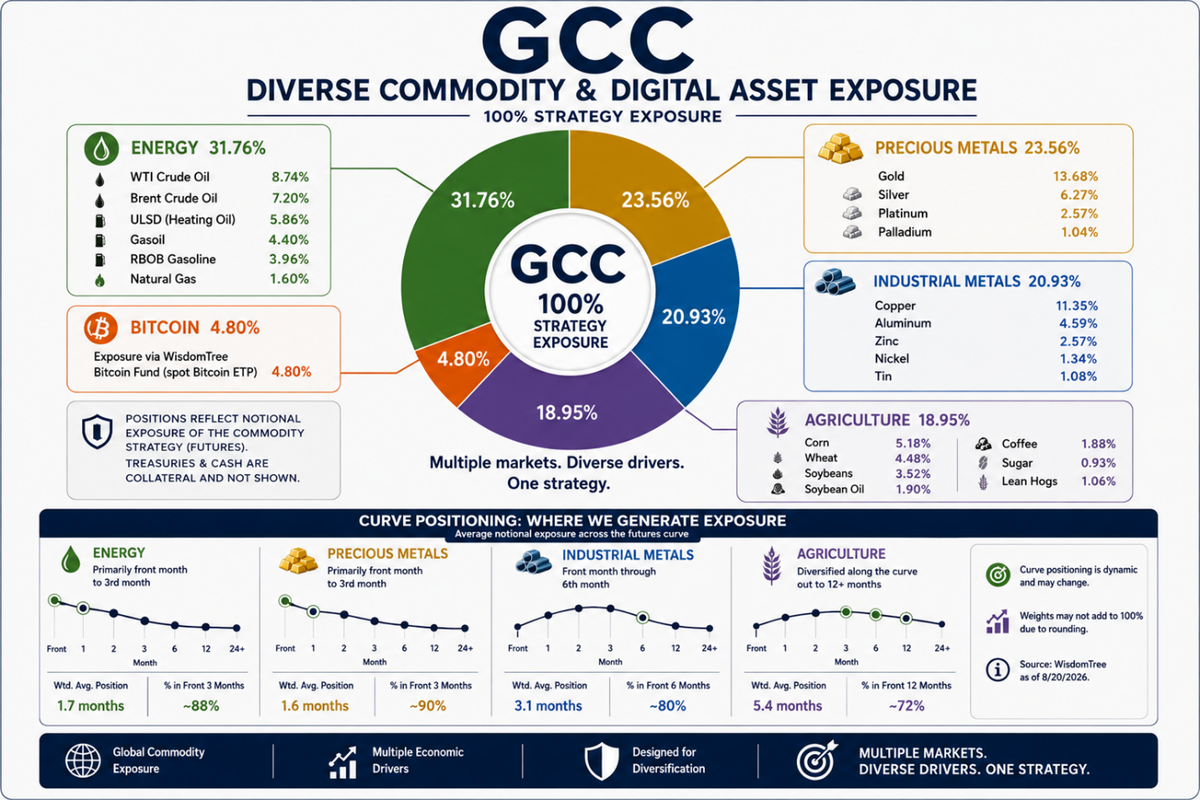
Source: Holdings from the GCC fund page with data sourced as of August 20, 2026. The WisdomTree Bitcoin Fund is an exchange-traded fund whose investment objective is to gain exposure to the price of bitcoin, less expenses and liabilities, by holding bitcoin. The Fund will generally value its shares daily using an independently calculated value based on an aggregation of executed trade flow of major bitcoin spot exchanges. Holdings subject to change.
Putting It Together
So, to summarize:
- Industrial Metals are tight on structural supply in 2026.
- Precious metals have been largely consolidating defensively in 2026.
- Energy is caught between geopolitical risk and a refined-versus-crude divergence that many investors may not be tracking.
- Agriculture is quietly splitting between crops under real stress and livestock markets normalizing.
That’s not commodities being confusing, that’s commodities behaving exactly the way an asset class built from independent economic engines should behave, and it’s a live argument for why a strategy built to be broad by design, weighted toward the sectors with the clearest structural case and rolled with an eye toward carry rather than passively into the front of the curve, is arguably better matched to this specific moment than to any single quarter’s headline.
1 Source: Bhardwaj, G., Gorton, G., & Rouwenhorst, K. G. (2015). Facts and fantasies about commodity futures ten years later (NBER Working Paper No. 21243). National Bureau of Economic Research.
2 Source: Goldman Sachs Research. (2025, December 22). 2026 outlook: Ride the power race and supply waves. Goldman Sachs.
3 Source: Discovery Alert. (2026, May 23). Trafigura’s copper withdrawals drain LME warehouses to historic lows.
4 Source: Mining.com.au. (2026, July). Codelco abandons near-term copper production target.
5 Source: Reuters. (2026, August 12). EGA says its Al Taweelah aluminum smelter running at 18%, expects full return in early 2027. MINING.COM.
6 Source: World Bank. (2026, May 11). The commodity markets outlook in eight charts. World Bank Blogs.
7 Sources for relative positioning of GCC against BCOM or S&P GSCI Indices: WisdomTree, Bloomberg, S&P, as of 6/30/2026. BCOM refers to the Bloomberg Commodity Index and SPGSCI refers to the S&P GSCI Index. BCOM and SPGSCI weights represent target weights for 2026. GCC weights as of 6/30/2026. As we rebalance the strategy, actual weights on any business day may vary from rebalance weights due to market price fluctuations. Past performance is not indicative of future results. You cannot invest directly in an index.
8 Source: World Gold Council. (2026, July 1). Gold mid-year outlook 2026: Point break.
9 Source: International Energy Agency. (2026, August 12). Oil market report – August 2026.
10 Source: Ecofin Agency. (2026, July 10). El Niño pushes cocoa prices higher as West Africa supply risks return.
11 Source: International Food Policy Research Institute. (2026, August). Tensions in the Black Sea and regional droughts spark rising global wheat prices.
12 Source: U.S. Department of Agriculture, Economic Research Service. (2026, July 17). Cattle & beef: Market outlook.
13 Sources: WisdomTree, Bloomberg, as of 6/30/2026. Start date is chosen to eliminate bias in bitcoin’s early-stage performance, which had very high returns and we deem unlikely going forward. GCC does not invest directly in bitcoin.
See the WisdomTree Glossary for definitions of terms and indexes.
Important Risks Related to this Article
For current holdings of GCC, please click here. Holdings are subject to risk and change.
There are risks associated with investing including possible loss of principal. An investment in this Fund is speculative, involves a substantial degree of risk and should not constitute an investor’s entire portfolio. One of the risks associated with the Fund is the complexity of the different factors which contribute to the Fund’s performance. These factors include use of commodity futures contracts. In addition, bitcoin exchange-traded products (ETPs) and bitcoin futures are relatively new and the markets may be less developed. They are subject to unique and substantial risks, and historically, have been subject to significant price volatility. As a result, the markets for bitcoin futures and bitcoin ETPs may be less developed, and at times, potentially less liquid and more volatile, than more established commodity futures and ETP markets. While the bitcoin futures market has grown substantially since bitcoin futures commenced trading, there can be no assurance that this growth will continue. In addition, derivatives can be volatile and may be less liquid than other securities and more sensitive to the effects of varied economic conditions. The value of the shares of the Fund relate directly to the value of the futures contracts and other assets held by the Fund and any fluctuation in the value of these assets could adversely affect an investment in the Fund’s shares. Because of the frequency with which the Fund expects to roll futures contracts, the price of futures contracts further from expiration may be higher (a condition known as “contango”) or lower (a condition known as “backwardation”) and the impact of such contango or backwardation may be greater than the impact would be if the Fund experienced less portfolio turnover. The Fund will not invest in bitcoin directly. Please read the Fund’s prospectus for specific details regarding the Fund’s risk profile.
Past performance is not indicative of future results.
U.S. investors only: Click here to obtain a WisdomTree ETF prospectus which contains investment objectives, risks, charges, expenses, and other information; read and consider carefully before investing.
WisdomTree Funds are distributed by Foreside Fund Services, LLC, in the U.S.
This WisdomTree article is provided as part of a paid sponsorship.
Related: SpaceX as Platform: What a Value Investor Found When He Did the Engineering Work