


If the party you oppose wins the election, what happens to your portfolio?
For many investors, the answer feels obvious: trouble. They see policies they disagree with, leaders they distrust, and consequences they believe others are ignoring. Moving money out of the market can feel less like an emotional reaction and more like a responsible precaution.
But there is a dangerous leap between “I believe this administration will hurt the country” and “I should change my investments.”
The first is a political judgment. The second requires an investment forecast. Strong conviction about one does not establish accuracy about the other.
When Conviction Feels Like Insight
Political beliefs often connect to our values, identity, and hopes for our families. That makes them especially powerful, and especially difficult to set aside when making financial decisions.
When the opposing party takes power, we may become more receptive to warnings about debt, inflation, taxes, or economic decline. When our preferred party wins, we may become more willing to look past those same concerns.
The risks don’t have to be imaginary for our interpretation to be biased. We can identify a legitimate problem and still draw the wrong investment conclusion.
Financial headlines can reinforce this tendency. A market pullback becomes a “wreck.” A rally becomes evidence that investors approve of a particular leader. Whatever our political perspective, there is usually a story available to confirm it.
Before acting on that story, consider what investors experienced through several administrations.
A Chart That Challenges Both Sides
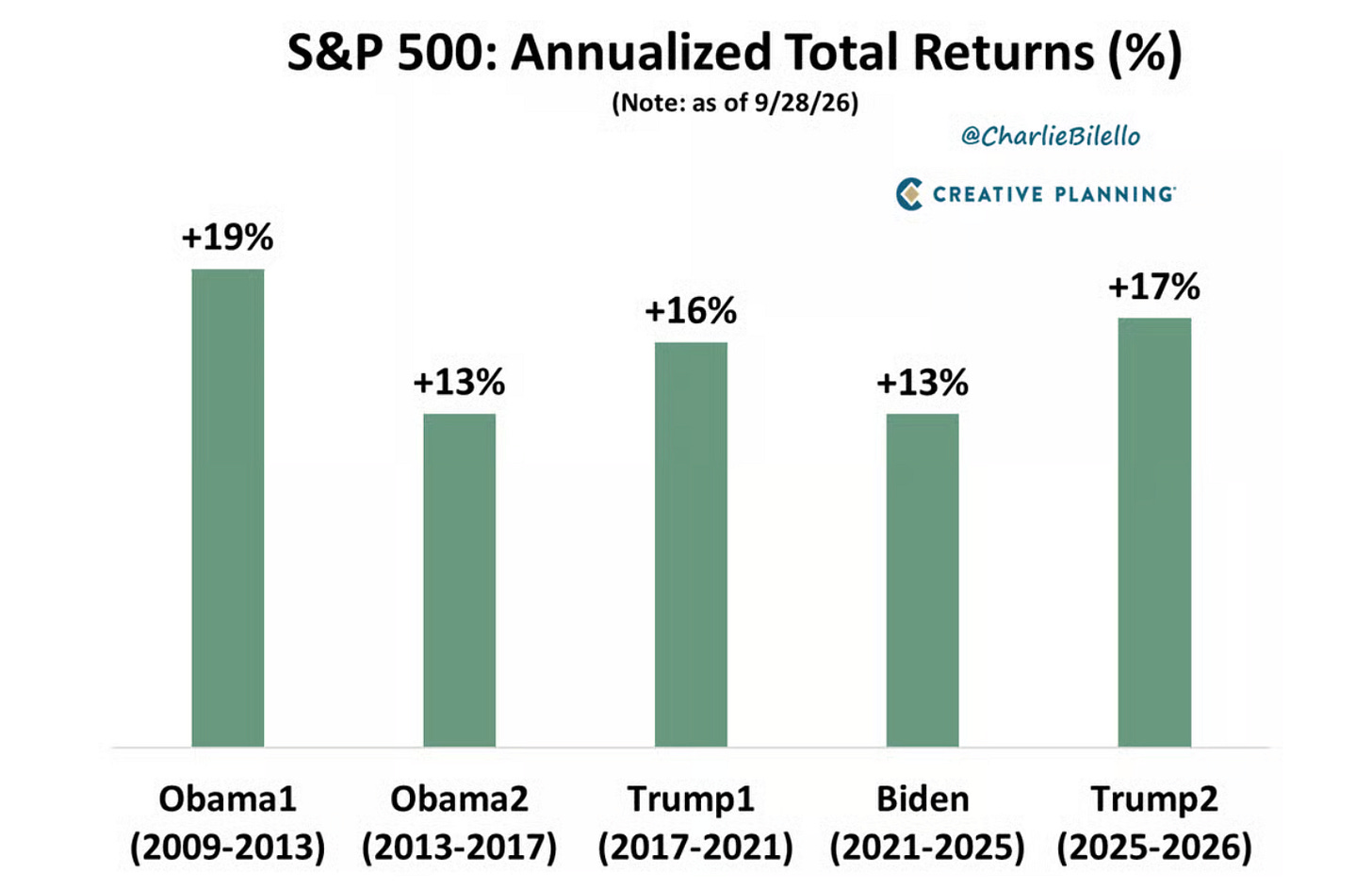
Source: Charlie Bilello / Creative Planning. Annualized S&P 500 total returns as shown through September 28, 2026. Trump’s second term represents an incomplete period.
The chart shows positive annualized returns during both Obama terms, Trump’s first term, Biden’s term, and the portion of Trump’s second term shown.
These periods included very different leaders, policies, priorities, and political conflicts. Yet investors had opportunities to grow their wealth under both parties.
That doesn’t mean presidents deserve credit for every gain or that their policies are irrelevant. It also doesn’t mean the market rose steadily throughout each period. Positive annualized returns can include painful declines along the way.
What the chart challenges is the belief that the opposing party’s control of the White House is, by itself, a sufficient reason to avoid stocks.
An investor who stayed out during the administrations they opposed would have missed positive returns during those periods. Their political convictions may have remained intact. Their participation in the market’s growth would have been interrupted.
The Market Answers a Different Question
An election asks voters who should govern. The stock market reflects what investors are willing to pay for businesses and their expected future earnings.
Those questions overlap, but they are far from identical.
Businesses respond to changing conditions. They adjust prices, manage expenses, develop products, and pursue customers. Their results depend on much more than the person occupying the White House.
There is another complication: markets respond to expectations. Recognizing a potential problem doesn’t tell you how much of that concern is already reflected in prices, or whether the eventual outcome will be better or worse than investors anticipate.
To profit from a political forecast, you need more than a persuasive argument about what could go wrong. You also need to make useful decisions about when to leave, where to put the money, and when to return.
Feeling confident about the election doesn’t resolve those questions.
Before You Change Your Portfolio
If political developments make clients want to act, ask them:
- What has changed about your financial needs? Has your time horizon, spending need, or ability to tolerate losses changed?
- Would you interpret this risk the same way if your preferred party were in power? This can help reveal whether standards shift with political loyalties.
- What would bring you back? If you sell now, what specific conditions would persuade you to reinvest? Would you wait until your desired party is in power?
That last question matters. Waiting for a preferred political climate can last a long time and be quite costly (per the graphic above).
We can care deeply about the direction of the country. We can vote, advocate, and work for changes we believe would improve it.
But our portfolio serves a different purpose: helping fund our lives and future needs.
Before changing it because of an election, make sure your clients’ decisions follows from their financial plan. The intensity of political feelings is not a measure of the quality of an investment forecast.
Related: When Clients Want To Sell Because of the Election: A Conversation Guide for Advisors