


The US Is Dead Broke
We’re not broke in 20 years or 10 years or 5 years. We’re broke today. In fact, we’re in far worse shape than Italy.
Can’t believe that?
Read this study co-authored with Italian economists, including one at the Bank of Italy. The study took a year to complete. Its fiscal gap and generational accounting take careful account of demographic, productivity, growth, fiscal, and all other relevant differences across the two countries.
To balance its books, the US needs an extra 7.49% of GDP, year in and year out, starting now! For Italy, the shortfall is 3.99% of GDP. Were we running a 7.49% of GDP budget surplus, we could breathe easy. We’re not. Instead, we’re running a 3.00% of GDP deficit once one corrects for inflation’s erosion of the real value of outstanding debt.
Assuming no spending cuts, the 7.4% of GDP translates into a required 26.5% increase in tax revenues from each and every federal and state revenue source — starting today and lasting forever. Of course, we can cut spending and not raise taxes. The required across-the-board immediate and permanent spending cut on everything but interest on government debt is 23.9%. Clearly, a combination of these dreadful potions can also balance our nation’s intertemporal books.
Higher Taxes Are Coming
My co-author, Scott Burns, and I have been warning about US fiscal insolvency for over two decades. See our books: The Coming Generational Storm, published in 2004, and The Clash of Generations, published in 2012. My economist co-authors, Alan Auerbach and Jagadeesh Gokhale, and I developed Fiscal Gap Accounting and Generational Accounting — two interconnected methods of measuring a nation’s long-term fiscal imbalance. These methods have been applied not just to the US, but to roughly 50 countries across the planet. They are routinely used by the European Union and often used by the World Bank and IMF.
What about the Congressional Budget Office, the Office of Management and Budget, and the Government Accountability Office? They couldn’t and can’t be bothered doing proper fiscal long-term accounting. Instead, they’ve focused and continue to focus on official US debt, largely ignoring our off-the-book debts, including Social Security’s colossal $71.9 trillion unfunded liability. Since official US debt accounts for less than half of our insolvency problem, these agencies are missing over half the forest for the trees.
Herb Stein, Richard Nixon’s Chair of the Council of Economic Advisers, used to say, “What can’t go on will stop.” My version is “What can’t go on will stop too late.” Unless we radically reform our fiscal and healthcare systems to make them dramatically more efficient and less expensive, we are facing major tax hikes. It’s only a question of their start date and magnitude. Clearly, the longer we wait to adjust, the worse things will get. As it is, this year’s interest on federal debt will exceed all spending on defense.
Optimizing Roth and Social Security Decisions Can Limit the Pain
Who knows when Congress will get its act together. In the meantime, each of us needs to look out for ourselves. Let me use my company’s MaxiFi Planner software to illustrate how the combination of contributing to Roths, converting from non-Roth to Roth accounts, and optimizing Social Security can limit our future fiscal pain.
(By the way, you can now try out a simplified version of MaxiFi for free for two weeks! You’ll need to subscribe for a year, but are free to cancel your subscription within the two-week period. But once you confirm your subscription, all of MaxiFi’s marvelous optimization and investment guidance tools will be yours to use.)
Consider Joe Smith, age 46. Joe’s single and lives in Montana. He earns $100K, which he assumes will keep pace with inflation until he retires at 65. Joe works for himself — he’s an electrician, contributing $7500 (also inflation-adjusted) a year to his IRA.
Joe started working at age 20. His initial job paid $35K and his salary grew by 4% each year thereafter. Joe owns his own house, free and clear. It’s worth $500K, but comes with $15K in annual expenses — expenses that will also keep pace with prices.
To date, Joe has accumulated $300K in his regular IRA. He also has $200K in his checking account. Joe figures he’ll take Social Security when he retires and also begin smooth real withdrawals from his IRA in that year.
Joe is a conservative investor. He holds all his assets in TIPS (Treasury Inflation Protected Securities). Joe runs MaxiFi’s safety-first plan assuming he’ll be able to earn 2.85% on TIPS — the current 10-year TIP yield. Joe assumes inflation will be 2.25% — the current long-term rate implied by the difference in yields between 30-year nominal Treasury bonds and 30-year TIPS. Finally, Joe tells MaxiFi to plan for a 20 percent increase in federal and state income taxes starting in a decade.
Joe’s Safety-First Base Plan
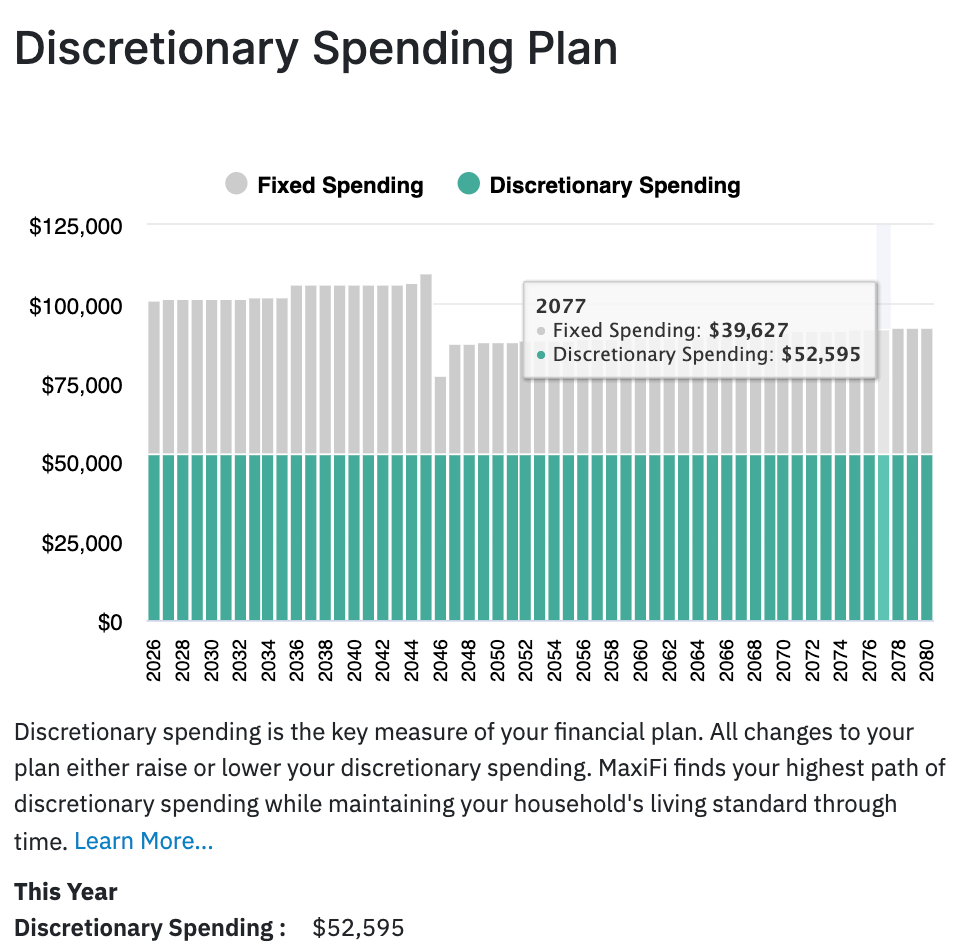
As the chart below shows, Joe can spend $52,595 real (inflation-adjusted) year in and year out until he reaches 100 — MaxiFi’s default assumed maximum age of life. Joe kept the default knowing that no one can count on dying on time.
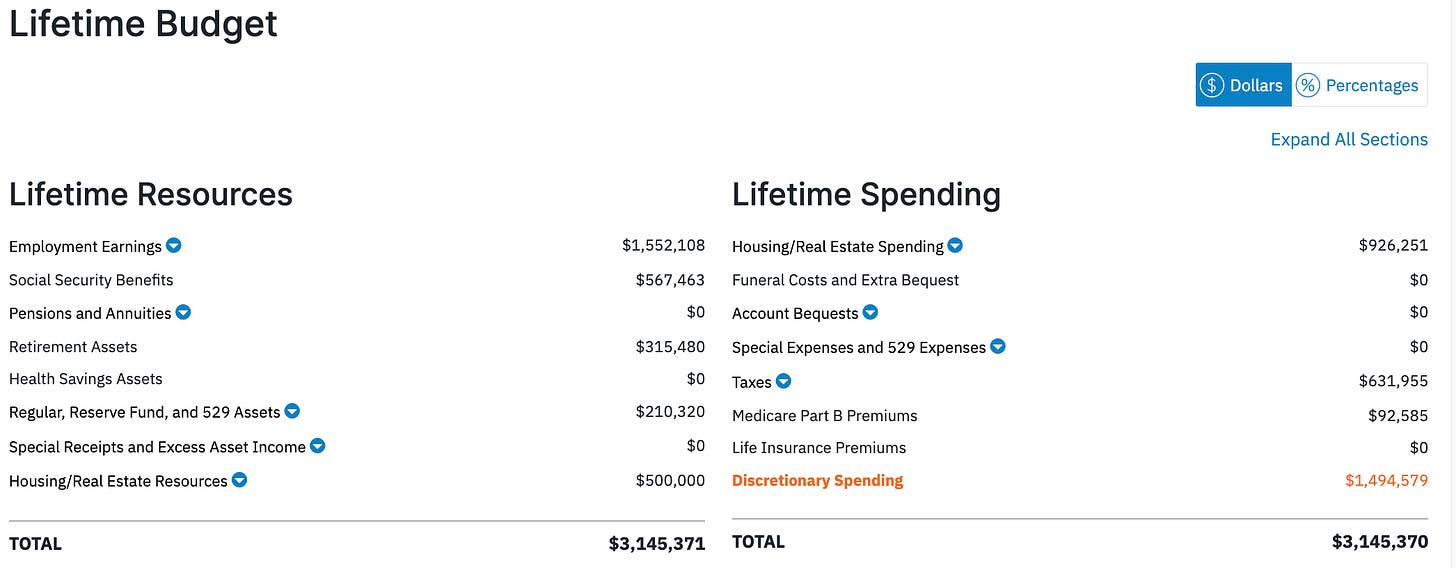
How does Joe know his plan is affordable? He looks at MaxiFi’s lifetime budget. As you can see in the chart below, lifetime spending — fixed as well as discretionary — equals, apart from rounding, Joe’s lifetime resources. All amounts are measured in present value. Fixed spending references spending on housing, taxes, special expenses, Medicare Part B premiums, and other off-the-top expenses. If Joe’s lifetime spending exceeded his lifetime resources, he’d end up going broke. If the opposite occurred, he’d die having left money on the table. (Forgot to say: Joe’s leaving his house to The Wilderness Society.)
Raising Joe’s Lifetime Discretionary Spending by $134,622
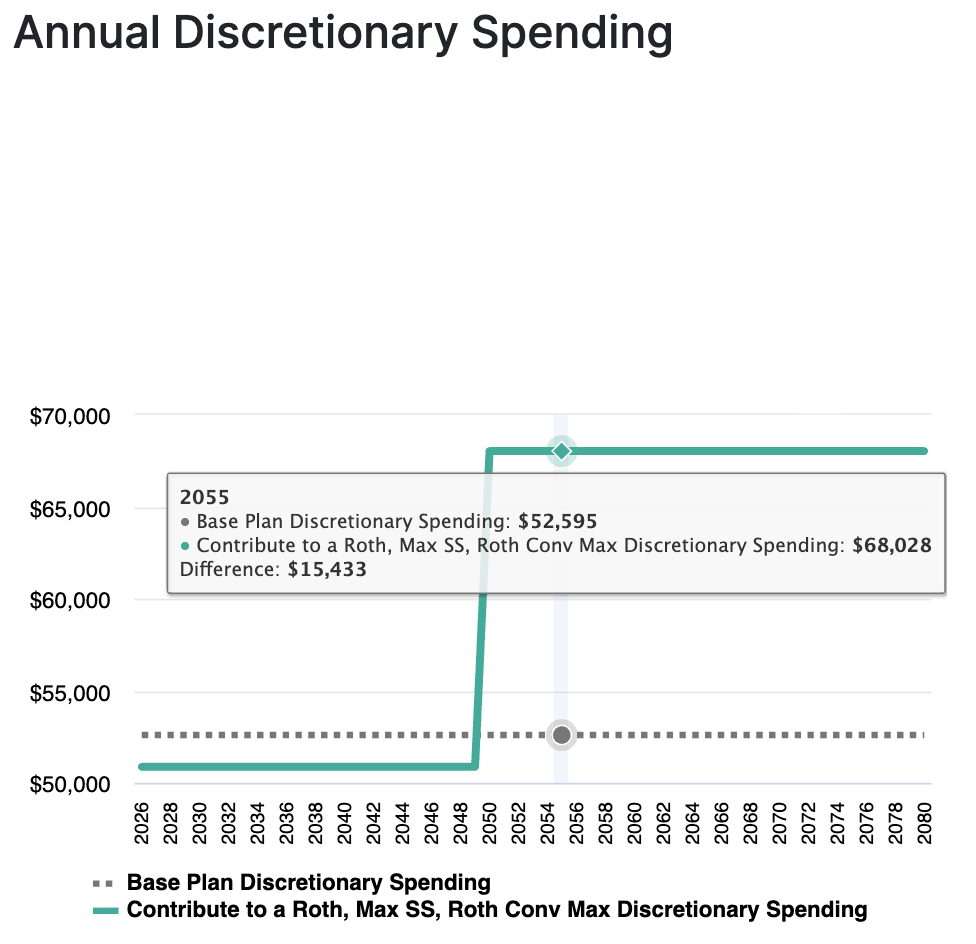
After running Joe’s base plan, I set up an alternative and compared the two. In the alternative, I had Joe a) start contributing to a Roth IRA rather than to his regular IRA, b) take Social Security at 70, not 66, and c) make optimal Roth conversions based on his $300K IRA. The optimal conversion plan entails converting $89,513 this year, $86,241 next year, and $70,231 the following year. By converting right away, Joe will enjoy more years of lower taxes. This is discussed in my 2024 column entitled Go Big or Go Home.
Although the three steps raise Joe’s lifetime spending by almost two years of after-tax earnings, taking them comes at a small short-term sacrifice. Each year through age 66, Joe needs to cut his spending by $1,729.
How come?
In the new plan, Joe is cash-flow constrained due to the need to cover, over the next three years, significant taxes on his Roth conversions. Joe views this sacrifice as well worth it after he sees that he’ll have a 29% higher annual living standard from age 66 through, potentially, age 100.
Joe’s Optimization Gains Far Exceed His Loss from Tax Hikes
The loss to Joe from his assumed 20% tax hikes, starting in 2036, is $61,089. But his gain from optimization is $134,622. Hence, letting MaxiFi figure out how to raise his living standard, with not a shred of risk, produced a windfall that’s more than twice the extra taxes he’ll face under his assumed size and timing of future tax hikes.
And, just to recall, all Joe is doing to produce his freebee $134,622 is to wait four years to call Social Security and request his retirement benefit, open a Roth IRA and direct his contributions to that account, and take withdrawals from his current IRA balance over the next three years, pay taxes on those withdrawals out of his regular assets, and contribute the amounts withdrawn into his Roth account. No risk of any kind. And, to ease his cash flow issue, Joe can opt to put somewhat less than the amount withdrawn into his Roth. (See this example.)
Do Try This at Home
MaxiFi was named “Best Personal Financial Planning Software of 2025” by Bankrate. Over 100 million American households visit its website annually. Here’s AI’s why:
Bankrate is considered a major, highly authoritative tier-one publication within the personal finance and consumer banking industries. It functions as an industry benchmark and a primary source of data for both everyday consumers and mainstream financial media.
Bankrate, founded 50 years ago, ranks MaxiFi as tops for a reason. You won’t find another financial planning tool that will correctly calculate what Joe should do and when he should do it to maximize his lifetime discretionary spending.
This goes for AI, which is hopeless when it comes to making even remotely correct financial planning suggestions. I’m referencing the most powerful versions of AI — the versions with 400-billion-plus parameters.
Earth to AI: It doesn’t help to have an ever-better aping machine if you don’t know what to ape. In this case, AI doesn’t know MaxiFi’s extraordinarily complex algorithms, let alone the order in which they are applied. Nor can it access/steal MaxiFi’s private code to provide correct answers.
As for other, i.e., conventional financial planning tools, they may have prettier charts, but they don’t have internally correct answers. As the video on the home page of maxifi.com makes clear, everything depends on everything when it comes to personal financial questions. Specifically, you need to jointly solve a massive number of highly non-linear simultaneous equations — all in half a second — to match MaxiFi.
Our competitors’ tools can project many things, but they can’t calculate the right things. Indeed, everything they tell you is internally inconsistent or, to put it less politely, dead wrong. This includes how much to save, the cost of early retirement, when to take Social Security, the precise annual amounts to convert to optimize Roth conversions, how much life insurance to buy, whether to rent or own, the cost of having another child, the value of downsizing, the gain from relocating to a low-tax, low-cost state, and, well, you name it.
Actually, it’s hard to say what aspect of conventional planning is worst. But, as discussed here, it’s likely conventional planning’s investment advice. The methodology underlying that advice bears absolutely no relationship to anything the field of finance would consider appropriate. In particular, it ignores the key driver underlying optimal portfolio choice — the household’s risk tolerance, which economists call risk aversion. MaxiFi, on the other hand, produces asset allocation guidance in full accordance with a century of financial science. This is why Nobel Laureate, Robert Merton, teaches MaxiFi to his finance students at MIT.
But here’s the deal. You don’t have to see a chiropractor when you need and can see a back surgeon. You don’t need to call a plumber when you need a skilled carpenter. You don’t need to hire a bookkeeper when you need an accountant. And you don’t need to use primitive planning tools when an economically correct tool, which embodies a century of financial science, including work by John von Neumann and a host of Nobel Laureates, is available. Nor is anything keeping you or your financial advisor from comparing your conventional financial plan with MaxiFi’s economics-based financial plan. This is particularly the case given how fun, easy, and inexpensive MaxiFi is to use. (Again, the starter version is freed!) But don’t take this from me. Check out these 130 plus testimonials by people just like you.
There is everything in the world riding on your getting the best medical care — your future physical health. And there is everything in the world riding on your getting the best financial guidance — your future economic health.
Related: TIPS Are Paying 3%. Is It Time to Rethink Your Retirement Portfolio?