

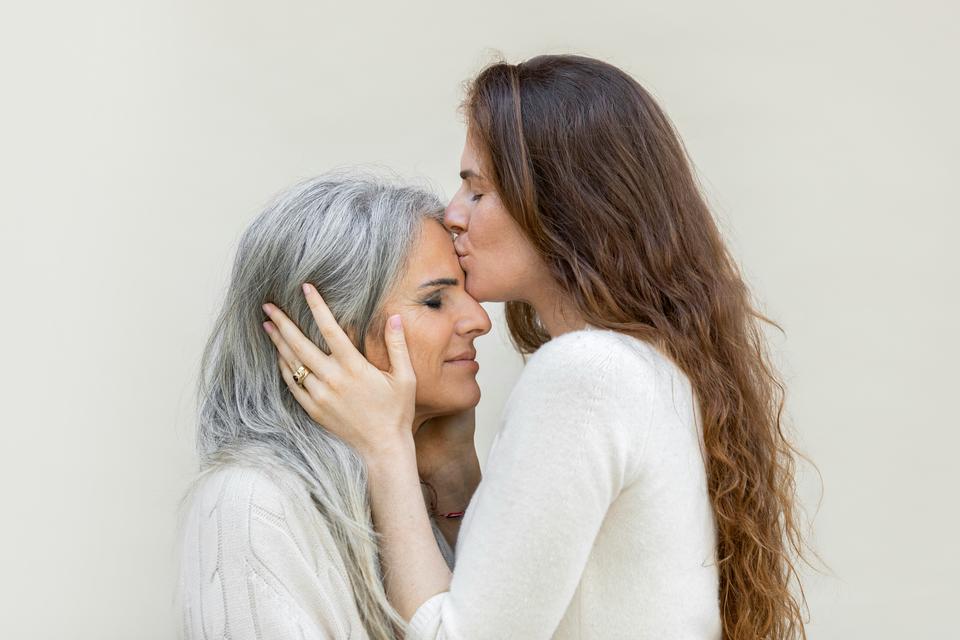
In a lot of things I’ve been reading and watching this month, I noticed ways that care can take unexpected directions.
A new report, “The Financial Impact of Caregiving,” finds that adult children are financially supporting their parents, while worrying their financial sacrifices now will make their kids responsible for them down the road.
Over at Oldster, Kimberly Dark writes about taking care of an elderly mother who never liked her much. And two sisters, estranged for nearly two decades, are reconnecting by comparing their biological age tests.
As we age, our complicated relationships don’t get any simpler. But we keep showing up anyway. As Kimberly Dark writes of her mother, “She maintained connection though, and that’s not nothing.”
For Two Sisters, a ‘Biological Age Test’ Became a Ledger of Their Past
Emily Baumgaertner Nunn, The New York Times
This story follows two sisters who’ve been mostly estranged for decades. Now in their 50s, Deb, the ostensibly healthier of the two, proposes they each take a mail-in epigenetic test.
Deb is a nurse without a primary care doctor. Instead of typical medical care, she uses ChatGPT, injects peptides, and bathes herself daily in red light therapy. Her sister, Michelle, sees seven specialists to make life with an autoimmune illness bearable, and suspects the test is pseudoscience.
The results don’t come in where either sister expected. And with no doctor to put them in context, Deb responds by ordering more tests.
This is a long article (22 minutes for the audio version), but it’s a fascinating glimpse into biological age testing and how we see and compare ourselves to our siblings.
“As with a personality test — or even a horoscope — proven accuracy is hardly a requirement. People crave new ways to define themselves.”
Full story [gift link]
Vadim Gladyshev and the Science of Aging
Eric Topol and Vadim Gladyshev, Ground Truths
After the deep-dive into mail-in genetic testing, it’s refreshing to be reminded that there’s some really solid, useful research happening around aging.
I shared Eric Topol’s research on biological aging back in my July roundup. At that time, he was writing about the ways that biological aging comes at us in waves and how different organs age at their own pace. Here he digs into this more with Harvard researcher Vadim Gladyshev.
A few highlights: When Gladyshev surveyed 100+ aging experts, he got 100+ different definitions of aging. His lab has found that old hearts transplanted into younger bodies get partly younger (at least in mice), while a young heart in an old body ages.
And it seems like alcohol rejuvenates arteries while aging many other organs, which is just one example of why many universal anti-aging interventions don’t make sense. Whether or not you should have that glass of wine might depend on whether aging arteries are your biggest concern.
“When we age, we age unequally in different organs. And therefore, we need interventions that work against our older organs. Organs and systems, not the whole thing. So perhaps it’s an opinion, but I think there would be no universal interventions against aging. Interventions would be targeted to particular ageotypes.”
6 Things Longevity Experts Wish People Would Stop Saying
Melinda Wenner Moyer, The New York Times
This is a quick, useful list to help sort the reality from the noise about longevity. It picks up where the Lance study morbidity gap that I wrote about in August left off: from 2009 to 2019, U.S. life expectancy rose by only about six months, while healthy life expectancy actually declined.
The experts interviewed here point out that no drug or supplement has been shown to extend human life and that weight loss after 65 isn’t always a good thing. Also, while women tend to live longer than men, they tend to spend more time in poor health.
“If extra years turn out to be a side effect of keeping people healthy longer, well, that’s great... But that’s not the goal.”
Full article [gift link]
Caregivers Are Facing a “Generosity Paradox”
Noah Sheidlower and Madison Hoff, Business Insider
A new report from Edward Jones, Age Wave, and The Harris Poll surveyed more than 5,000 financial caregivers. The report finds that caregivers who contribute financially spend more than $8,700 a year on average, and about 70% have cut back on saving.
Some 81% of the caregivers surveyed said they’re willing to weaken their own financial security to support a loved one, while 87% said they don’t want to become a burden themselves. Two goals that tend to be incompatible.
“An overwhelming number of people want to continue to do this for their loved ones, but they don’t want their own family members, their own children, to go through the same thing that they’re going through right now.”
Sometimes, Parents Don’t Like Their Children
Kimberly Dark, Oldster Magazine
Sociologist Kimberly Dark writes candidly about a mother who never liked her, and who now, with Alzheimer’s, depends on her.
It’s good to see more people reckoning honestly with complicated relationships with their parents. In my work as an advisor, I’ve seen that when things get hard, being realistic about those relationships is more useful than sugarcoating things.
“Though we don’t particularly like one another, I love her and don’t want her to suffer. I believe she felt the same for me, back when she remembered me.”
Wealth and Wisdom
And finally, I always appreciate a good post articulating the connection and disconnection between wealth and wisdom.
Chip Conley writes about how many of us spend the first half of adulthood trading health and relationships for wealth, then the second half spending that wealth to get them back. His advice is to “wise-size” rather than downsize — to try letting go of old identities and obligations, along with empty bedrooms we keep paying for, and to put what we’ve learned to good use.
“Wealth without wisdom can become a beautifully furnished prison. We keep paying for a life we no longer want because we’ve confused maintaining it with living it.”