


“Somebody” Doesn’t Count: Your retirement plan may be counting on people who don’t know they’re in it.
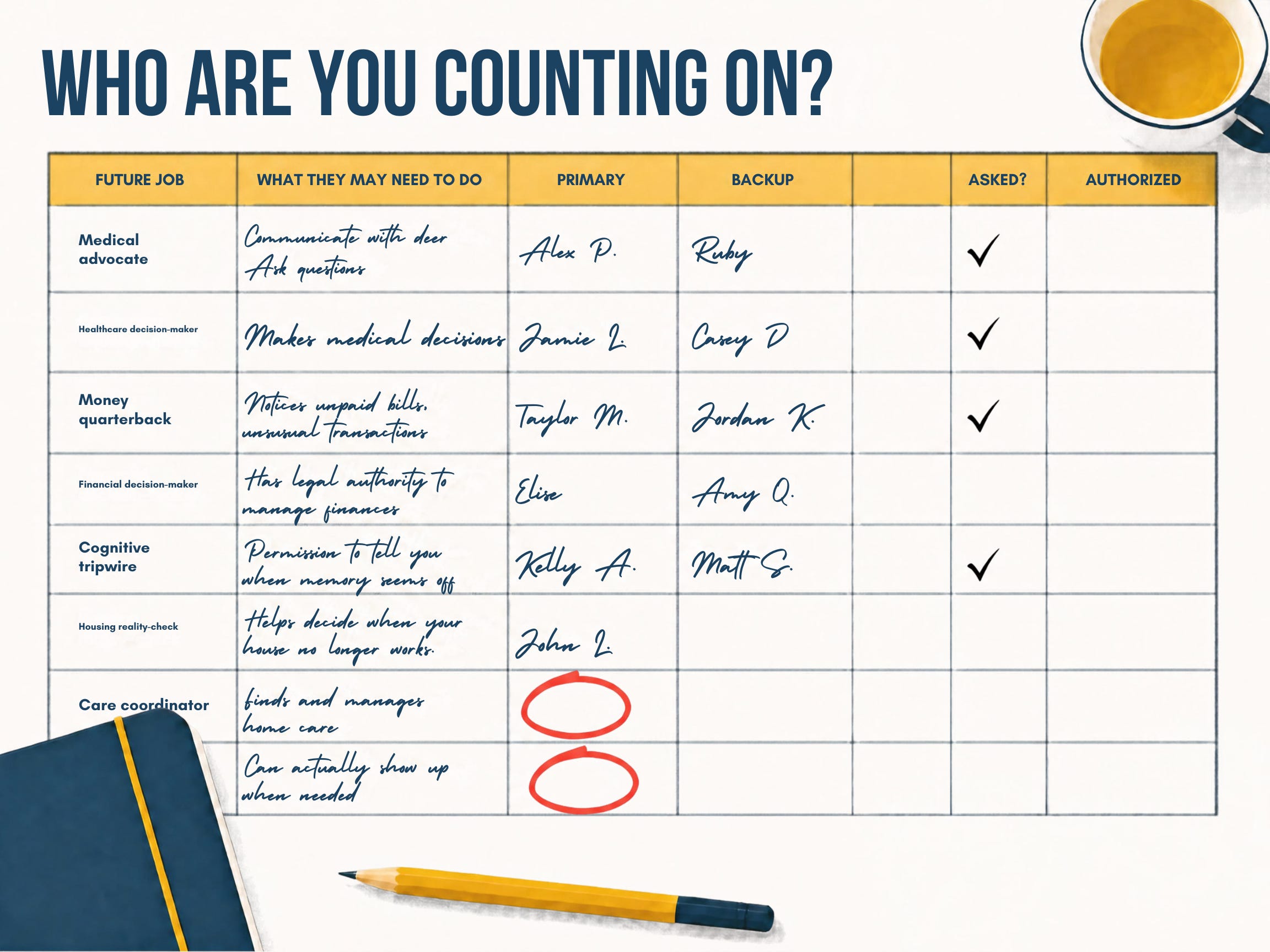
Image created in Canva
I’ve been thinking about a very simple exercise that probably belongs somewhere between a retirement plan and an uncomfortable family dinner.
Take out a piece of paper and write down the people Future You is counting on. These are the people you are assuming will actually do things for you if, at some point, you can’t do them yourself. These aren’t necessarily the people you love or who love you. They are also not the same as your emergency contacts. Don’t cheat and just recite people named in your estate documents.
We are talking about preparation vs. documentation. What’s the difference?
Who comes to the important doctor’s appointment and remembers what the doctor said? Who notices that you’ve started doing strange things with your money? Who tells you that maybe driving at night is no longer a great idea? Who figures out what to do with the house? Who finds a caregiver, deals with the long-term care insurance company, or shows up at the emergency room at 2:00 in the morning? Who knows where the passwords are?
We typically aren’t starting from scratch, thank goodness. Most of us have answers to at least some of these questions. The problem is that the answers often exist entirely in our own heads.
I started thinking about this as a Who Are You Counting On? exercise. The idea is to take all of those vague assumptions about who is on the roster of the team Future You will depend on. And like a roster card, attach actual names to them. Then, because aging has a nasty habit of ruining perfectly good plans, attach a backup name too.
I put together a simple worksheet that does exactly that:
Who Are You Counting On Worksheet: Download
The worksheet asks you to identify the people you are counting on for 14 jobs that tend to show up as we get older:
- medical advocate
- healthcare decision-maker
- money quarterback
- financial decision-maker
- cognitive tripwire
- housing reality-check
- care coordinator
- emergency person
- transportation backup
- household backup
- digital administrator
- long-term care point person
- social tripwire
- the person who handles things after you die
Remember, if nobody in your personal life is right for a job, that somebody could be a professional.
For each job, there are three questions:
- Who is the person?
- Who is the backup?
- Have you actually asked them?
That last one is super important.
SHARE your plans so you don’t go solo
The idea behind the worksheet isn’t entirely mine. The Benjamin Rose Institute on Aging developed an evidence-based program called SHARE for Dementia****—Support, Health, Activities, Resources and Education—for people with early-stage dementia and their care partners. SHARE gets very practical about future care tasks and who will perform them, including family, friends, and professional service providers.
SHARE was developed specifically around dementia, but I think the basic exercise deserves to start decades earlier. I can tell you firsthand that by the time you desperately need someone to perform one of these jobs, it’s a lousy time to discover that the person you were counting on isn’t available, or never knew you were counting on them in the first place. The SHARE framework always struck me as being such a helpful starting point for planning ahead for our grey(er) years.
This is also why I was struck by Ailene Gerhardt’s new Navigating Solo white paper, based on a survey of 507 people thinking about or experiencing solo aging.
Gerhardt makes an important distinction about what it means to be a solo ager. We normally picture someone without a spouse or children, probably living alone. Her broader definition treats solo aging as a planning condition—one in which reliable support cannot simply be assumed.
That changes the conversation considerably. You can be married and become functionally solo because your spouse gets sick. You can have three children and discover that they live in three different time zones. You can have a terrific group of friends who are all getting older at roughly the same inconvenient rate.
Family structure isn’t the same thing as support structure.
Years ago, I was referred to a married couple, Gene and Frances, who had done almost everything we normally tell people to do, yet they were in a bit of a crisis. They had saved well, owned their home, completed their estate planning, and had two successful adult children.
Then Gene began experiencing cognitive problems. Frances gradually became responsible for almost everything. She handled the doctors, medications, finances, and household while also trying to understand what was happening to the person she had expected to grow old with.
Their children loved them but also lived hundreds of miles away and had careers and families of their own. They could fly in when something went seriously wrong. They couldn’t handle a Tuesday morning doctor’s appointment or notice that Dad had started doing something strange with the checking account.
Frances, a competent senior, wasn’t aging solo in the traditional sense. But her support system had suddenly become very thin. I have a specific memory of Frances showing me her to-do list, which went on for two pages of a legal pad. That’s what reminded me of the SHARE plan. Every job would have had “Frances” next to it, and that probably would have been enough to be more intentional about getting more support sooner.
This is one big problem hiding underneath a surprising amount of retirement planning. There is an assumption nobody ever bothers to write down:
Somebody will figure it out.
And somebody frequently does. Usually a spouse, daughter, son, sibling, or close friend gets drafted into the job.
But “somebody” doesn’t count.
Procrastinaging
This is where Gerhardt’s research intersects with something I’ve been calling Procrastinaging.
Procrastinaging isn’t simply failing to prepare for getting older. Plenty of people prepare. They save money, buy insurance, and execute estate documents. Procrastinaging is putting off the uncomfortable decisions inside the plan because Future You still seems far enough away that Present You can get away with it.
We’ll figure out where to live later. We’ll talk to the kids eventually. I’ll update the power of attorney next year. Somebody will help with the healthcare stuff. We’ll cross that bridge when we get there.
The Navigating Solo numbers suggest that ignorance isn’t really the problem. Respondents identified almost five planning concerns on average. Nearly 96% identified at least two concerns and 86% identified three or more. Yet only 28% described themselves as somewhat or very confident about their solo-aging plan.
One respondent described the problem particularly well: “Being so overwhelmed by options and decisions so I do nothing. Inertia.”
That’s one root cause of Procrastinaging.
We know we’re getting older. We know there are things we should probably deal with. But most of them don’t need to be dealt with today, which makes tomorrow an extremely attractive option.
Unfortunately, aging has its own calendar and doesn’t always consult yours.
A plan can be perfect and still not work
I saw a different version of this with another client. Agnes was single, financially secure, and extremely organized. Her estate documents were immaculate. She had a trust, healthcare directive, power of attorney, and detailed instructions about what she wanted.
Then we started talking about the people named in those documents.
Her younger sister was her healthcare decision-maker, but she was getting older herself. Another friend had moved away. Someone else was perfectly willing to help but wasn’t remotely suited to managing money or navigating a complicated healthcare situation.
The documents were excellent. The infrastructure underneath them wasn’t.
Gerhardt calls that infrastructure an Architecture of Support: trusted people, skilled professionals, defined roles, practical services, communication pathways, and backup options that make a plan actually work.
We spend a lot of time making sure the right documents are in place and much less time thinking about what happens when someone actually has to use them. Your power of attorney may be perfectly drafted, but if the person you’ve named lives three states away, hates dealing with money, or doesn’t really understand what you’ve asked them to do, you still have a problem. There is a difference between having a plan and having the capacity to execute it.
There is a financial dimension to this as well. Gerhardt calls it the Solo Aging Support Premium. If family or friends aren’t available to provide transportation, caregiving, advocacy, household assistance, fiduciary work, or care coordination, those functions may have to be purchased. Her research doesn’t attempt to calculate that premium, but the concept itself is useful.
For years, we’ve asked people how much money they will need in retirement. We haven’t spent nearly enough time asking how much free human labor we’ve quietly assumed will come with it.
Circle the blanks
Which brings me back to the worksheet.
- Put a name beside every job.
- Then put a backup beside every name.
- After that, ask the slightly embarrassing question: Have I actually talked to these people?
Assuming your daughter will manage your finances someday and telling your daughter that you expect her to manage your finances someday are two very different things.
Then circle the blanks. Those gaps are your Procrastinaging list.
You don’t need to fill all of them this weekend. Trying to engineer your entire life through age 95 would be its own form of insanity. The people will change. Your health will change. Technology will change. Your relationships, housing, and finances will change along with them.
That’s why every plan is a draft. The point isn’t to predict Future You correctly. It’s to preserve Decision Liquidity—enough money, relationships, professional resources, and alternatives that you can adjust when life inevitably refuses to follow the plan.
And maybe that’s the useful part of doing a recount now.
Present You doesn’t have to solve Future You’s life. You just need to replace “somebody” with a name.
Because somebody doesn’t count.
Related: Aging in Place Is Getting Harder. Are We Thinking About Home the Wrong Way?
