


Four years into this bull market and the easy gains may be over
The bull market that began in October 2022 turns four this week, and what a ride it’s been. This shorter bull run is just the latest segment within the nearly uninterrupted 17-year, post-Financial Crisis, bull market.
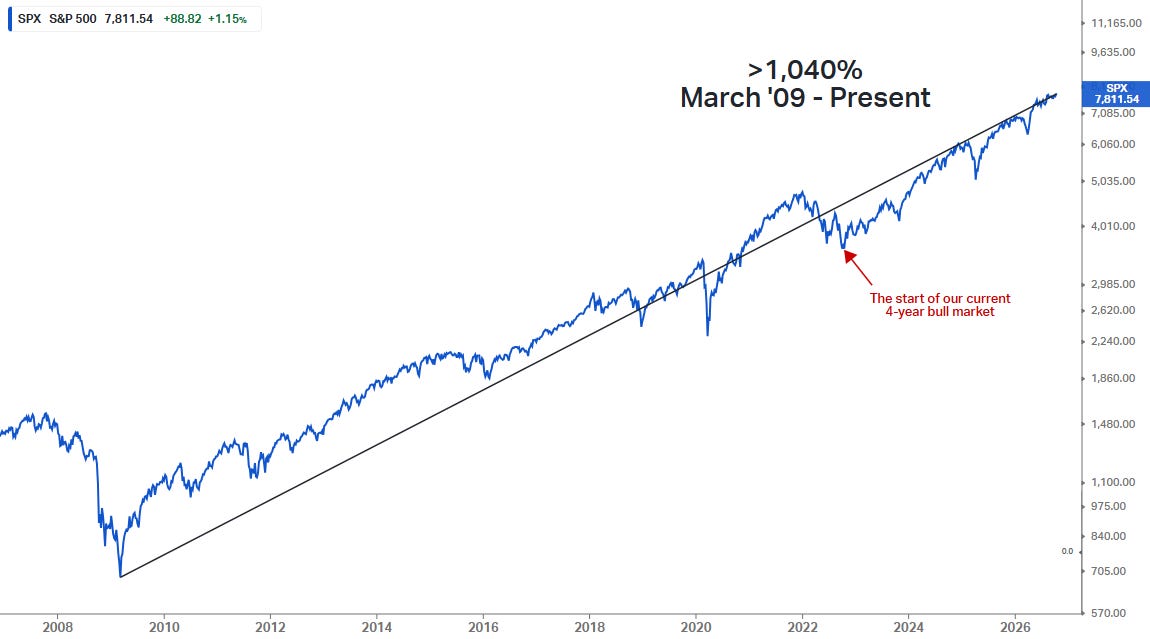
Hell of a run
The market, and we along with it, have survived recession fears, aggressive Federal Reserve rate hikes, trade tensions, and geopolitical shocks. The S&P 500 has gained 117% since its October 2022 low (130% including dividends) and has clocked 124 all-time highs along the way. This rally has been impressive and, at times, hated for its seemingly gravity-defying progress.
This bull market’s defining features haven’t necessarily faded, and it will be critical to monitor how strongly headwinds and tailwinds blow as we enter 2027.
Headwinds
- Persistent inflation
- High yields and tightening monetary environment
- Concentrated market leadership
- Narrowing market breadth
Tailwinds
- Resilient economic growth
- AI-driven investment and enthusiasm
- Strong earnings growth
- Potential for productivity growth and broader market participation
The market’s dependence on a handful of mega-cap technology companies leaves little room for disappointment. The bull market’s next chapter may depend on whether earnings can keep growing fast enough to overcome the mounting headwinds. Whether gains can spread beyond the market’s biggest winners may be the key to how likely this bull market is to turn five.
The week in markets
Stocks finished the latest week mixed. For a week that was generally light on economic news, there was a lot to digest, and markets were buffeted by several narratives including the ever-present Middle East tensions, AI-related jitters, and the prospect of further Fed tightening.
The S&P 500 gained 1.15%, the Dow rose 0.93%, and the Nasdaq advanced 0.64%. Small-cap stocks declined, while the S&P MidCap 400 was little changed. Consumer staples, utilities, and energy led sector performance, while technology and industrials lagged. The defensive leadership and uneven participation suggest investors are becoming more selective, even as the major indexes remain near elevated levels.
A resilient economy meets high(er) rates
Four years ago, inflation exceeded 8%, the Fed was raising rates aggressively, and recession fears dominated the outlook. But the downturn many investors anticipated never arrived.
Real GDP growth exceeded the often-cited 2% trend in each of the past three years, supported by consumer spending, a healthy labor market, fiscal stimulus, and business investment. AI-related spending was and still is a particularly powerful growth engine that stitched back together some fraying economic seams.
The remarkable resilience of the US economy has come with a trade-off, particularly when it comes to yields and interest rates. Treasury yields climbed to their highest levels since 2002 this week before retreating on strong auction demand and easing geopolitical concerns. Fed minutes from the September meeting showed that most policymakers anticipate another rate increase by year-end.
Inflation has been a constant nuisance throughout, and both hard and soft data still point in the same direction when it comes to stubborn inflation. The services sector continued to expand in September, and its price index reached its highest level since July 2022. Year-ahead inflation expectations also rose in separate surveys from the New York Fed and University of Michigan.
Even though it is far below its former peak, the cumulative effects of the 2020s inflation have contributed to dreadful consumer sentiment. The Fed’s September Summary of Economic Projections points to target inflation reached by 2029, which continues the five-year-long tradition of hitting inflation targets “three years from now”.
For some reason, there are still people asking whether interest rates could return to the unusually low levels of the 2010s (hint: they will not). Elevated government borrowing, substantial capital investment, and potential productivity gains could support a higher-rate environment for longer. This new rate regime will require reevaluation of appropriate stock valuations, bond prices, and portfolio asset allocation mixtures. The cost of financing business expansion is already creating trade-offs that investors need to account for in long-run projections. A
AI faces a broader market test
AI has helped transform the market over the past four years, and the introduction of the “AI-age” in 2022 may have offered enough of an economic and market lift to stave off a recession during the 2022-2023 hiking cycle. The massive increase in business investment to out-compete on AI has been a huge economic tailwind and driver of corporate earnings.
The rally has created an extreme level of concentration in AI-related companies. In his latest Eye on the Market, Michael Cembalest details how large an impact a small subset of companies has on the market and economy, while much of the rest of the public markets are languishing. It’s well worth it to read the entirety of the piece, but below is an excerpt from the relevant section.
“The charts below show that (i) a basket of 42 AI stocks accounts for 60%-80% of all S&P earnings growth, price returns and capital spending since Jan 2024; (ii) at the same time, 60% of S&P 500 stocks are down 20% or more from their all-time highs despite the market being close to all-time highs…”
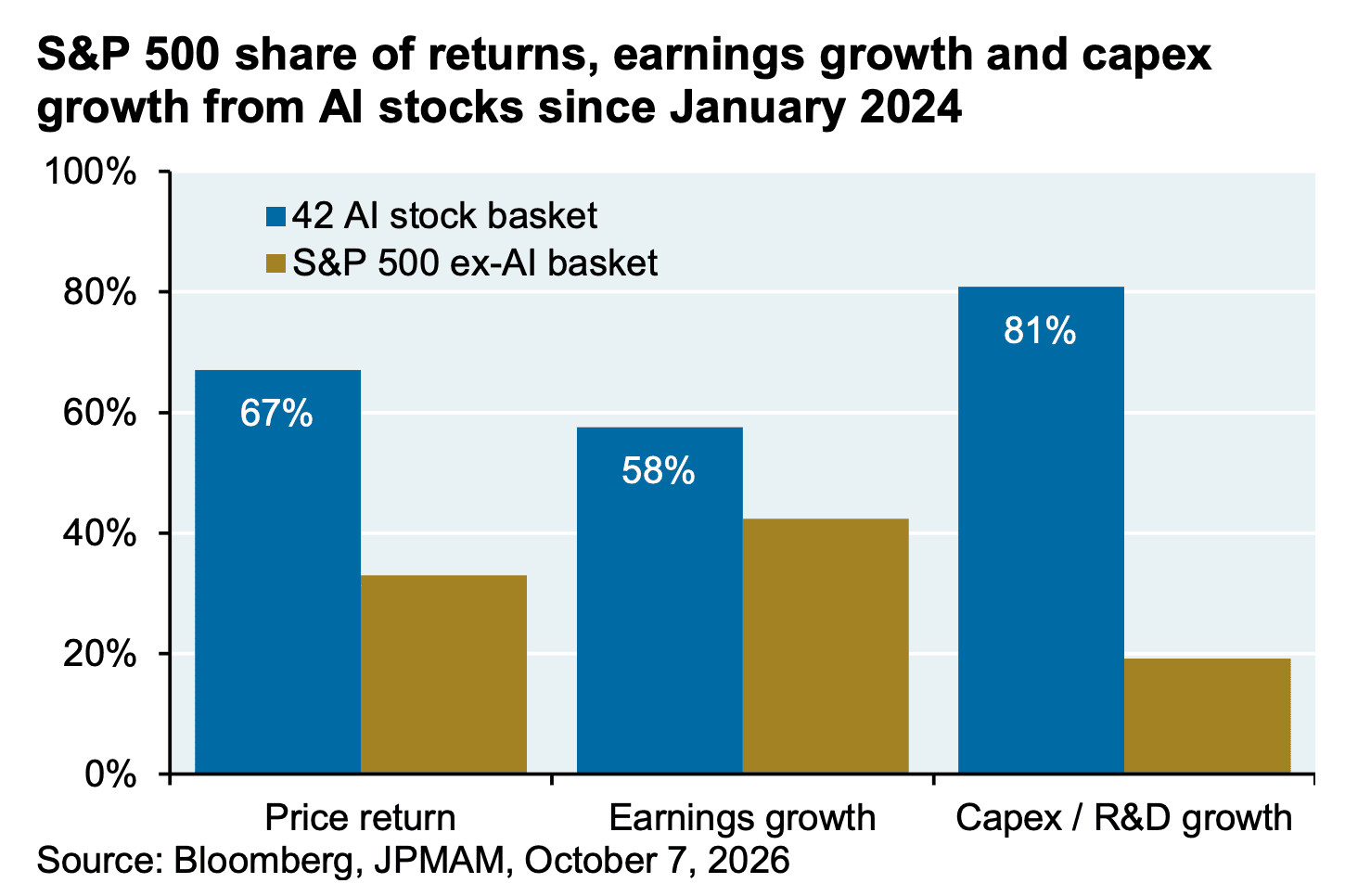
Source: JPM, Micheal Cembalest
The ten largest S&P 500 companies now account for roughly 40% of the index, with NVIDIA alone representing about 8%. Strong earnings have helped justify this leadership, yet concentration also leaves the market vulnerable if expectations for a handful of companies happen to disappoint.
Despite these concerning signals of bubble-like tendencies, there are reasons for cautious optimism. Approximately 70% of the S&P 500’s gain since October 2022 has come from earnings growth, with valuation expansion accounting for the remainder. If can continue to expand earnings, higher yields won’t necessarily take a bite out of valuations. Analysts expect another strong third-quarter earnings season, led in significant part by technology and semiconductor companies, although contributions from other sectors are also increasing.
Still, market breadth warrants attention. The percentage of S&P 500 stocks trading above their 50-day and 200-day moving averages fell to some of their lowest levels in more than a year recently. The NYSE Advance/Decline line has shown a modest recovery, offering an early sign that participation could be improving, although these trends suggest a market that remains resilient but is becoming less forgiving of disappointing news.
What this means for investors and what’s next
Next week, the Consumer Price Index on Wednesday and retail sales on Thursday will offer fresh evidence of inflation and consumer demand trends.
Investors should also be watching oil prices, Treasury yields, Fed expectations, and whether market participation improves beyond the largest technology stocks. The bull market has historical precedent for lasting longer than four years, but the risk of a correction rises as the cycle matures and a prolonged stretch without a meaningful pullback continues.
Maintaining diversification and managing concentration risk remain sensible priorities, particularly in AI-related holdings (semis, memory, hyperscalers, etc.), while recognizing that expectation-beating earnings growth and a resilient economy could still support further gains.
Related: The Midterms Could Change Congress. They May Not Change the Market.