


The market had plenty of drama to digest this week, but the stock market ultimately looked past the upheaval at Nvidia. CEO Jensen Huang’s resignation was one of the final acts in a wild story bound to light fires in Hollywood writers’ rooms. The crisis sent Nvidia shares down roughly 13% for the week, leaving the stock over 30% off all-time highs.
Despite the chaos, the broader semiconductor sector rose more than 6%, and the S&P 500 gained about 2.5%. The Russell 2000 added a more modest 1.32%.
Diversification 1, concentration risk 0.
The overall market resilience continues to impress. Investors are still focused on the underlying demand for AI infrastructure rather than any one company’s leadership, even when that one company happened to be a bellwether for the industry. Strong results from AI cloud provider CoreWeave, including raised revenue guidance and a reiteration of its substantial backlog, helped restore confidence in technology stocks earlier in the week.
Taiwan Semiconductor also reported strong revenue growth, reinforcing the view that demand for computing capacity remains steady. However, even though some of the fireworks have died down for Nvidia, the questions about Nvidia’s leadership and its role in financing the broader AI ecosystem are only just beginning.
There are still long investigations and uncomfortable reports yet to be completed. Answers to who knew what and when they knew it will probably keep the stock on the ropes well past next week’s earnings report, regardless of results.
Coming in hot: earnings and inflation
Q3 earnings continue to lay out a strong foundation for the market. With roughly 90% of S&P 500 companies reporting third-quarter results, earnings growth is running near 32%. 10 of the 11 S&P 500 sectors have delivered positive earnings surprises, and full-year earnings growth is now projected to land close to 33%. The breadth of earnings success is particularly encouraging. While mega-cap technology had been carrying the earnings torch in recent quarters, it is now the other 493 companies that have dominated market returns.
While earnings are impressive, the investors are not actually impressed. On Monday, FactSet reported that the forward 12-month price-to-earnings ratio for the S&P 500 is now the lowest in three years.
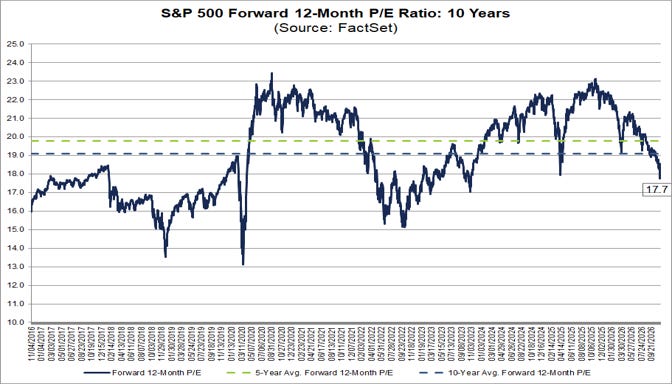
Source: FactSet
Inflation is still an ever-present challenge. October CPI rose 0.4% month over month, above the 0.3% expected, while core CPI increased 0.3%. Producer prices were mixed, with annual headline PPI accelerating to 6.5%, its highest rate since November 2022. The reports pushed Treasury yields higher, with the 10-year yield moving above 5.1%, as investors wrestled with the potential for additional Fed tightening.
It is not all bad news when it comes to inflation. Oil prices have fallen roughly 14% since the end of October. If that decline holds, it could provide some relief to headline inflation in November.
The biggest weapon against inflation is time, which will eventually return the pace to the 2% target. However, that may be little comfort for households who are bogged down with the feeling of never-ending sticker shock on everything from groceries to new cars to health insurance. For now, however, the Fed has plenty of work to do to beat back the rising inflation expectations.
What this means for investors and what’s next
Next week brings two major catalysts that will blot out the sun, at least in terms of financial news.
Nvidia reports earnings Tuesday, offering investors an important update on demand and leadership transitions. This call will be a critical chance for management to calm investors and show that there is a steady hand on the wheel. It’s entirely possible that nothing they say will do that. The sooner the board selects a permanent CEO, the better.
The Anthropic IPO will also capture attention, with pricing expected Wednesday and trading beginning Thursday. The IPO is reportedly six times oversubscribed, but with industry nerves rattled, it will still act as a test for investor appetites. I’m sure Anthropic would have preferred not to have Nvidia’s mess overshadowed the lead-up to its IPO.
For those eyeing their portfolio, diversification remains important. I strongly favor equities over fixed income, with an emphasis on U.S. large- and mid-cap stocks, while avoiding excessive concentration. Small-cap companies are likely to be hamstrung by high borrowing costs for the foreseeable future.
That’s not to say that there aren’t worthwhile fixed income options for those focused on income or safety, but that’s simply not where long-term growth will be found. Elevated bond yields also offer attractive starting points for U.S. corporate or high-yield bonds.
Strong earnings are encouraging, but inflation and shifting interest-rate expectations remain risks worth watching for all portfolio makeups.
Related: Why the Post-Election Rally Collapsed Into an AI Selloff