


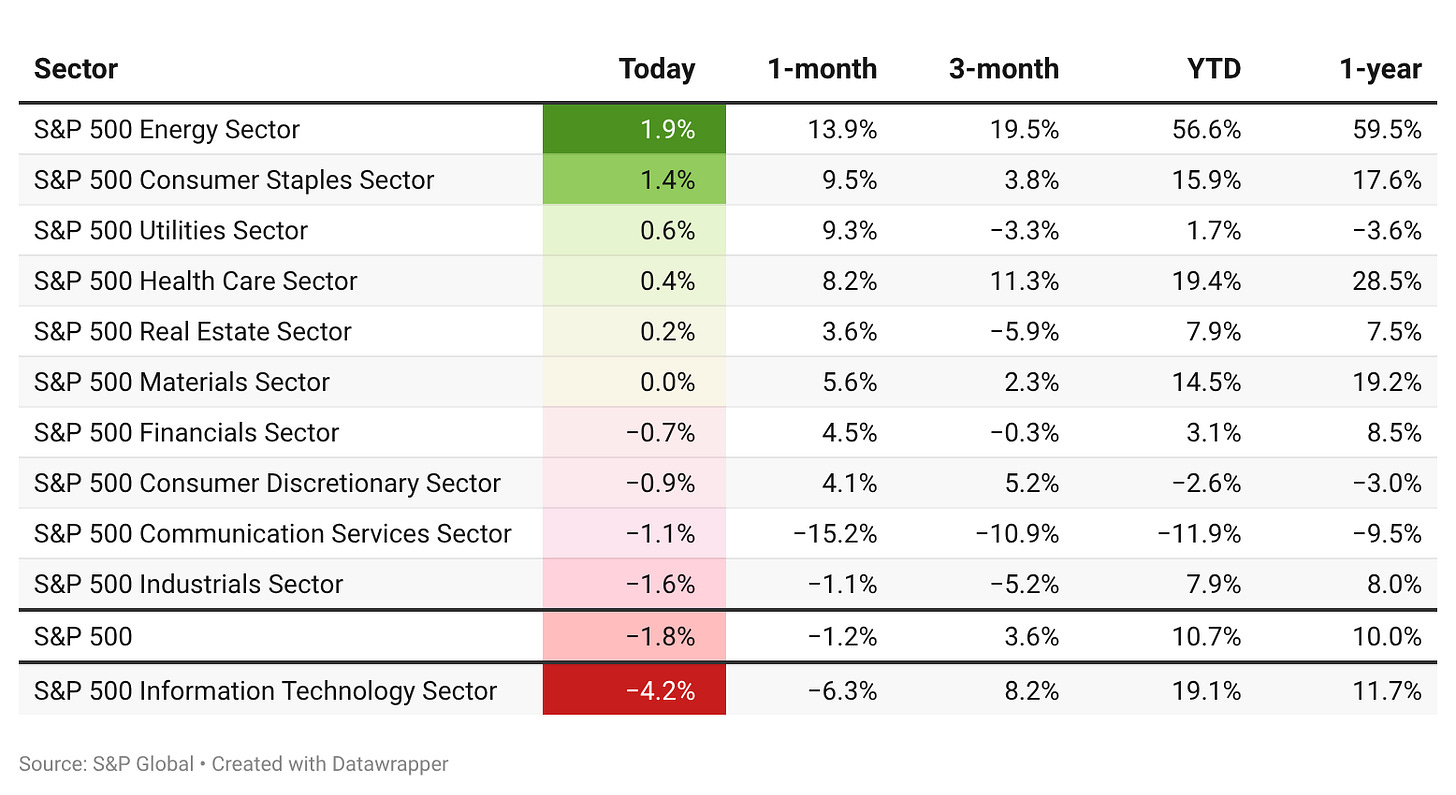
The stock market ended the week with a severe shift in tone and a handoff to new leadership as the overall market was dragged down by heavy selling of technology companies. Smaller companies and value-oriented stocks welcomed the inflows and basked in outperformance.
Technology and AI-related shares surrendered gains from earlier in the week as investors punished even the hint of weakness. Unsatisfactory earnings reports from numerous technology companies led to harsh selloffs and a repudiation of the broader industry by week’s end. The silver lining is that the selling was somewhat balanced by the rotation into other sectors.
Stronger-than-expected GDP data reinforced the resilience of the U.S. economy, even as persistent inflation adds to the pressure on the Federal Reserve. In the meeting this week, which unfortunately preceded the release of PCE inflation data, the committee held interest rates steady (as expected). The upgraded assessment of economic activity and continued concern about inflation leave the path for future policy uncertain, but dripping with a hawkish intent.
With another busy week of technology earnings, the midterm elections, and the monthly jobs report only days away, markets have a lot to wrestle with.
AI Optimism Meets a Higher Bar Brick Wall
The rotation away from technology and AI-related stocks accelerated quickly after a somewhat cheerful start to the week. Early results reflected optimism surrounding corporate earnings and continued investment in AI infrastructure. Company commentary pointed to strong demand, and some companies, like Oracle, spelled out the path toward easing capex spending and a return to plentiful free cash flow.
Microsoft delivered a strong earnings report, exceeding expectations and reporting accelerating Azure revenue growth. Alphabet and Amazon also posted double-digit revenue growth, but their results and forward guidance failed to satisfy investors.
By Thursday morning, the reaction to Google’s earnings kicked off selling that never quit. Disappointing results and guidance from companies including Intel, ServiceNow, Fortinet, and Twilio added to the pressure, and the pace of selling on Friday hit overdrive.
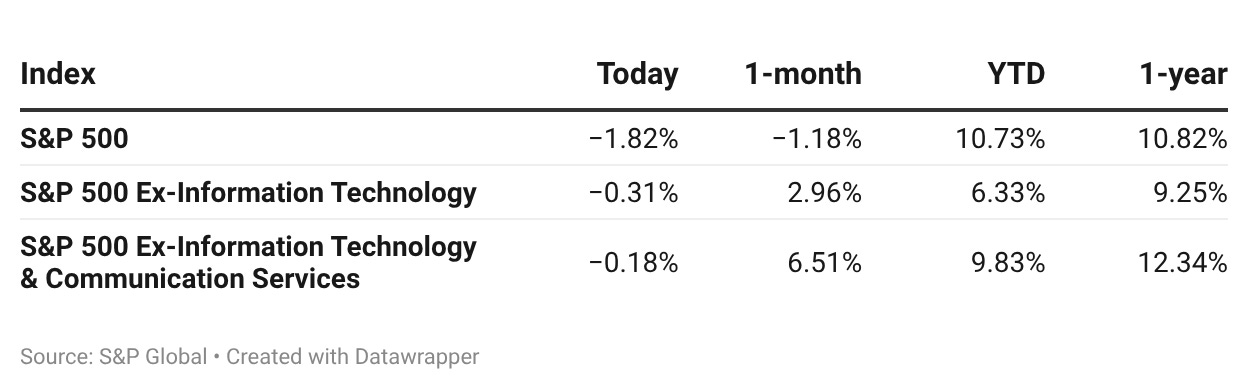
The extent of the damage is obvious when we exclude information technology and communication services from the index performance. Without both of those sectors, the index is up 6.5% in October.
The changing market dynamics suggest investors are becoming more selective about which companies deserve premium valuations. Strong AI demand remains an important long-term growth opportunity, but spending alone is no longer enough to justify higher stock prices. Companies must increasingly demonstrate that investment is translating into revenue, earnings, and ultimately free cash flow. Businesses with longer paths to profitability or greater financing needs are facing immediate hostility.
The beneficiary of this breakdown is almost everything else, with few exclusions. While the Nasdaq fell 2.0%, the Russell 2000 and S&P MidCap 400 each gained 1.3%. The S&P 500 declined 0.57%, and the Dow lost 0.85%. Large-cap value stocks outperformed growth stocks for a fourth consecutive week.
Defensive sectors, including consumer staples, health care, and utilities, attracted additional investment as technology shares weakened. Breadth improved across all three major indices this week, and this broader participation can help reduce the market’s dependence on a handful of mega-cap companies.
Patience at Fed
The Federal Reserve left the federal funds interest rate unchanged at 3.75% - 4.00% in a 10-2 vote. The decision to hold was widely expected, but members Cook and Hammack favored another quarter-point increase. Given the data that followed a day later, the debate over how much additional restraint may be needed to bring inflation under control is hardly settled. The Federal Reserve minutes from October will be far more interesting than they were in September given the dissent.
The Fed upgraded its assessment of economic activity, describing growth as proceeding at a strong pace. That assessment was reiterated by Thursday’s GDP report, which showed the U.S. economy expanded at a 3.4% annualized rate in the third quarter, above expectations of 3.0% and up from the 2.2% in the second quarter. Consumer spending and business investment were important contributors.
The inflation picture remains less encouraging. September’s personal consumption expenditure (PCE) price index rose 3.6% from a year earlier, while core PCE, which excludes food and energy, increased 3.1%. Both measures accelerated modestly from August and remain not only above the Fed’s 2% target, but clearly heading in the wrong direction.
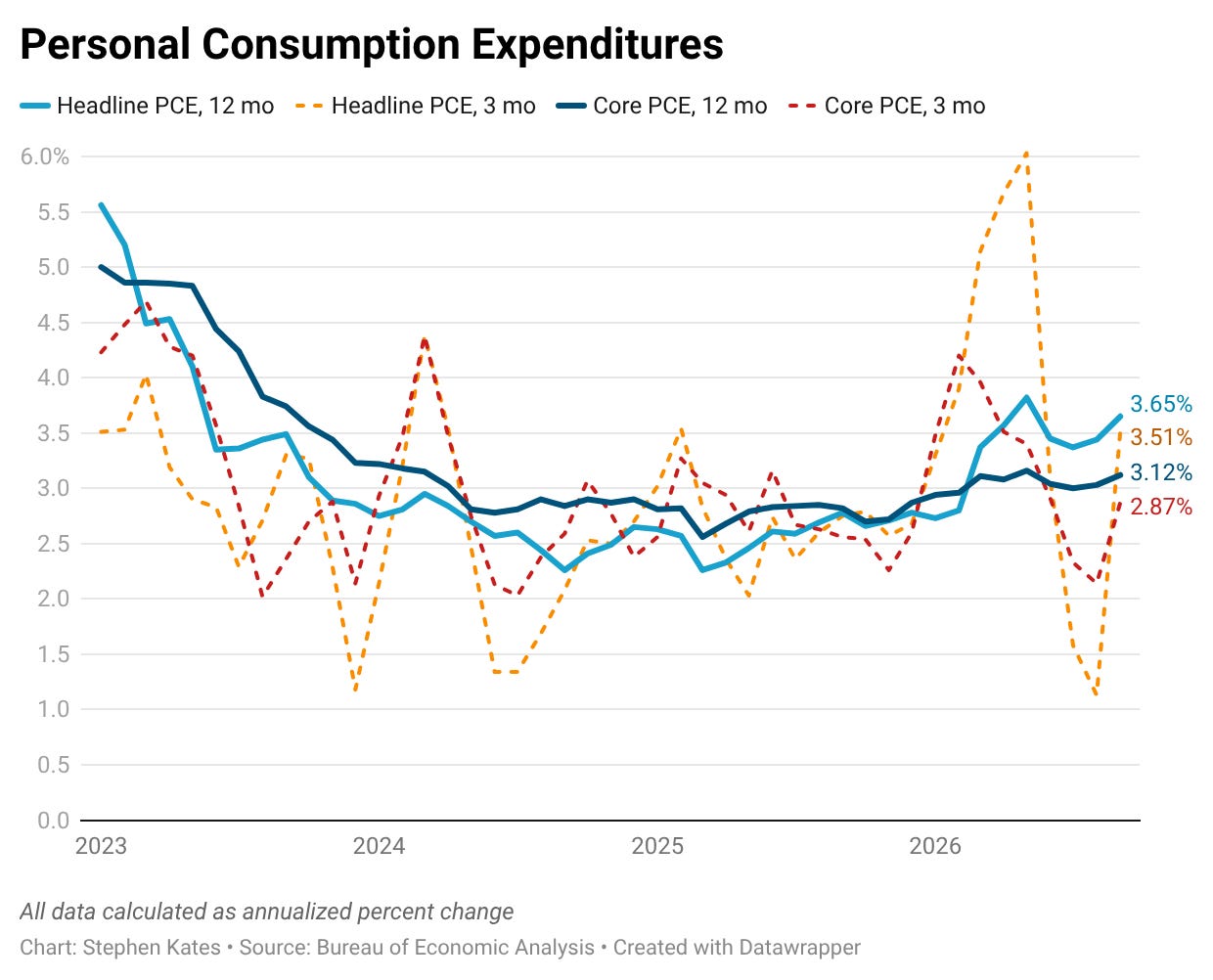
Energy prices have been a significant contributor to headline inflation, with prices rising 21.3% over the past year. Meanwhile, higher market-based inflation expectations suggest investors see a greater risk that inflation could remain elevated for longer. The five-year break-even inflation rate has moved higher, a concerning development that can influence borrowing costs and expectations for future Fed policy. We haven’t heard the words ‘unanchored inflation’ as much lately, but as expectations of elevated inflation grow, it can become a self-fulfilling prophecy.
For now, the strong growth gives policymakers room to remain focused on inflation without necessarily putting economic expansion at risk. Consumer confidence (Conference Board) also improved in October, reaching 91.7 from an upwardly revised 84.2 in September. Initial jobless claims remained subdued at 194,000. These readings suggest the economy continues to hold up despite slightly tighter financial conditions.
Earnings perform a miracle
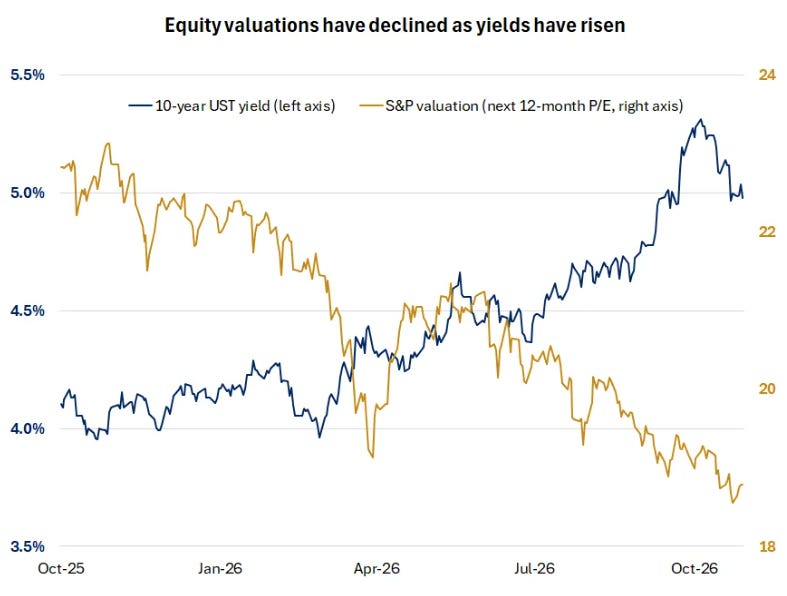
Earnings growth is becoming increasingly important as higher interest rates put pressure on stock valuations. The S&P 500's forward price-to-earnings ratio has declined over the past year as Treasury yields have risen, leaving less room for multiple expansion to drive returns. Earnings have single-handedly shouldered the burden of lifting prices. This growth has helped the market absorb higher yields, boosting price returns even as P/E valuations fell.
Source: FactSet via Edward Jones
Focusing on Q3, earnings have so far provided a meaningful counterweight to the anxiety about, well, everything. Of the 301 S&P 500 companies reporting results, 82% exceeded earnings expectations, while 61% beat revenue estimates. Reported year-over-year revenue growth stands at 13.6%, with earnings-per-share growth reaching 29.4%.
Without the scale of earnings growth over the past year, stock prices would have retreated alongside valuations. Instead, the opposite happened.
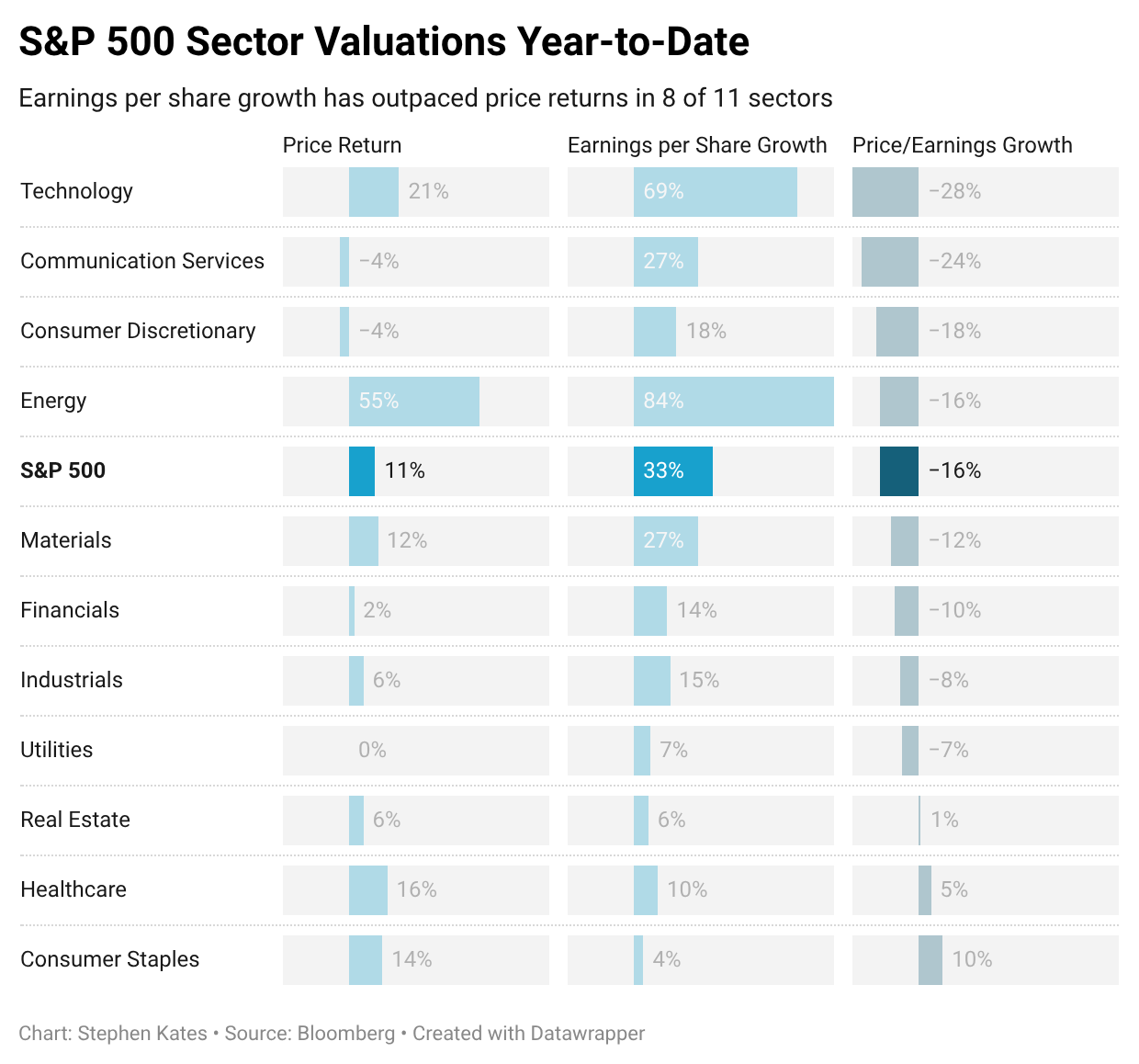
These results suggest that corporate profitability remains healthy enough to support further market gains, even if valuations do not expand. Companies with durable margins, strong balance sheets, and consistent free-cash-flow generation may be particularly well positioned as investors become more selective. That doesn’t describe many of the largest technology companies, which is why the sector took it on the chin this month.
Treasury yields retreat
Treasury markets finished the week stronger, with the 10-year yield falling to approximately 4.92% from around 5.00% a week earlier. The two-year yield declined to a six-week low of 4.78%. Investment-grade corporate bonds also posted positive returns.
Higher yields remain a persistent risk for equity valuations, but they can create opportunities for bond investors seeking income. Bonds haven’t been this exciting in many years, and they are worthy of fresh attention.
What this means for investors and what’s next
Markets enter November coming off an appropriately frightening Halloween week. There is no time to wallow in this past week’s bruises with fresh earnings and economic catalysts landing immediately. Apple and Palantir report Monday evening, and are followed by additional reports from AMD, Amgen, Pfizer, Qualcomm, and other major companies throughout the week.
Tuesday’s midterm elections and Friday’s monthly employment report will also carry weight. Geopolitical uncertainty surrounding Iran and continued volatility in oil prices add another potential source of inflation pressure and market instability.
A major risk for the overall market is that continual selling pressure in mega-cap growth and smaller technology names will begin to bleed into other sectors. If selling broadens, rather than investors simply rotating between sectors, the entire market could start sliding faster.
Technically, the S&P 500 is testing support around 7,600. The VIX climbed to 22, signaling increased demand for portfolio protection. I’m cautiously optimistic about the longer-term market outlook, but I expect more volatility as investors digest fresh information throughout the rest of earnings season.
In the short-term, we’re likely to have a lot of price gyrations within technology, and by extension, the major indices that have a heavy weighting to them. But the fact that there is so much fear right now takes the edge off a bit.
If the narrative was that all these companies are bulletproof and valuations were sky-high, I’d be nervous. It’s quite the opposite, and risk is being priced in a clear-headed way. Don’t get me wrong, plenty of selling could be coming. But at the moment many of the largest businesses in technology and AI aren’t seeing degradation in their businesses, only their stocks. The ability of corporate profits and broader market participation to offset pressure on valuations will be an important test of the market’s resilience.
Related: Small Caps Surge as Tech Stumbles: Can AI Earnings Save the Market?