


One of the biggest risks of covered call ETFs – one confounding income hungry retail investors – is finding the right balancing act between harnessing significant income while not sacrificing too much long-term capital appreciation.
As advisors know, that is one the biggest, overlooked risks with covered call ETFs: sacrificing too much upside for income. Yes, the performance-for-income trade-off is part of the game with options income ETFs, but not all funds in this category require massive upside compromise. Take the case of the NEOS Nasdaq-100® High Income ETF (QQQI).
As its name implies, QQQI, one the largest and fastest-growing covered call ETFs, extracts income from the widely followed Nasdaq-100 Index – a benchmark not known for a big dividend yield. Beating the paltry yield of 0.43% on the largest Nasdaq-100-tracking ETF isn’t difficult, but QQQI is accomplishing that feat with an impressive track record of upside generation.
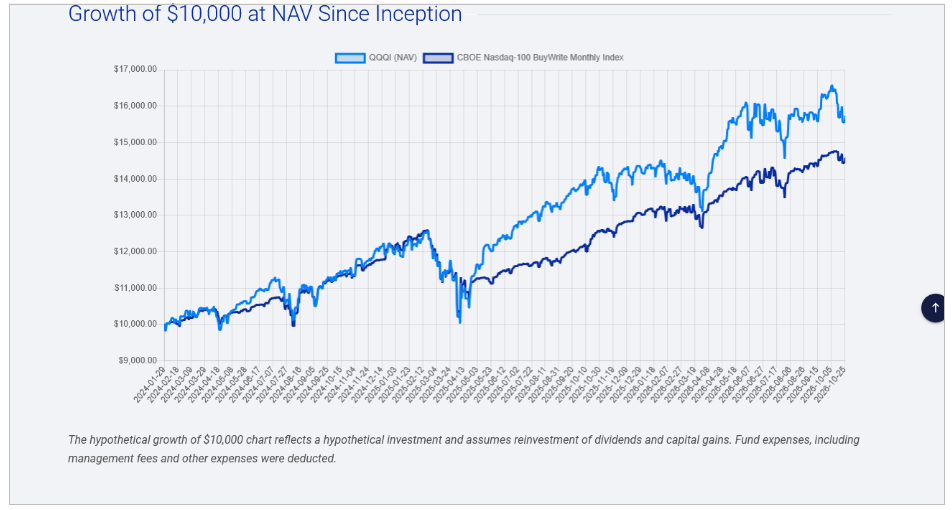
(Image Courtesy: NEOS Investments)
Like any covered call ETF linked to a major equity index, such as the Nasdaq-100 of the S&P 500, QQQI doesn’t move in lockstep with the traditional version of the gauge. That’s the price of covered call ETF admission, but as the chart above confirms, the NEOS fund as better-than-admirable job of delivering capital appreciation.
QQQI Sets Itself Apart
Not all covered call ETFs are created equal and QQQI, which turns three years old in January, confirms as much. Put simply, advisors and investors have choices when it comes to Nasdaq-100-linked options income ETF, but it’s hard to beat QQQI.
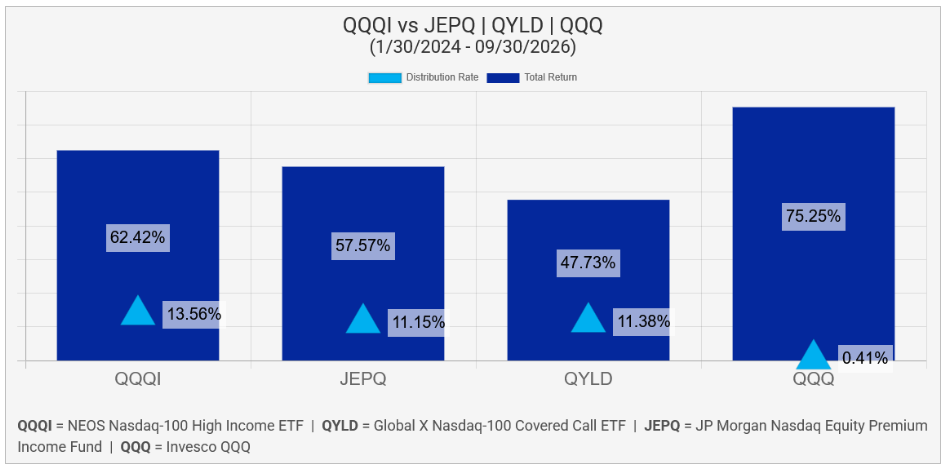
(Image Courtesy: NEOS Investments)
While the chart is a baseline, it indicates QQQI delivers solid monthly income in tax-efficient fashion while not leaving too much upside on the table. In the world of covered call ETFs, that’s an enviable combination. The results are also testament to QQQI’s actively managed, data-driven call selling strategy, which clearly is difficult for competitors to mimic.
Speaking of Strategy…
One of the major risks of covered call ETFs is net asset value (NAV)-sapping return of capital (ROC). ROC has some tax efficiencies, but many of the highest-yielding options income ETFs get carried away with it, leaving unknowing investors wondering their initial stakes are being chipped away at.
In a hypothetical example, a covered call ETF trading at $100 with an annual yield of 50% is paying out roughly $4.16 per share monthly. Chances are with each one of those large distributions, the $100 per share an investor paid to get involved is eroded, leaving investors with an income vehicle with essentially no upside potential.
With QQQI and its other ETFs, NEOS avoids jaw-dropping NAV deterioration while preserving income integrity and upside potential.
“Options-based income ETFs from NEOS aim to harness the tax efficiency of return of capital distributions for investors without eroding their underlying principle,” according to the issuer. “Each ETF seeks to fund a portion of its monthly income distributions from sold index option premium, which is converted to capital gains, and then paid out to investors on a monthly basis.”
At the end of the day clients and investors want big income and the possibility of decent capital appreciation under one umbrella. Thanks to QQQI, that’s not a one-or-the-other proposition.
Related: Why Gen Z Investors Are Wasting Their Biggest Financial Advantage: Time