

Investors with predilections for disruptive themes know that when it comes to robotaxi stocks, Tesla (TSLA) is one of the leading names. That goes with the territory given the company’s status as perhaps the most inventive automotive company in modern history.
Hey, this is a company that recently introduced a flying car and while that’s a longer-ranging effort, it jibes with the electric vehicle’s robotaxi ambitions as well as its burgeoning Optimus robotics platform. Estimates are subject to change, but Cathie Wood’s ARK Invest, a long-running, noted Tesla bull, quantifies the positive effects robotaxi could have on Tesla stock in the years ahead, assuming the company remains a standalone entity.
“ARK estimates that Robotaxi will account for ~80% of Tesla’s enterprise value in 2031, down from ~90% in 2029 as presented in our previous model published in 2024,” according to new research from the fund issuer. “The primary reason is that we believe Optimus Robot-as-a-Service (RaaS) is likely to inflect as robotaxis continue to proliferate.”
Tesla On the Cusp of Robotaxi Dominance
Unbeknownst to some retail investors, there robotaxi stock universe is more expansive than meets the eye. There’s even an ETF for that.
However, robotaxi stock “safety” is hard to come by because the large-cap landscape in this segment is dominated by Tesla and Alphabet (GOOG), parent of Waymo. However, and this isn’t a knock on Waymo, Alphabet’s robotaxi stock purity is questionable.
That leaves many robotaxi investors turning to Tesla. As ARK Invest points out, that may prove to be the smart play over the long haul.
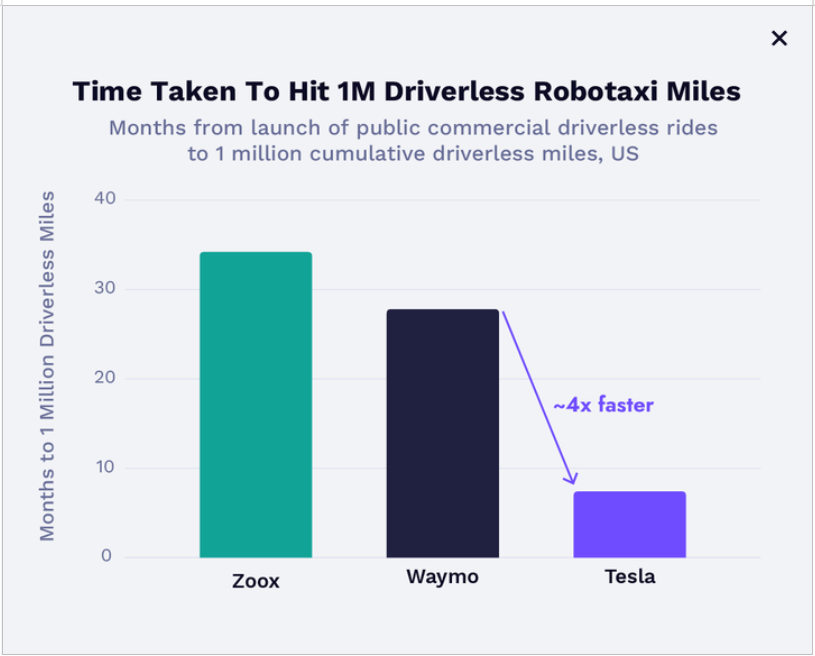
“Tesla launched its robotaxi service in Austin, Texas, in June 2025, matching the most probable launch year in our prior model,” notes the asset manager. “Since then, Tesla has scaled to seven cities across three states, and has completed more than 1 million unsupervised driverless miles in ~7 months, ~4x faster than Waymo’s first million, as shown below. Tesla expects the ramp to accelerate with Full Self-Driving (FSD) V15 late this year. Tesla has framed FSD V15 as the gating factor for scaling its robotaxi service.”
(Image Courtesy: ARK Invest)
Vertical Integration Matters
In the robotaxi stock competition – one that’s still in its early innings – Tesla has advantages over rivals because it leverages its roots in automotive production to attain vertical integration that’s likely to prove advantageous as the robotaxi theme takes flight.
“Thanks to its vertical integration and vision-only approach to autonomous driving, our research suggests that, at equal utilization rates, Tesla’s operational costs per mile will be ~40% lower than those for Waymo’s next-gen robotaxi,” observes ARK. “Tesla also could scale its robotaxi supply through consumer-owned vehicles, which would increase utilization and lower operating costs further. In our base case, Tesla deploys ~8 million robotaxis cumulatively by 2031.”
That vertical integration will be enhanced by Optimus, which Elon Musk views as perhaps the biggest value driver in Tesla history. If Optimus achieves human-level proficiency early next decade, which some experts believe is possible, that’s additive to Tesla’s robotaxi stock thesis.
Related: Private Credit Without the Junk: How Investment-Grade ETFs Like PRIV Work