

The 2026 midterm election is now in the rearview mirror and it’s probably safe to say that the overall result wasn’t surprising – the party controlling the White House usually loses in the midterms – the depth of Democrats’ victory was perhaps stunning to some.
Now, advisors are staring at least two years of navigating clients through a divided government scenario. That endeavor isn’t as perilous as initially meets the eye because history confirms that stocks often perform well under divided governments.
The current state of affairs is as follows: President Trump is still the president and Democrats will hold deep majorities in both houses of Congress come January. It’s speculated that emboldened by their midterm success, Democrats will push an ambitious spending agenda. That may be unnerving to some clients, but it’s possible that although Trump is now a lame duck president, he’s not going to grant Democrats carte blanche to run-up spending, which would almost certainly stoke inflation.
Gird for ‘Good Gridlock’
While the post-mortem on the 2026 midterm election is still fresh on the minds of advisors and clients, a new year beckons, meaning it’s time to prepare, not despair. Fortunately, there may be positivity ahead for clients because as Simeon Hyman, global investment strategist at ProShares, points out, there is such a thing as “good gridlock.”
“There’s a notion among investors that the stock market loves gridlock: Give it a divided government with limited ability to change rules and regulation, and companies can thrive, as the theory goes,” observes Hyman. “Wouldn’t a Democratic victory of this magnitude, which delivered both the House and the Senate to single-party control again, be viewed negatively by the market?”
While the midterm results were debacles for data centers, stocks have held up fairly well post-election, though the road has been somewhat bumpy. And if history is an accurate guide, equities could be in for upside in the months ahead.
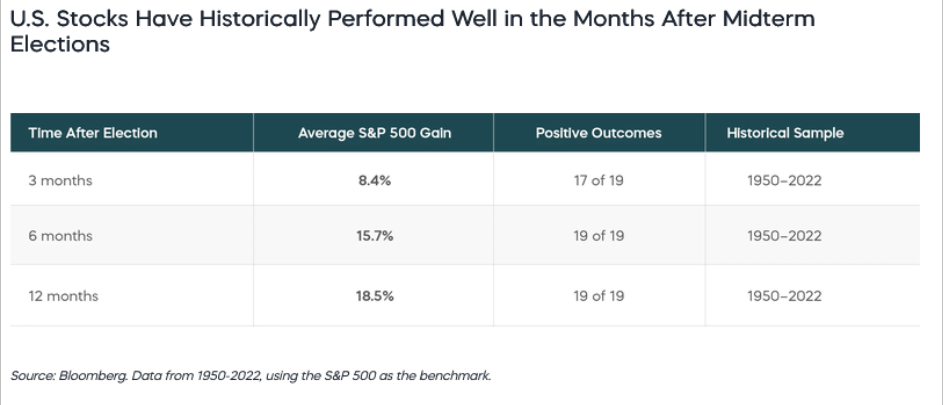
(Chart courtesy: ProShares)
“Any ‘good gridlock’ outperformance piles on top of historically strong stock market performance post midterm election,” adds Hyman.
Trump the Referee?
As experienced investors know, Trump isn’t one to shy away from controversy. That may well be one reason why he’s in this predicament heading into the final two years of his presidency. However, he appears sanguine regarding the election results and that could be a positive equities heading into 2027.
He might be content to spend his last two years in office vetoing over-the-top spending proposals, essentially playing referee while the two parties squabble and bicker within the halls of Congress. That could benefit investors.
“The sheer scale of the Democratic victory was a likely driver of President Trump declaring that he was ‘absolutely willing to accept those results,’ removing much of the threat of post-election chaos and litigation—a clear positive for markets. But the president said something else as well,” concludes Hyman. “He declared himself ‘Mr. Veto.’ As a result, gridlock may be alive and well. Thus, the sweet spot for companies may be here—a well-behaved democracy where not much changes. That is perhaps the expectation that was exceeded on election day.”