


The Spousal Help Desk
Lucy makes Bill’s doctor’s appointments, keeps track of his medications, and handles most of their passwords. When they’re going somewhere unfamiliar, she usually drives. She deals with the insurance company because Bill hates dealing with the insurance company. Lately, though, Lucy has also started double-checking a few things Bill used to handle himself. Nothing dramatic. Just little things.
Ask Bill how he’s doing, and he’ll probably say he’s doing fine. Ask Lucy if she’s his caregiver, and she’ll probably laugh and say, “No, I’m just being his wife.”
Ask her what would happen if she disappeared for 30 days, though, and you might get a very different answer.
That’s because “just being his wife” can become something else long before either of them recognizes it as a path to dependence.
Have you become the Spousal Help Desk?
Settle down, Bill says. Lucy’s handling of insurance hardly qualifies as evidence of cognitive decline. In fact, Bill regularly gets a snarky smile from his audience when observing that avoiding insurance companies may actually be a sign of superior judgment.
And Bill has a point. The problem isn’t that Lucy does things for him. If that were the standard, my wife, Beth, and I would have been each other’s caregivers for most of our marriage.
What interests me is the direction of travel.
The Spousal Help Desk rarely opens with a grand announcement. Nobody wakes up and says, “Starting today, I’ll be assuming responsibility for your executive function.” It happens one small handoff at a time. One person is better at dealing with insurance, so they handle the insurance. They have more patience with doctors’ offices, so they make the appointments. They know the passwords, so they log in.
None of that is particularly interesting by itself. What gets interesting is when the handoffs keep moving in one direction.
Five years ago, Bill made his own appointments. Now Lucy makes them. He used to organize his medications. Now she does. He used to drive anywhere. Now she drives when they’re going somewhere unfamiliar. Maybe Bill could still do all of those things. Maybe he couldn’t. Lucy isn’t entirely sure because there hasn’t been much reason to find out.
I think that’s the part we tend to miss. We notice when someone can’t do something. It’s much harder to notice when they’ve simply stopped doing it because someone they love has become very good at doing it for them.
Dividing responsibilities is, of course, a normal part of marriage. Beth and I have done that for years, as do most couples. Responsibilities may be divided because of skill, specialty, convenience, and so on.
But there’s a difference between dividing responsibilities and absorbing responsibilities. The first is specialization. The second can become dependency, and the transition between the two is surprisingly difficult to see.
When help becomes infrastructure
Suppose Bill can still manage his medications, but Lucy reminds him to take them. Fine. Then Lucy starts filling the pill organizer because it’s easier. She rationalizes that she’d rather do that than have him mess up his doses.
Flash forward a few years, and Lucy is ordering the prescriptions, picking them up, filling the organizer, reminding Bill to take them, and keeping the medication list on her phone because Bill isn’t entirely sure what he takes anymore.
There wasn’t a moment when Lucy became responsible for Bill’s medications. Nobody handed her the job at a family meeting. She just kept doing the next useful thing.
The same thing can happen with finances, driving, appointments, technology, or travel. Eventually one spouse can become the backup operating system for another adult without either person realizing the software has been installed.
That creates a strange situation. Bill may still think of himself as completely independent, and in most ways he may be. But part of what allows him to feel independent is that Lucy is quietly doing more of the work required to keep his life running.
The 30-Day Spousal Help Desk Assessment
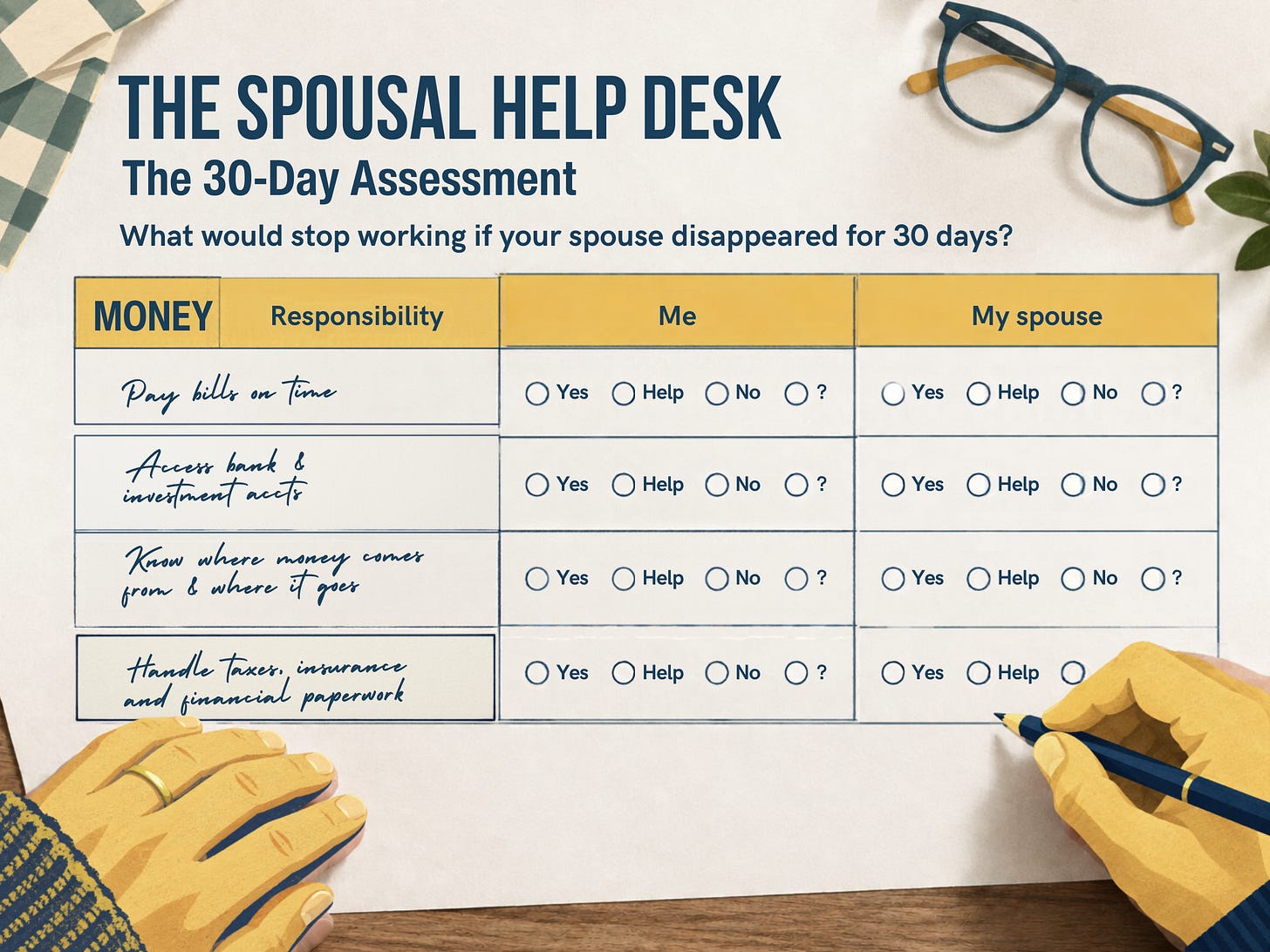
Image created in Canva
I started thinking about a question that might tell us more than asking somebody whether they need help.
Imagine your spouse disappeared for 30 days. Nothing sinister. No need to involve Dateline. They’ve just been temporarily removed from the household.
What stops working?
Could you access every important financial account? Do you know which bills are automatically paid and which require action? Could you refill your prescriptions and give a doctor an accurate medication list? Could you find the insurance information and legal documents?
Then there’s all the stuff that probably isn’t in the financial plan. Could you manage the house? Make the travel arrangements? Get somewhere unfamiliar? Find the passwords? Know what you’re supposed to be doing next Thursday?
Now turn the question around: Which of those things could your spouse do without you?
I liked that question enough to turn it into a worksheet.
Take the Spousal Help Desk Assessment
Whether someone is a “caregiver” is not important. Instead, you need to know where one spouse has gradually become necessary for the other to keep doing things they both still think of as independent.
Take it separately then compare answers. You may be surprised at what you find.
Spousal Help Desk 30 Day Assessment
48.5KB ∙ PDF file
What would stop working if your spouse disappeared for 30 days?
The helper may be the bigger risk
This is where I think we tend to look at the wrong person.
We naturally focus on Bill because he’s the one receiving more help. But from a planning standpoint, I may be more worried about Lucy. She remembers the appointments, notices when something looks wrong, deals with the annoying phone call, fixes the problem, and generally keeps things moving. She may have become so good at it that nobody around Bill realizes how much she’s doing.
Including Bill.
Take Lucy away for those 30 days and Bill doesn’t just miss his wife. He may suddenly be without the person who knows his medications, the passwords, the doctors, the travel plans, and where the estate documents are.
Competence can hide dependence
There’s another reason this is easy to miss. Losing the ability to manage complicated tasks doesn’t necessarily look the way most of us imagine decline is supposed to look.
Someone’s father can still be funny, social, and informed. He can discuss the market, argue about last night’s game and tell the same stories he’s always told. He still sounds exactly like Dad and probably has more opinions than anyone requested.
Meanwhile, Mom has quietly started handling six things Dad handled five years ago.
That doesn’t automatically mean Dad is experiencing cognitive decline. Roles change for all kinds of reasons, and I’d be very careful about turning every changing household responsibility into a neurological symptom.
The real question is what has changed? What was he doing five years ago that someone else is doing now? And why?
The problem with efficient marriages
The irony is that the Spousal Help Desk is often the product of a very good marriage. Couples adapt to each other and over decades they can become extremely efficient at it. Handling something to make life easier for the other person is part of being married.
The problem isn’t specialization. It’s specialization without a backup plan.
Maybe one spouse handles the investments, insurance, and passwords. The other manages the bills, healthcare, and household. Over 20–30 years, they become a well-oiled machine.
But what happens when one spouse has to assume all of it, yet they only know how to operate half of it?
Time for a system check
This is where I’d go back to the 30-Day Assessment and look for every place where either spouse essentially answered, I couldn’t do this without them.
You don’t need to cross-train your marriage until both spouses can independently reset the Wi-Fi router and explain Medicare Part D. There are limits to what any relationship should endure.
Start with the things that would really cause a problem if you got them wrong. If only one person knows how to access the financial accounts, fix that. If only one understands the medications and doctors, document it. If only one can locate the estate documents, make sure somebody else knows where they are and has whatever legal authority they would need.
I’d pay particular attention to anything one spouse used to do but no longer does. Ask why. Maybe there’s a perfectly good answer. Maybe Lucy started doing it because she’s faster, Bill hates it, and everybody is happier this way.
But maybe the answer is less clear.
You don’t have to diagnose it. You just have to notice it early enough to figure out what it means.
Independence isn’t the point, support is
I’ve written a lot about decision liquidity—preserving enough flexibility that Future You still has choices when life refuses to follow the plan. I usually think about that in terms of money, housing and health, but it applies to marriage too.
A resilient marriage doesn’t require two completely independent people maintaining duplicate versions of their lives. Beth does not need to know everything I know, and I certainly don’t want to learn everything she knows merely in the interest of household redundancy.
However, both of us should know enough that if one of us suddenly couldn’t do our half, the other wouldn’t be starting from zero.
That means sharing enough information, documenting the important stuff, giving the right people authority, and occasionally forcing ourselves to learn something our spouse has conveniently allowed us to ignore for the past 20 years.
The goal is to avoid confusing being supported with being independent.
Because caregiving doesn’t always begin when someone needs help getting dressed. Sometimes it starts years earlier with a spouse saying, “Don’t worry about it. I’ll take care of that.”
And then, little by little, they’re taking care of almost everything. They’ve become the sole Help Desk.